



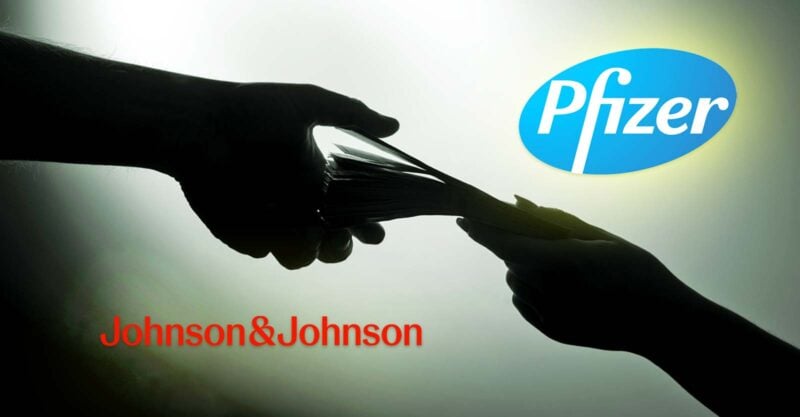
Combined, Pfizer and Johnson & Johnson, along with their subsidiaries, have reportedly paid at least $12.6 million in bribes to win drug approvals, boost sales and secure government contracts, a new analysis of international enforcement records shows.
The kickbacks, sham studies and regulatory payoffs distort prescribing and drug approvals.
In Greece, Novartis Hellas paid for physicians to attend international medical congresses and warned it would withdraw support if prescription quotas for its drugs were not met.
The subsidiary admitted misconduct in 2020 and agreed to pay $225 million in criminal penalties under a deferred prosecution agreement, as parent company Novartis AG entered a series of settlements with US enforcement agencies to resolve Foreign Corrupt Practices Act (FCPA) violations abroad.
Previously, in 2016, Novartis paid $25 million to resolve SEC civil charges over bribery in China, without admitting or denying the findings, according to the US Securities and Exchange Commission (SEC).
Meanwhile, Pfizer subsidiaries in multiple countries, including Italy and Russia, were accused by the SEC in 2012 of paying bribes over about a decade to foreign officials to secure regulatory and formulary approvals, boost sales and increase prescriptions, the SEC complaint shows.
In China, one subsidiary allegedly created “points programmes” that let doctors earn gifts based on prescribing its medications, according to the SEC, while in Croatia, another offered a “bonus programme” that reportedly rewarded doctors with cash, international travel or free products.
After voluntarily disclosing the misconduct in 2004 and cooperating with investigators, Pfizer and an indirect subsidiary agreed to pay more than $45 million in separate settlements without admitting or denying the allegations, the SEC reported.
In a parallel action, Pfizer H.C.P., an indirect, wholly-owned healthcare-focused subsidiary, agreed to pay a $15 million penalty to resolve its investigation of FCPA violations after admitting to improper payments to foreign government officials, according to the US Department of Justice (DOJ).
And in Greece, Poland and Romania, Johnson & Johnson subsidiaries, employees and agents were accused by regulators of using slush funds, sham contracts and offshore companies in the Isle of Man to reward doctors and administrators who ordered or prescribed its products, including surgical implants.
The 2011 SEC complaint also accused the company of paying kickbacks in Iraq to obtain business.
Johnson & Johnson voluntarily disclosed some of the violations and conducted an internal investigation. Without admitting or denying the allegations, the company agreed to pay more than $48 million to settle the case and $21.4 million to resolve parallel DOJ criminal charges, SEC records show.
Together, these pharmaceutical companies, their subsidiaries and others have reportedly paid at least $12.6 million in bribes to win drug approvals, boost sales and secure government contracts, a new analysis of international enforcement records shows.
The cases resulted in more than $1.1 billion in sanctions, often without admissions or denials of wrongdoing. Yet many alleged schemes designed to prioritise profits over patients persisted for years before they were uncovered.
From a public health perspective, the impact of pharmaceutical industry bribery extends well beyond financial penalties and corporate reputations, the study’s authors say. Corruption, they note, is harmful for patients, especially when companies seek to promote the sale of drugs with unproven or dangerous uses.
“It creates barriers to health services and products and compromises quality of products and care,” said lead author, professor Jillian Kohler of the Leslie Dan Faculty of Pharmacy, Dalla Lana School of Public Health & Munk School of Global Affairs & Public Policy at the University of Toronto. “In the worst case, corruption kills.”
Published in February in The Journal of Law, Medicine & Ethics, the review draws on reports published between 1999 and early February 2025 by the Organisation for Economic Co-operation and Development (OECD) Working Group on Bribery.
The OECD does not directly investigate international business transactions but documents alleged bribery incidents and monitors enforcement under its Anti-Bribery Convention, which requires member states to criminalise foreign bribery.
The reports summarise cases provided by member states, including the US and are informed by on-site visits and consultations. (Cases involving medical devices were excluded from the review.)
While corruption and unethical practices in the pharmaceutical sector have been well documented, the study offers one of the most comprehensive cross-country snapshots of investigations and enforcement actions related to bribery in the global pharmaceutical industry.
It points to systemic vulnerabilities in how medicines are approved, purchased and prescribed worldwide, and highlights structural weaknesses in pharmaceutical oversight and enforcement.
The review also notes some common patterns:
Bribery was often approved (or at least knowingly tolerated) by high-ranking managers.
Intermediaries and complicated corporate structures obscured bribes, with subsidiaries, third-party vendors or shell companies disguising payments as legitimate transactions.
Among other harms, systemic bribery (including individual medical specialist payments not related to research) can distort prescribing patterns and reimbursement decisions, diverting resources toward higher-cost, lower quality or unnecessary drugs and treatments, which is damaging to patients both medically and economically, the researchers say.
Bribes can also compromise regulations designed to ensure drug safety and efficacy, jeopardise clinical decision-making and undermine trust in medical institutions and practitioners, the study’s authors say.
Such impacts, they say, erode public confidence in medical institutions and can harm patient outcomes “when decisions are driven by financial incentives rather than medical need.”
The researchers say the scale of financial penalties underscores how improper practices can become institutionalised, while the wide range of concealment tactics highlights the complexity of detecting and prosecuting such misconduct.
Government officials, regulators and healthcare providers were allegedly bribed through cash, gifts, luxury travel and fraudulent research to gain market access, increase sales or influence prescribing, according to the study.
Additional reported tactics, the authors say, included compensating officials under the guise of consulting or speaker fees, using charitable front groups and making direct payments to inspectors or regulators.
“These findings underscore the systemic nature of bribery in the pharmaceutical sector and call for stronger oversight and accountability to protect public trust and equitable medicine access,” wrote Kohler and her co-authors.
“Bribery is not limited to one region; it was documented across a wide geographic spectrum. The repeated reliance on sham clinical studies, inflated distributor discounts and disguised consulting contracts supports the idea that certain systemic weaknesses transcend national boundaries.”
Researchers identified 21 investigations involving pharmaceutical companies and their subsidiaries in five OECD countries. The US accounted for 14 cases, followed by Germany and Denmark with three each, and Greece and Italy with one each.
Other findings are:
In total, 19 companies and many of their subsidiaries were implicated, including allegations against publicly named firms. Among them BioTest, Novartis, Johnson & Johnson, Pfizer, Teva, Eli Lilly, Bristol-Myers Squibb, SciClone, Nordion, AstraZeneca, GlaxoSmithKline, Sanofi and Novo Nordisk.
Across the cases, the total timeframe of the investigations ran from 1994 to 2016. The longest, documented alleged scheme lasted 11 years, with the average persisting for nearly five years. Once uncovered, cases took more than four years on average to move from detection to prosecution.
Alleged bribes amounted to at least $12.6 million, the review shows. Total financial sanctions reached more than $1.1 billion, including roughly $586 million in fines, $447 million in corporate disgorgement (repayment of profits linked to alleged misconduct) and roughly $77 million in prejudgment interest.
The largest single sanction of more than $519 million for foreign bribery was imposed on Teva Pharmaceuticals in a 2016 deferred prosecution agreement to settle parallel civil allegations and criminal charges that it paid officials to win business in Russia, Ukraine and Mexico. (Just two years earlier, a Chinese court fined GlaxoSmithKline nearly $500 million after finding its local subsidiary guilty of bribery.)
“While the conduct that resulted in this investigation ended several years ago, it is both regrettable and unacceptable, and we are pleased to finally put this matter behind us,” said Teva’s Erez Vigodman in a 2016 statement. “Since becoming CEO, I have worked diligently to make our culture of compliance central to everything Teva does.”
The research review relied only on cases that advanced to official investigation and prosecution and were made public. Other incidents – for instance, those involving companies not listed on major exchanges or operating in countries with less rigorous enforcement – may never come to light, the authors say.
“The discrepancy between the small number of detected cases and the extensive use of sophisticated concealment methods suggests that the OECD [Anti-Bribery] Convention, while significant in principle, has had only a modest effect on curtailing opportunities for corruption,” they wrote.
According to the review, alleged bribery payments were directed toward recipients in 30 countries across Eastern Europe, Asia, the Middle East, Latin America and Africa. Many schemes targeted public hospitals and ministries of health in systems where governments play central roles in financing and procuring medicines.
In the US, the FCPA generally prohibits bribery of officials in other countries to get or retain business and requires publicly traded companies to maintain accurate and transparent accounting.
FCPA also prohibits indirect bribes made to any person “knowing” that some or all of the payments will be used to bribe foreign officials or other prohibited recipients.
The researchers categorized bribery cases into three types, with varying degrees of health risks for patients and consumers:
Boosting profits without directly compromising drug quality, such as paying prescribers to favour certain approved drugs, potentially steering decisions away from cost-effective or optimal care.
Bypassing regulatory scrutiny to boost the sale of falsified, substandard, adulterated or unapproved drugs, creating direct public health risks. In these cases, bribes were paid to inspectors, regulators or supply chain actors to ignore safety and manufacturing violations.
Combining profit-driven motives with drug quality or misuse risks, such as off-label marketing or securing approvals without full review, which increase sales while exposing patients to unproven or dangerous uses.
For instance, pharmaceutical sales teams, incentivised by bonuses, promoted drugs for uses not supported by evidence, or bribed officials to overlook inadequate clinical testing.
Schemes targeted publicly and privately employed physicians, nurses, pharmacists, hospital administrators, government health staff and others, the study reports. Customs officials, members of parliament and employees of state-run procurement agencies were also implicated.
In at least one instance, consultants from the United Nations (UN) Development Programme (UNDP) were involved.
“Across cases, company employees at every level from frontline sales and distributor personnel to middle managers, local executives and even high-ranking corporate officers were directly complicit in planning, executing or approving bribery strategies. Senior managers authorised inflated payments or disguised expense claims,” Kohler and her colleagues wrote.
They continued:
“At times, executives approved false documentation or misrepresented financial transactions in official records and audits and lower-level sales representatives regularly funnelled funds or gifts, meticulously tracking prescription volumes or purchase orders to justify continued bribes.
“Frequent internal warnings and compliance reviews, which spotlighted obvious red flags in accounting and documentation, were often ignored or treated as isolated incidents.”
In one case, Bristol-Myers Squibb’s joint venture in China reaped more than $11 million in profits from alleged misconduct that included faking invoices, receipts and purchase orders to fund improper payments to healthcare providers in exchange for prescription sales, the SEC alleged.
Without admitting or denying the findings, the company agreed in 2015 to pay more than $14 million to settle charges that it violated the FCPA’s internal controls and recordkeeping provisions.
- A Tell Media report / By Pamela Ferdinand – Former Massachusetts Institute of Technology Knight Science Journalism fellow who covers the commercial determinants of public health.


About author