
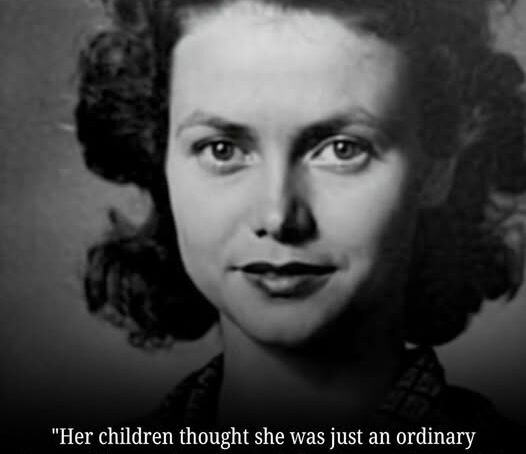
“Her children thought she was just an ordinary housewife – until a stranger’s Google search revealed she’d been the most dangerous teenage girl in Nazi-occupied France.
For 56 years, Phyllis “Pippa” Latour kept a secret that would have made James Bond look cautious.
Born in South Africa in 1921, Pippa’s childhood read like tragedy. Her mother died from illness when Pippa was young. Her father was killed in the violent upheaval of 1920s South Africa. Orphaned and alone, she could have been defined by loss.
Instead, she became a weapon.
Pippa possessed a gift: languages came to her like breathing. English, French, Arabic, Swahili, Kikuyu – she absorbed them all with an ease that made her valuable to people who needed secrets kept in multiple languages.
By 1944, as World War II reached its climax, Winston Churchill’s most secretive organisation came calling.
The Special Operations Executive – SOE – was Britain’s shadow war machine. They recruited civilians for missions so dangerous that regular soldiers couldn’t accomplish them. Their motto: “Set Europe ablaze.”
They needed someone who could disappear into occupied France, gather intelligence on Nazi defences, and survive long enough to transmit it back to London before the D-Day invasion.
They chose a 23-year-old woman who’d never fired a gun in combat. On May 1, 1944 just five weeks before Allied forces would storm Normandy’s beaches – Pippa Latour parachuted into Nazi-occupied France in the dead of night.
Her mission was simple to describe, impossible to survive: Infiltrate Normandy, catalogue every German defensive position along the Atlantic Wall, and radio the intelligence to London so RAF bombers could destroy them before invasion day.
Oh, and don’t get caught. Because if you do, the Gestapo will torture you until you reveal every Allied secret you know.
Pippa’s cover was brilliant: She posed as a 14-year-old French girl selling soap door-to-door through Normandy’s villages and farms.
Picture this: A seemingly harmless teenager on a bicycle, basket full of soap bars, pedalling through the French countryside. Smiling at German soldiers. Flirting innocently. Asking directions. Complaining about the weather.
All while memorising every bunker, gun emplacement, troop movement and defensive position she passed.
She would cycle past German checkpoints, chat with soldiers who never suspected the “child” on the bicycle was cataloguing their positions for destruction. She’d sell soap to officers’ wives while noting the locations of ammunition depots.
At night, in hidden locations across the countryside, Pippa would unpack her wireless radio – disguised as a suitcase – and transmit coded messages to London.
Over the course of her mission, she sent 135 coded messages. Each one directed RAF precision bombing runs. Each one armed French Resistance cells. Each one brought D-Day closer to success.
But here’s the ingenious part: SOE had taught her to print codes on silk fabric. Pippa braided this silk into a shoelace and wore it as a hair tie. If searched, it looked like an ordinary teenage hair accessory. German soldiers literally looked at her secret codes every day and saw nothing but a girl’s vanity.
The danger was suffocating and constant. One night, mid-transmission to London, two German soldiers burst into her safe house. Pippa had seconds to react.
She hid the wireless radio, looked the soldiers dead in the eye, and with the confidence of someone who’d rehearsed this nightmare a hundred times, she lied: “”There’s scarlet fever in this village. You should leave. It’s spreading quickly.””
The Germans fled.
Twice, the Gestapo arrested her. Twice, they interrogated her. Twice, they had the girl who was systematically destroying their defences right in their hands.
And twice, Pippa Latour stayed ice-cold, spun flawless cover stories, and walked out alive.
The silk codes braided into her hair? They never found them.
When D-Day came on June 6, 1944, Allied forces stormed beaches that Pippa’s intelligence had helped clear. RAF bombs had destroyed gun positions she’d identified. Resistance fighters she’d armed disrupted German communications.
The teenage girl on the bicycle had helped change history.
After the war, France awarded Pippa the Croix de Guerre – one of their highest military honours. Britain recognised her extraordinary service.
And then Pippa Latour did something perhaps more extraordinary than anything she’d done during the war: She disappeared into normal life.
She moved to New Zealand. She married a quiet engineer named Bob Doyle. She raised children. She lived in a modest home and never spoke a word about parachuting into Nazi territory or fooling the Gestapo.
For over half a century, her family thought she was just Mom. A housewife who spoke multiple languages but never explained why.
Then, around 2000, one of her children was researching genealogy online and stumbled across declassified SOE records. There, in black and white government documents, was their mother’s name. Codename: Genevieve. Mission: Pre-invasion intelligence gathering in occupied France. Status: Successful.
The quiet woman who’d made them breakfast for decades had been one of Churchill’s secret weapons.
When they confronted Pippa, she simply confirmed it was true and moved on. That generation didn’t need praise. They’d done what needed doing, and that was enough.
Pippa Latour Doyle died in May 2023 at age 102 – the last living female SOE operative.
Her medals were found tucked away in a drawer, rarely displayed. Her stories remained mostly untold. The woman who’d risked everything for freedom spent her final decades in quiet obscurity.
But now her story is emerging, and it deserves to be told loudly:
A 23-year-old orphan from South Africa disguised herself as a French teenager, cycled through Nazi checkpoints with codes braided into her hair, talked her way out of Gestapo custody twice, transmitted 135 intelligence messages that helped win D-Day, received France’s highest military honours, and then lived for six decades without seeking recognition.
Phyllis “Pippa” Latour wasn’t just a hero. She was a reminder that the most dangerous person in the room is often the one no one suspects. And that the Greatest Generation earned that title not just through battlefield courage, but through decades of quiet humility afterward.
Her children only learned who their mother really was because someone else found her story online.
How many other Pippas are still out there, their extraordinary courage hidden behind ordinary lives?”
- A Tell Media report / Source: History Words


About author