

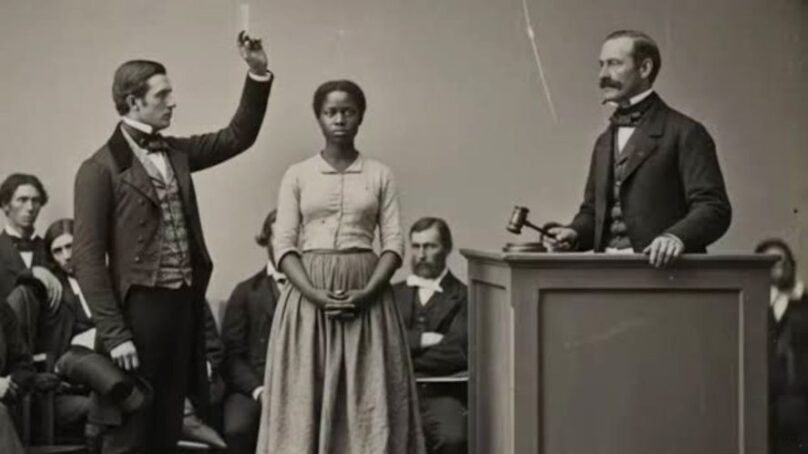
They wrote her price down like you’d note the cost of a rusty nail.
“Lot 17, female child, approximate age. What would you say, Mr Dobs?”
The traitor squinted at the small figure on the block. She was barefoot, ankles too thin for the iron ring that had hung there last month, when she’d belonged to another man’s inventory.
Her dress was little more than a gray rag, damp with the morning drizzle.
“Eight. Nine,” he said. “Hard to tell when they’re stunted. She don’t look like much.”
The crowd shifted. Most men weren’t interested in children that small. A boy could grow into a plough hand, a girl into a field worker or worse.
But it took years of feeding before either paid for themselves. And this one, this one had that hollow look that said somebody had already tried to make her work like a grown woman and nearly rung the life out of her. Up close, her eyes were the only thing that didn’t look worn out. Too big for her face, dark and steady, taking in everything without giving much back.
When the traitor’s assistant grabbed her chin and turned her head roughly from side to side, she didn’t cry. She just watched the line of men staring at her like she was the only person in the yard who understood exactly what the numbers on the slate meant.
“Mother dead,” the traitor called. “Came in as part of a debt settlement. Previous owner let her run half wild. Could be trained up for housework. Could be put to light field labour. Breeding potential in a few years.”
He said the last part like a man pointing out a tree that might someday bear fruit. A few men chuckled. One muttered, “I ain’t paying good money to feed another man’s mistakes.”
At the edge of the circle, Henry Caldwell shifted his weight from one boot to the other and tried not to think about his own mistakes, waiting for him back at the plantation. The folded letter in his coat pocket pressed against his chest. Another notice from the bank, polite words wrapped around hard numbers.
Interest arrears, collateral – the kind of language that made a man feel like a field left too long without rain, cracked and close to breaking. He hadn’t come to town meaning to buy anyone. He’d come to talk to Mr Hathaway at the bank about extending his note. But Hathaway had been delayed on other business, and the auction yard had a way of pulling a man in while he waited.
“Come now, gentlemen,” Dobs called. “She may be small, but she’s sound. No visible deformities, teeth decent. You can see she’s got all her fingers.”
He lifted the girl’s hand, prying her fingers apart to show the crowd. Something small and dirty and frayed shifted at her wrist. A bit of string with a scrap of cloth tied to it – the remains of some long-ago ribbon or tag. Before Henry could see more, the traitor let her hand drop.
“Who’ll start me at $2?” Dobs asked. Silence, a cough, a laugh, a spit into the mud. The rain came down a little harder, pattering on hats and shoulders.
“All right then,” Dobs said, forcing a smile. “$1. You won’t find a cheaper lot today.” Nothing.
The girl shifted her weight. The plank under her feet creaked. She looked out over the sea of faces and saw nothing soft there. If fear lived anywhere in her, it had long ago learned to sit very still. Henry’s gaze drifted back to the letter crumpled in his pocket.
$1 might as well have been a hundred when a man was short on every bill that mattered. Still, he felt something like shame creep up the back of his neck as he watched no one raise a hand for a living child. Dobs sighed and wiped rain from his eyes. “All right, gentlemen. Let’s not play stubborn. Who’ll start at 50 cents?”
A man near the front snorted. “She ain’t worth the trouble,” he said. “I got dogs at home that eat more than she’ll ever be worth.” Laughter rippled from somewhere behind Henry. Another voice drawled, “I’d take her for 20 cents just to keep the flies off your block.”
“Dobs sold you a broom for that yesterday,” someone else said. The jokes piled up, cheap and easy, each one chipping a little more off whatever was left of the girl’s sense that she was human.
Henry shifted again, irritation prickling at him now. It wasn’t kindness; it was a different kind of discomfort. The kind that came when a man saw a spectacle that hit too close to his own anxieties. He was tired of hearing numbers attached to things he couldn’t quite afford. Tired of watching the bank judge his worth line by line. He found his hand lifting before he’d fully decided. “19 cents,” he called, his voice cutting through the noise.
The yard went quieter than such a small number deserved. Dobs blinked. “Come again, Mr Caldwell?”
“19,” Henry said. “You want to scrape the bottom? Might as well do it properly. I’ll take her for 19 cents and save you the trouble of feeding her another week.” A few men laughed, this time with a hint of mean admiration. Trust Caldwell to haggle the price of a child lower than a stamp.
Dobs hesitated, pride wrestling with practicality. Every day a lot stayed unsold, it ate into his margin. This one had already been turned down twice in other towns; she was becoming dead weight.
“Do I hear better than 19?” he called. “20? 25? Anyone?” The yard answered with silence and rain. Finally, Dobs sighed. “Sold,” he said, “to Mr Henry Caldwell for the princely sum of 19.”
A battered gavel came down on the block with a hollow thud that sounded too much like a closing door.
The girl didn’t move. No one cheered. She stepped down when the assistant jerked his head, the chain at her ankle clinking softly as they unclipped it. She stumbled once on the wet step and righted herself without help.
Up close, Henry saw that the scrap of cloth at her wrist had once been blue, striped with white, now faded to the colour of old sky. Two tiny letters were stitched there in clumsy thread, nearly worn away by time and dirt.
“Tag from the last owner,” Dobs said, noticing his glance. “You can cut it off. Means nothing now.” Henry made a mental note to do so later. The last thing he needed was another man’s mark on something he’d paid for, however little.
In the trader’s office, he counted out the coins with a rueful shake of his head.
“You going to put that one to work in the house?” the clerk asked, scratching out a receipt.
“Maybe,” Henry answered. “Maybe I’ll let her carry kindling till she grows into something useful. Can’t be worse than some of the stock I’ve got now.” “You’d be surprised,” the clerk muttered. “Trouble comes in all sizes.”
When Henry stepped back into the yard, the girl stood where they’d left her, small and damp and stubbornly upright. He studied her a moment.
“What’s your name?” he asked. She hesitated. Names had been taken from her before, traded like everything else.
“They called me Nora,” she said finally. “They?” he asked. She lifted one shoulder. “The last place.”
“You had another before that?” Her eyes flickered. He caught the ghost of something there – loss maybe, or a memory shoved down so deep it only showed itself when surprised.
“Yes, sir,” she said. He didn’t push. The story of which man had first bought her mother was not one he needed to balance his accounts. He jerked his chin toward the street. “Come on then, Nora, for now,” he said. “We’ll see what 19 cents buys these days.”
As they walked toward the buggy, rain pattering on the brim of his hat and into her hair, he felt a strange, uneasy satisfaction. There was something almost defiant in slapping such a ridiculous figure onto a purchase. When the bank looked at his books, they’d see the usual: feed, tools, minor stock additions. No one would care about a single line that read ‘one female child: $0.19’. To Henry, it was a joke he could afford – a story to tell.
“Times are so tight I’m buying children for loose change.” To Nora, it was a number that would lodge in her bones. 19 cents – less than a decent meal, less than a cheap knife. A price that said she wasn’t even worth the smallest round number.
The buggy jolted as they hit the ruts outside town. Nora gripped the side, keeping her balance by instinct. Henry watched her out of the corner of his eye, noting how she scanned the roadside, how she flinched at certain sounds and ignored others.
“You from around here?” he asked suddenly. She shook her head. “Don’t know,” she said. “Been moved too much.”
Her fingers brushed the faded cloth at her wrist. For a flash, Henry saw the letters again. MB, or maybe NB. Something about them tugged at the back of his mind – a shape half-remembered from some other piece of paper he’d once signed without reading all the way through. He frowned and shook it off. He had bigger worries than a scrap tag on a cheap child.
The Caldwell place rose out of the mist an hour later. Two stories of peeling white paint, flanked by rows of cotton. As they rolled into the yard, a few heads turned. Curiosity was the only luxury the enslaved people allowed themselves freely. Henry climbed down, then jerked his head for Nora to follow. “You’ll take orders from the housekeeper for now,” he said. “Light chores. We’ll see where to put you.” “Yes, sir,” she said.
As he handed her over to the older woman at the kitchen door, he caught the way the housekeeper’s eyes narrowed just a fraction at the sight of the girl’s face. “What?” he asked more sharply than he meant to.
“Nothing, sir,” the woman said quickly. But when he turned away, she looked at Nora again, harder this time, as if she were staring at a ghost wearing rags. “You come with me, child,” she murmured. “We’ll get you washed.”
In the dim light of the kitchen, the housekeeper took a damp cloth to Nora’s wrist. She wiped away years of dirt until the faded blue scrap showed clearer. The letters on it stood out just enough now to read: MB. The housekeeper’s breath caught. Her mind flew to another piece of cloth packed years ago in a trunk that had belonged to Miss Margaret Beaumont before she became Mrs. Caldwell.
“That can’t be,” the housekeeper whispered to herself. Nora looked up. “Ma’am?” “Nothing,” the woman said too quickly. She cleared her throat.
“You remember where you got this?” Nora frowned. “My first mama tied it on me,” she said slowly. “Said it was so I wouldn’t be lost. They tried to cut it off when they sold me, but I bit.”
A flicker of fierce pride crossed her face. “I kept it.”
The housekeeper’s hands shook. She had been here long enough to remember the day a different young woman had been sold away from this family. Long enough to remember the half-heard rumours about a Beaumont girl who’d gone too far with someone she shouldn’t have and the quiet disappearance that followed. She stared at the letters again. MB. Margaret’s maiden name had been Beaumont. Her oldest sister’s name had been Maryanne.
“Lord help us,” the housekeeper breathed. 19 cents. The master thought he’d bought a cheap child. He hadn’t realised yet that he’d brought a living piece of his wife’s family history onto his land. DNA testing kit
Hester didn’t sleep that night. Her mind was in a different time, watching a different girl step into a carriage with a trunk that had a blue striped ribbon tied around the handle. Maryanne Beaumont had laughed that day. People always laughed around her. She’d laughed even when Hester had whispered, “Miss Maryanne, you be careful now. White girls don’t get to play with fire and not get burned.”
Then one day, the laughter had stopped. There had been whispers, visits from doctors, and then Maryanne’s belly had swelled. She was packed off to visit relatives for a season that stretched into a year. When she came back thinner and quieter, there was a new rule in the house: no one was to mention that year ever again. Hester had seen a small bundle carried out the back way with a scrap of blue striped cloth hanging from the blanket.
Now, years later, she stared at the same pattern around a slave child’s wrist. “I’m trying to see,” she told Nora, her voice tighter than she meant. Nora didn’t squirm. “My mama,” she repeated, “the first one. She worked in a house, not the fields. Said this meant I wasn’t to be mixed up or forgotten.” “That work out for her?” Hester asked before she could stop herself. Nora’s eyes went flat. “They sold her,” she said. “Sold me after. So I guess no.” Hester let the child’s wrist go. “You keep that on,” she said. “No matter who tells you, don’t cut it. You hear?” “Yes, ma’am,” Nora said.
When morning came, Hester’s first errand was the big house. She waited until Mr Caldwell rode out. The moment his horse’s hoof-beats faded, Hester climbed the back stairs. She found Margaret in the sitting room.
“Is there some issue in the kitchen?” Margaret asked.
“Not in the kitchen, ma’am,” Hester said. “In the yard, maybe. In the past, surely.”
Margaret’s brows drew together. “You’re talking in riddles, Hester.”
“I’m talking in threads,” Hester said, moving closer. “Threads from a cloth I seen before. Blue stripes, white in between. Two letters stitched clumsy but loving: M and B.”
Margaret’s face drained of colour. “Where did you see that?” she whispered.
“On the new girl the master brought home last night,” Hester said. “The 19-cent child. He called her Nora.”
Margaret shut her book, her fingers pressing hard into the cover. “You must be mistaken,” she said automatically.
“Maybe,” Hester allowed. “But I seen that cloth once before on a trunk that came back without the baby that left with it.” The air between them thickened. “You were talking about my sister,” Margaret said finally. “About Maryanne.”
Hester inclined her head. “I was here then. I remember the bundle that went out the back door with a scrap of sky tied to it.” Margaret’s jaw tightened.
“My father took care of it,” she said stiffly. “Arrangements were made. The child was placed.”
“How old would that child be now?” Hester asked gently.
Margaret did the math without wanting to. “Nine,” she said. “Or ten.” “She’s standing in your kitchen,”
Hester said, “Calling herself Nora, with your family’s letters tied to her wrist so she wouldn’t be lost.”
Margaret’s hand flew to her mouth. “No,” she said. “My father would never…”
“Never what?” Hester asked quietly. “He’d never sell his own blood? You sure you want to finish that sentence, ma’am?”
Memories crashed into Margaret…her father’s hard voice, her mother’s red eyes, Maryanne’s laughter turning brittle. “You said the tag was MB?” she asked.
“Yes, ma’am,” Hester replied. “Maryanne Beaumont. Coincidence like that, I don’t put much stock in.”
Margaret turned away, looking out the window.
“What are you asking me to believe?” she said. “That the child in my kitchen is my niece? My sister’s bastard?”
“I ain’t asking you to believe nothing,” Hester said. “I’m telling you what my eyes saw. What you do with it is your burden.”
“Does Mr Caldwell know?” Margaret asked. “Not yet,”
Hester said, “Far as he’s concerned, she’s just 19 cents worth of trouble.”
Margaret let out a breath like a sob. “You think I should tell him?”
“I think a man who sees 19 cents when he looks at a child don’t deserve to know what she really cost your sister,” Hester said.
That afternoon, Margaret went to the kitchen herself. Nora stood at the table, sorting beans. Under the dirt, the lines of her face were finer than Henry had noticed. Her mouth compressed when she concentrated in a way that stabbed Margaret with a memory – Maryanne squinting at embroidery in the same way.
“What did you say your name was?” Margaret asked.
Nora stiffened. “Nora, ma’am.”
“Who gave it to you?”
“My first mama,” Nora replied. “She said it sounded like ‘no rain’ and ‘no running’ mixed together.”
Margaret’s throat tightened. “Hold out your hand.” Nora obeyed.
“Who tied this?” Margaret asked. “Mama,” Nora said. “She said if anybody ever cared to look close, they’d see I belong to something.”
“She was right,” Margaret murmured.
“Ma’am, do you know who my father is?” Nora blurted out.
Margaret’s hand tightened on the doorframe.
“Children like you seldom get tidy answers to that,” Margaret said. “Sometimes the truth is a knife we can’t afford to handle.”
Nora’s jaw set. “I just wanted to know if he ever looked for me.” Margaret swallowed.
“If he did,” she said, “he looked in the wrong place. Men like him always do.”
That night in their bedroom, Henry tossed a bank letter onto the dresser.
“Hathaway’s tightening the screws again,” he said. Margaret sat at her vanity, brushing her hair.
“Perhaps if you spent less time at auctions and more in the fields,” she said lightly.
“I barely spent anything today,” he snapped. “Picked up that little girl for less than a cup of coffee. Might even make herself useful.” “Is that how you measure usefulness?”
Margaret asked, “By the cost of acquisition?” “
Yes,” he said bluntly. “Isn’t that how your father measures everything he lends us?”
A few days later, a letter arrived from her father. Her eye snagged on a line halfway down: “I trust you recall the necessary corrections made when your sister’s youthful foolishness threatened to stain our name permanently. I will not have my grandchildren dragging us into such murky waters.” Margaret read it thrice. “Necessary corrections.” A baby bundled out the backdoor with blue striped cloth.
She began to watch Nora like an old portrait. One evening, Henry barked at Nora for spilling gravy.
“For God’s sake, girl,” he snapped. “It’s not that hard to hold a spoon steady.”
Nora’s shoulders hunched, but her eyes flashed.
“My hand steady enough when I’m working,” she muttered. “Maybe the table’s what’s crooked.”
It was exactly what Maryanne would have said. Henry slammed his hand on the table.
“What did you say?”
“Nothing, sir,” Nora said quickly.
Margaret cut in: “She said she’d be more careful. And she will. Won’t you, Nora?”
“Yes, ma’am,” Nora murmured.
Later, Margaret found Nora in the pantry.
“You mustn’t talk back to him,” Margaret said.
“He owns my back,” Nora said, “not my tongue.”
“For now, he owns both,” Margaret replied. She stepped closer.
“Do you know how old you are, Nora?”
“About 10,” Nora said. “Maybe 11.”
Margaret felt a cold certainty. The timeline, the letters, the mannerisms – it all fit. Nora was the living consequence of Maryanne’s secret. The plantation master had bought a young slave for 19 cents, unknowingly buying his wife’s blood.
Henry noticed the connection “like a man notices a leak – too late and all at once.” He saw Nora in the yard and for a second thought he saw Margaret as a girl.
“That one walks like she owns the place,” a neighbour joked one evening.
That night, Henry mentioned it to Margaret. “Dobs sold me one with airs this time.”
Margaret replied calmly, “Maybe she comes by it honestly. Some children are born into the wrong rooms; doesn’t mean the blood forgets the right ones.”
“If I sounded like my father, Henry,” she added, “that child would be on another man’s ledger by now, far away, where no one could see her face and ask questions.”
“What questions?” Henry asked. Margaret’s brush slowed.
“About why a little girl from nowhere wears cloth that looks like it came off a Beaumont trunk. You think she’s related to you?”
“I think my father once paid good money to make sure my sister’s baby was someone else’s problem,” Margaret said. “I think problems have a way of finding their way home.”
Henry rolled his eyes, but he didn’t sleep well. Blood complicated things.
A week later, Mr Hathaway arrived. The bank wanted security. “A handful of younger slaves of good breeding and potential would go a long way,” he said. His eyes flicked to Nora in the yard.
“That girl, for instance. In a few years, her uses will multiply.”
Henry stiffened, but the logic was brutal.
“Put her down then,” he said. “Nora, age 10 or 11, house trained.”
Margaret appeared in the doorway. “I think that’ll be all for now.”
After Hathaway left, Margaret found Nora.
“You were in the wrong man’s gaze at the wrong time,” she said. She explained what ‘collateral’ meant.
“I already been on too many lists,” Nora whispered. “Then what’s the point of this?” she asked, tapping her ribbon.
“I’m going to do what my father did,” Margaret said, “only in reverse.”
She told Nora to sew the ribbon inside her dress. “On paper, you’ll be assigned to field support. If they come to count house assets, they won’t find you. I can misplace things they think they own.”
Hester sat with Nora that night, unpicking the stitches of the ribbon.
“Now, even if they strip you bare, only you will know it’s there. That’s your history. Guard it quiet.” In the big house, Margaret opened Henry’s account book. Beside Nora’s name, she wrote: “To be hidden when collection comes.”
Two months later, a drought hit. Hathaway sent an agent to inspect the collateral.
“The girl?” the agent asked. “House servant, Nora.”
Margaret met him with polite confusion. “You must have old information. We have a girl by that name, but she’s only just come up from the quarters. Too small for housework.”
Hester joined the ruse. “Our Nora’s barely worth a broom.”
The agent, hot and tired, amended the list. Nora “collateral” disappeared, replaced by other names.
Years later, people remembered how Henry Caldwell kept the bank from taking everything. No one mentioned the 10-year-old girl bought for 19 cents. But in the quarters, the story stayed sharp: “He bought her for less than a cup of coffee and never knew he’d paid for the right to sit at table with his own wife’s blood.”
In an old trunk, another scrap of cloth with the same letters, MB, remained – a reminder that not even 19 cents could keep blood from finding its way.
- A Tell Media report / Source: Legacy of Strength


About author