



On June 4, 1896, at 2am in Detroit, Henry Ford broke down a brick wall with an axe. The Quadricycle he had spent months building was too wide for the garage door. So he smashed his way out and drove his first car into history.
Henry Ford was 32 years old and working as chief engineer at the Edison Illuminating Company. For two years, he’d spent every spare moment – nights, weekends, every Saturday from dawn to midnight -building a gasoline-powered automobile in a small brick shed behind his rented house at 58 Bagley Avenue.
His wife Clara watched anxiously as he worked. His co-workers from Edison – Jim Bishop, George Cato, and others – helped when they could. Ford was obsessed. He studied engine designs from American Machinist magazine. He experimented with a Kane-Pennington engine design he found in the January 9, 1896 issue, but the details were incomplete.
So Ford invented his own ignition system from scratch. The vehicle he built was astonishingly simple- m – deliberately so.
Ford used whatever materials he could find:
Angle iron for the frame
Four bicycle wheels with pneumatic tires
A buggy seat
Leather belt and chain drive for the transmission
A two-cylinder engine that produced 4 horsepower
It weighed just 500 pounds without fuel.
It had no steering wheel – just a tiller, like a boat. No brakes. No reverse gear. No windshield. It had a doorbell as a horn. The engine was originally air-cooled, but it ran too hot. Ford added water jackets to the cylinders.
The transmission had two forward gears: first for up to 10 mph, second for up to 20 mph. Ford called it the Quadricycle – because it ran on four bicycle-style wheels.
In the days before it was finished, Ford barely slept. He worked through the night, checking every detail, making final adjustments. Finally, in the early morning hours of June 4, 1896, it was ready.
That’s when Ford realised the problem: the Quadricycle was wider than the garage door. He grabbed an axe. He broke out the doorframe. He smashed through bricks. He widened the opening enough to roll the vehicle into the alley.
His wife Clara and Jim Bishop stood watching as Ford put the clutch in neutral and spun the flywheel. The engine sputtered to life. And at 2amon a Detroit Street, Henry Ford drove his first automobile.
Neighbours woke to the sound of clanging and sputtering. Most were probably annoyed. None realised they were witnessing automotive history.
The test drive was successful. Ford drove through the streets of Detroit at 20 mph – the Quadricycle’s top speed – proving his design worked. But Ford wasn’t satisfied.
Over the following months, he practically rebuilt the entire vehicle. He replaced wooden parts with metal. He installed a better cooling system. He fitted sturdier wheels.
And then, in late 1896, Ford sold the Quadricycle for $200. He used the money to build his second car.
Seven years later, on June 16, 1903, Ford launched the Ford Motor Company in a small converted carriage factory in Detroit. The company’s first year brought in $37,000 in profit against $28,000 in investment.
And in 1904, when Ford Motor Company was becoming successful, Ford did something revealing about how he felt about his first creation: He bought the Quadricycle back for $65.
The little vehicle that had launched everything – the one he’d built in a shed, the one he’d smashed a wall to get out, the one he’d sold to fund his next project – Ford wanted it back. He kept it for the rest of his life.
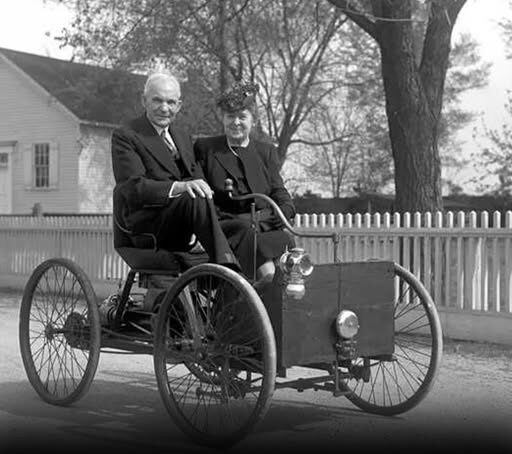
In May 1946, Henry Ford, now 82 years old, sat in the Quadricycle with his wife Clara at Greenfield Village in Dearborn, Michigan. It had been 50 years since that early morning test drive; 50 years since he’d broken down a brick wall with an axe at 2am; 50 years since neighbours woke to the sound of the first Ford automobile clattering through Detroit streets.
The photograph shows them both in the vehicle – Henry and Clara, the Quadricycle between them, a reminder of where it all started.
Ford had gone from that 500-pound horseless carriage to founding one of the world’s largest companies. From a shed behind a rented house to revolutionising manufacturing with the assembly line. From selling his first car for $200 to producing millions of Model Ts that put America on wheels. But he kept the Quadricycle.
Henry Ford died on April 7, 1947 – less than a year after that photograph was taken. The Quadricycle still exists today, on permanent display at the Henry Ford Museum in Dearborn, Michigan.
It weighs 500 pounds. It has four bicycle wheels. It has no reverse gear, no brakes and a doorbell for a horn. It’s crude. Simple. Unimpressive by modern standards.
But on June 4, 1896, at 2am on a Detroit street, it represented something extraordinary: the beginning of the automotive age.
And it reminds us that every revolution starts somewhere small – often in a shed, built by hand, requiring someone to literally break down walls to bring it into the world.
- A Tell Media report / Source: The way we were


About author