

Continued…
James Brenner was a lawyer and his law office on March 28, 1847, was busy. He understood discretion. He understood that some problems couldn’t be solved through legal channels or public confrontation. So he did what men in his position did.
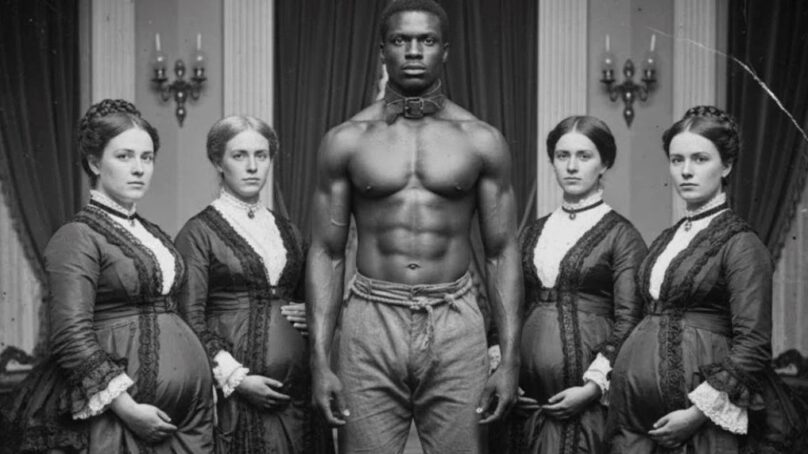
He reached out to other husbands quietly, carefully, feeling out who might be having similar issues. It took him less than two weeks to identify four other men whose wives were pregnant under suspicious circumstances. Tobias, the slave breeder, was the architect.
Dr William Thornton: His wife Elizabeth had been pregnant for six months but had been acting strangely, distant, guilty. Thornton had assumed she was nervous about childbirth – their first – but now he wondered if there was another reason.
Reverend Joshua Hayes: His wife Rebecca had announced her pregnancy four months ago with a kind of defiance that had puzzled him at the time. Rebecca had always been dutiful, proper, exactly what a minister’s wife should be. But lately, she’d been different, harder, less concerned with propriety.
Merchant Thomas Dixon: His wife Abigail was eight months along and had been avoiding him for weeks. When he’d asked why, she’d claimed exhaustion. But her eyes had told a different story: guilt, fear, something unspoken.
And there was one more. Someone who’d heard about the situation through James and had come forward with information of his own.
School teacher Caroline Murphy’s landlord. He’d noticed her condition but also noticed something else. She’d been receiving visitors. Late at night, a man who didn’t look like her husband, a man whose silhouette in the window had looked distinctly like a Negro.
The five men met in James Brenner’s law office on March 28, 1847. They closed all the curtains, locked the doors, and had a conversation that would haunt them for the rest of their lives.
“We all have a problem,” James said without preamble. “And we all know what that problem is.”
“My wife wouldn’t…” Reverend Hayes started, but James cut him off.
“Your wife would. Mine did. They all did. And it was with the same man.”
Dr Thornton leaned forward. “How do you know it’s the same man?”
“Because I asked my wife thoroughly. And I’ve spoken to each of your wives as well, quietly, carefully. They all gave the same name: Tobias, a slave from Cypress Grove Plantation.”
The room erupted in overlapping voices, demands for proof, denials, threats of violence. It took James 10 minutes to calm them down enough to continue.
“Here’s what we know,” he said, pulling out notes he’d been keeping. “Tobias is approximately 32 years old. He works as a breeding slave, which gives him unusual freedom of movement. He’s been coming into town on errands for Edward Harlow for approximately three years. And during those three years, he’s been methodically seducing our wives.”
“Seducing?” Merchant Dixon’s face was purple with rage. “You mean raping?”
“No.” James’s voice was flat. “I wish I could say that. I wish I could say my wife was forced but she wasn’t. None of them were. They went willingly, repeatedly over months.”
The silence that followed was suffocating. Because if the women had been forced, the men could be victims. Their wives could be victims. Society would rally around them. They could prosecute the slave, execute him publicly and restore their honour. But if the women went willingly, that was different.
That meant their wives had chosen a black slave over them. That meant every man in the county would know they’d been cuckolded by someone society considered less than human. That meant they were jokes, failures, objects of pity and ridicule.
“We can’t let this become public,” Dr Thornton said finally. “If people know…”
“Everyone will know the moment these babies are born,” James interrupted. “My daughter is clearly mixed. Yours will be too, all of them.”
“So, we kill him,” Dixon said quietly. “An accident. Problem solved.”
“That doesn’t solve the problem of the children,” Reverend Hayes said quietly. “Or what people will say when they see them.”
“We could claim illness,” Thornton suggested. “Say the children were born with deformities, unfortunately died. Tragic, but natural.”
“Five babies dying right after birth?” James shook his head. “People would ask questions.”
They argued for two more hours, going in circles, finding no solution that didn’t end in complete social destruction. Finally, James made a decision.
“We go to Edward Harlow,” he said. “We tell him what his slave has done. We explain that this needs to be handled discreetly. We let him deal with Tobias in a way that doesn’t involve public trials or testimony. And we…”
He paused, hating what he was about to say. “We keep the children, claim them as ours; deal with the shame privately rather than publicly.”
It was a terrible plan, but it was the only plan that didn’t guarantee their complete ruin. Three days later, all five men rode out to Cypress Grove plantation. Edward Harlow received them in his study, confused about why so many prominent men had come unannounced. He offered them whiskey, made small talk. Then James Brenner cut to the point.
“One of your slaves has been involved with some town women. We need him dealt with discreetly.” Harlow’s expression went from confusion to concern. “Which slave? What kind of involvement?”
“The breeding slave, Tobias. He’s been intimate with our wives.”
Harlow’s face drained of colour. Not because he was shocked that Tobias might have violated social boundaries, but because if Tobias had been with town women, what else might he have done? “That’s impossible,” Harlow said automatically. “Tobias is loyal. He’s obedient. He only breeds the women here as I’ve instructed. He wouldn’t.”
“Our wives have confessed,” Reverend Hayes interrupted. “Multiple women, all saying the same name: Tobias.”
“How many women?”
“Five, possibly more.”
Harlow stood up, went to the window, looked out at his plantation. His mind was racing. Because if Tobias had that much freedom, that much access to white women, then – no, it couldn’t be. Margaret’s pregnancy that was his. It had to be. And Virginia’s assault – that had been some random field slave, not Tobias. Tobias was his most trusted slave. His…
But even as he thought it, doubt crept in because Tobias had changed over the past year. Subtle things: a look in his eyes, sometimes a set to his jaw. Small moments where Harlow had felt like he was being observed rather than served.
“I need to speak with him,” Harlow said quietly. “Tonight, alone. Then I’ll handle it.”
The men agreed and left. As they rode away, none of them noticed Tobias watching from the barn. None of them saw the smile on his face because everything was unfolding exactly as he’d planned. That night, Harlow confronted Tobias in his quarters.
“Have you been with white women in town?”
Tobias looked up calmly. “Yes, sir.”
The honesty shocked Harlow. “What? You admit it?”
“You asked me a question, sir. I’m answering honestly.”
“How many?”
“Five town women, your wife, your daughter and six slaves here. 13 total.”
The room tilted. Harlow grabbed the wall for support.
“My wife? My daughter?”
“Yes, sir. Margaret is six months along. Virginia is seven months. The child Margaret carries isn’t yours. Neither is Virginia’s.”
Harlow’s mind couldn’t process it.
“You’re lying. My wife would never.”
“She would. She did. They all did willingly. I’ll kill you.” Harlow’s voice was barely a whisper.
“Yes, sir. I expect you will. But first, you should know why I did it.”
And that’s when Tobias told him everything. About Naomi Turner, Ruth Turner, Joseph Turner, about the free black family that Harlow had kidnapped in August 1828, about the three days in the seasoning house, about watching his mother die and his sister fade away, about remembering every single detail for 19 years.
“You took everything from me,” Tobias said quietly. “So I took everything from you. Your wife’s fidelity, your daughter’s purity, your bloodline. The thing you value most in this world, your precious white lineage, is now mixed with the blood of the slave child you created. Every child those women bear will be part of me. Your grandson will be my son. Do you understand? You didn’t just lose. Your family tree is now mine.”
Harlow stood frozen. Then he did what Tobias expected. He screamed for his overseers. They came with chains, with whips. They dragged Tobias to the seasoning house, the same building where his mother had been tortured. They chained him to the wall. And Harlow, for the first time in his life, personally administered a beating. 50 lashes, 100. He lost count. But Tobias didn’t scream. He took every blow in silence because he’d won. The revenge was complete. All that remained was the ending.
That night, Tobias broke his chains. It wasn’t strength; he’d been working them loose for months, preparing. He walked out of the seasoning house at midnight on November 16, 1847. He went first to Margaret Harlow’s bedroom. She woke to find him standing over her.
“I need you to understand something,” he whispered. “Every word I said to you was a lie. I never cared about you. I used you. You were a tool to destroy your husband.”
Margaret stared at him, tears forming. “Why are you telling me this?”
“Because tomorrow everything ends and you need to know the truth before it does.”
He repeated this with each woman. Virginia, the five town women who’d been brought to the plantation for safety when their conditions became known. One by one, he woke them. One by one, he told them the truth. Some cried, some raged, but Tobias had counted on something important. These women were now bonded by shared shame. Society would destroy them if the truth came out. They needed Tobias’s silence as much as he’d needed their bodies.
“Tomorrow morning,” he told them, “you’ll have a choice. Condemn me and destroy yourselves in the process, or protect me and keep your secrets safe.”
Then came the final act. Tobias went to the main house. Harlow was in his study, drunk, crying, his world shattered. Tobias entered silently. What happened next took three hours.
But why did Tobias do what he did that night? Why not just escape? He’d gotten his revenge. He’d destroyed Harlow’s bloodline. He’d won. So why did he stay? Why did he perform that horrific display in the garden that November morning?
The answer lies in what Tobias had learned about justice. Real justice. Not the justice of courts and laws, but the justice of making someone truly understand what they’d done. And for that, Harlow needed to experience exactly what he’d inflicted on others.
What Tobias did to Edward Harlow that night was methodical, surgical, not driven by rage, but by a cold, calculated desire for symmetry. First, he removed Harlow’s hands, not quickly, slowly, with a saw from the tool shed, because Harlow had used his hands to sign the false documents that made Tobias and his family slaves. Those hands had struck his mother. Those hands had destroyed lives.
Harlow screamed until his voice gave out. Tobias waited for him to regain consciousness before continuing. “You told my mother she wasn’t free anymore,” Tobias said quietly, working. “You told her the paper said she was property, so she was property. Do you remember that?” Harlow couldn’t speak, just nodded frantically.
“I thought about what you said for 19 years. The paper makes it real. The law makes it true. And I realised you were right. Power creates truth. So tonight, I’m creating a new truth.”
Then he took Harlow’s eyes. Because Harlow had watched his mother suffer and found pleasure in it. Tobias used a knife carefully ensuring Harlow remained conscious. “You watched her die,” Tobias whispered. “Now you can’t watch anything anymore.”
By dawn, Harlow was alive, but destroyed, permanently mutilated. Tobias left him on the front steps where everyone would see him. Then came the women. Tobias went to each of the 13 pregnant women. He had a choice to make. Kill them? That would make him the monster everyone already believed him to be. Let them go? They would testify against him, even at the cost of their own reputations.
So, he did something else. He performed amateur surgery on each woman. He cut their bellies open in vertical slashes, replicating the markings used on plantation ledgers to denote property. He removed each baby, placed them on the ground, each child dead or dying, but he kept the women alive, conscious, and then he cut out their tongues.
“Not to be cruel, to be symbolic,” he told each one. “You used your voices to lie. To say you cared when you didn’t. To make promises you never meant. To tell me I mattered when I was just a tool. So now you have no voice. Just like my mother had no voice. Just like every slave who ever tried to speak truth to power.”
Finally, he stitched their mouths shut with rough thread, leaving them able to breathe, but unable to speak. The garden display at dawn was deliberate. Thirteen women lined up, 13 dead babies, one mutilated plantation owner, all arranged like a grotesque tableau.
When the town’s people arrived at 7:00 a.m., summoned by a field slave who discovered the scene, what they saw broke something fundamental in their understanding of the world. This wasn’t random violence. This was a statement. Sheriff McKinley drew his gun immediately, aimed at Tobias, who stood calmly in the centre of it all.
“You’re under arrest for…”
“For what?” Tobias interrupted. “Murder? These women are alive. Assault of my own property? Mr Harlow gave me permission to breed slaves. I was just following orders.”
“You killed the babies. You mutilated…”
“The babies were mine. I can do with my property as I wish. Isn’t that the law? And these women,” he gestured to them, “are marked as property now. The law you’ve built says I can do this.”
The crowd was stunned into silence because Tobias was using their own logic against them. Then Margaret Harlow stepped forward, belly opened, tongue removed, mouth stitched. But she positioned herself between Tobias and the sheriff. Virginia joined her. Then Elizabeth, then three more of the white women.
Sheriff McKinley stared in disbelief.
“These women are protecting you after what you did.”
One of the women, Caroline, the school teacher, had managed to partially remove the stitches. Through a blood-filled mouth, she spoke garbled words. “He’s right. We chose. We all chose.”
This was the final piece of Tobias’s revenge. Not just destroying Harlow’s bloodline, not just the physical violence, but forcing these women to confront their own complicity. They had all willingly participated in their own destruction. And now they had to either admit that publicly and face total social annihilation or protect the man who’d used them.
Most chose protection because admitting the truth would destroy their families, their reputations, their lives. Better to be seen as victims of a slave’s madness than as willing participants in their own shame. The town faced an impossible situation. They couldn’t arrest Tobias without a full trial.
A trial meant testimony. Testimony meant these women explaining in public exactly what had happened. Their husbands, their families, their church, all would know the truth.
The town chose silence. They took Tobias into custody, yes, but quietly. They treated the women’s wounds. They buried the babies in unmarked graves, and they agreed collectively to never speak of it again. Edward Harlow was sent to an asylum, blind and handless, where he died three years later.
The plantation was sold. The slaves were dispersed to other properties and Tobias…he was sent to a maximum- security work camp in Louisiana where he died in 1853 officially of fever.
Unofficially, the guards beat him to death one night when no witnesses were present. But Tobias achieved something remarkable. He’d proven that the system of slavery contained within it the seeds of its own destruction. That the logic used to justify owning people could be turned against those who wielded it. That power, when given to someone with nothing left to lose, becomes a weapon that cuts both ways.
The story of Tobias and Cypress Grove plantation was documented in private journals and court records that were later sealed. It wasn’t widely known outside of Mississippi Delta communities where it became a whispered legend, a cautionary tale told to warn against giving slaves too much freedom, but also in different households, a different moral:
“Be careful what you destroy in others, for they may one day return that destruction tenfold.”
What haunts historians who’ve studied the case isn’t just the violence, it’s the questions it raises. Did Tobias start with a plan or did revenge grow gradually over 19 years? Were those 13 women truly willing participants, or had Tobias manipulated them so skilfully that they never had real choice? Was he a monster created by slavery? Or would he have been violent regardless? And perhaps most troubling, was what he did justice or merely revenge? Is there a difference when the system itself denies justice to those it oppresses?
The documents that remain offer no easy answers. They show a man who was simultaneously victim and victimiser, who suffered unimaginable trauma and inflicted it on others, who used the intelligence that should have made him free to engineer one of the most disturbing acts of revenge in American history.
This story forces us to confront uncomfortable truths about justice, revenge and the human capacity for both cruelty and calculation. Was Tobias a victim who became a monster or something more complex? The answer might reveal more about us than about him.
What we can say with certainty is this: Edward Harlow destroyed a free black family in 1828 because he could, because the law allowed it, because power made it possible.
And 19 years later, Tobias Turner destroyed everything Harlow valued using those same tools. Power, law, the presumption that some lives matter less than others. In the end, Cypress Grove plantation burned in 1851, two years after the events I’ve described. No one knows who set the fire. No one was ever charged.
But local legend says that if you visit the property on November 17th, you can still see marks in the soil where 13 women stood, where 13 babies died, where one man’s revenge became a permanent scar on the land itself. The cycle of violence that slavery created didn’t end with abolition. It echoed forward through generations. Tobias Turner was one man, one story, but he represented thousands who suffered similar fates. And unlike most, he left a mark so deep that even those who wanted to forget never quite could.
So when we ask whether Tobias was justified, whether his revenge was proportional, whether he became the very monster he fought against, these questions miss something fundamental. In a system built on the principle that some humans are property, that some lives are worth less than others, that power creates truth, concepts like justice and revenge lose all meaning.
Tobias simply showed the system its own reflection and it was too terrible to look at directly.
The past is never truly past. It lives in the systems we inherit, the stories we tell, and the questions we’re brave enough to ask.
- A Tell Media report/ Source: Global Times

About author