

Every time Eberechi Eze represents England, a photo of him from nine years ago resurfaces on social media. The attacking midfielder’s dreadlocks are shorter than they are today, but his beaming smile is the same.
At first glance, there is nothing special about the image of Eze, who is standing next to Fulham’s then-Arsenal midfielder Alex Iwobi. But look closer and you will spot the badge of Nigeria’s Football Federation (NFF) on the polo shirts they are wearing.
In March 2017, Eze was invited to a training camp at Barnet, a League Two (the fourth tier of English football) side in north-west London, organised by the NFF in an attempt to recruit players with dual English and Nigerian nationality.
Ola Aina and Chuba Akpom were among the others who attended. At the time, Aina and Akpom were playing in the second-tier Championship on loan from parent clubs Chelsea and Arsenal. The pair had represented England across multiple youth age groups but never made a senior appearance.
Now at Nottingham Forest, full-back Aina has become a key figure for Nigeria – he started all seven of their games as they got to the final of the previous Africa Cup of Nations (AFCON) two years ago but missed out on this edition with a hamstring injury, while Akpom, at 30, is still waiting for an official senior call-up.
Iwobi, nephew of former Nigeria international Jay-Jay Okocha, played for England at under-16 and under-17 levels before switching allegiance. He made his Nigeria debut when still a teenager in 2015 and is now fourth on their all-time appearances list with 94 caps.
Eze was a slightly different case.
He was in Queens Park Rangers’ youth team when he attended that training camp but a successful loan spell with Wycombe Wanderers in the 2017-18 season kick-started his career. In October 2018, he was called up by an England youth team for the first time, starting in a 2-1 victory for the under-20s over their Italy counterparts, and never looked back. He got his first senior cap in June 2023 and made three substitute appearances at the following year’s European Championship, helping England reach the final.
While Eze was flattered by Nigeria’s interest and considered playing for them, his preference was to represent England. The NFF successfully pursued Aina, Iwobi and Ademola Lookman, a forward with Italy’s Atalanta who has arguably been the best player at the AFCON in Morocco, but Eze slipped out of their grasp.
He is not the only player with mixed heritage they have missed out on. Eze’s Arsenal team-mates Bukayo Saka and Noni Madueke have Nigerian roots, too. Michael Olise of Bayern Munich, who plays for France but was also eligible for Algeria and England, was on the standby list for Nigeria’s AFCON qualifying-phase games in March 2021. Olise was only 19 and playing for Reading in the Championship at the time.
This is how Nigeria tap into their global diaspora – and the many challenges they face. This issue is not unique to Nigeria. Over a third of the players at AFCON 2023 were not born in Africa. For example, Algeria’s captain for that tournament, Riyad Mahrez, and Sebastien Haller, who scored Ivory Coast’s winning goal in the final, were raised in France.
Brahim Diaz, currently the top goalscorer at this AFCON, and Achraf Hakimi, the reigning men’s Confederation of Africa (CAF) Footballer of the Year, grew up in Spain but represent Morocco. The Royal Moroccan Football Federation (RMFF) has scouts in different countries monitoring players who are eligible for them from a young age, but Nigeria’s approach is more informal.
William Troost-Ekong was one of the first players with dual nationality to represent Nigeria. The defender was born in the Netherlands and grew up in London, spending time in Tottenham Hotspur’s academy. He played twice for the Netherlands’ under-20 team. Troost-Ekong was not on Nigeria’s radar until he spoke about potentially representing them in an interview with local media during a loan spell from Groningen to fellow Dutch side Dordrecht.
Troost-Ekong made 22 league appearances for Dordrecht in the 2014-15 season and, after his public comments, Nigeria’s then head coach Stephen Keshi watched them beat Ajax on the campaign’s final day. Keshi rang Troost-Ekong, who was 21, afterwards and invited him to be a part of their squad for fixtures against Chad and Tanzania. Troost-Ekong went on to succeed former Chelsea midfielder Mikel John Obi as captain in 2019 and earn 83 caps before retiring from international duty last month.
Although the now 32-year-old’s initial call-up was unconventional, as he points out, recruiting players from the Nigerian diaspora “was not an established pathway” in those days.
“When I was growing up, we didn’t have players like that,” Troost-Ekong, who was voted player of the tournament after Nigeria made the final of AFCON 2023, says. “People have seen what it means to represent Nigeria – you can look up to Alex Iwobi. Ademola Lookman is a boy from London who became the best player in Africa (the men’s CAF Footballer of the Year award in 2024).
That is probably going to open a lot more doors, and if anything, is going to help Nigeria, because you want to have the best players, no matter where they are born, to come home and represent the nation.”
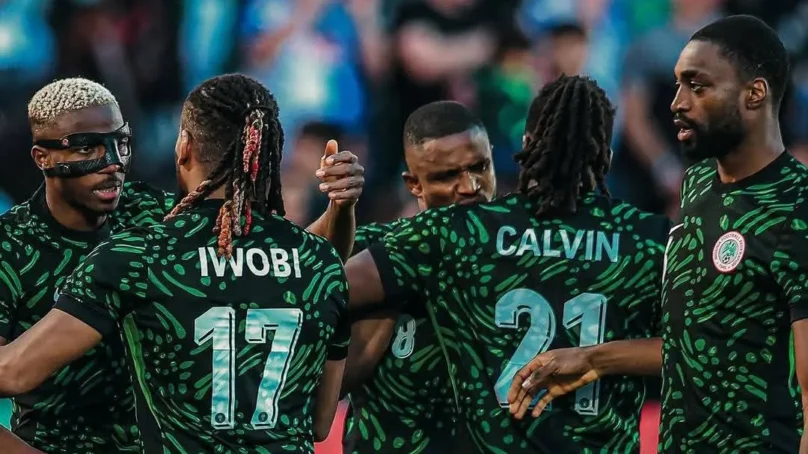
Troost-Ekong forged a strong bond with Aina, Iwobi, Lookman, Semi Ajayi and Calvin Bassey. The group all spent time in London during their childhood and are nicknamed the ‘Innit Boys’.
Gernot Rohr managed Nigeria for five years after being appointed in August 2016. Tunde Adelakun doubled up as Rohr’s assistant coach and chief scout. The pair, who now work together for Benin’s national team, played a key role in recruiting foreign-born players. It took them a long time to convince Lookman.
Nigeria first approached him shortly after he joined Everton from Charlton Athletic in January 2017. A few months later, he scored three goals for England at the Under-20 World Cup as they won the tournament. In September of the following year, England’s then senior manager Gareth Southgate insisted the forward was part of his plans.
Lookman’s career stuttered as he failed to settle in Germany after joining RB Leipzig in July 2019 and spent time back in England on loan with Fulham and Leicester City. He started the process of changing his nationality in 2021 but Rohr was sacked that December.
FIFA, world football’s governing body, eventually approved Lookman’s request in February 2022 and he made his debut, along with the Italy-born Bassey – who had been called up previously by Rohr – as substitutes in the first leg of their World Cup play-off final against Ghana the following month.
“It changed my career and life,” Lookman said in an interview with Arise TV last June. “This is my home, this is my place, Nigeria. I am the son of the soil.”
Maduka Okoye, who was a surprise omission from the Nigeria squad for this AFCON, was approached by Rohr in 2019. Okoye grew up in Germany, where former Bayern Munich defender Rohr is from. He played for Fortuna Dusseldorf, and Rohr knew some of their senior figures. Rohr contacted the club directly to gauge Okoye’s interest in representing Nigeria. Okoye, now 26 and with Udinese in Italy, became their first-choice goalkeeper for AFCON 2022 but has only made two appearances since, due to the emergence of current first-choice Stanley Nwabali.
- A Tell Media report / Adapts from The Athletic


About author