



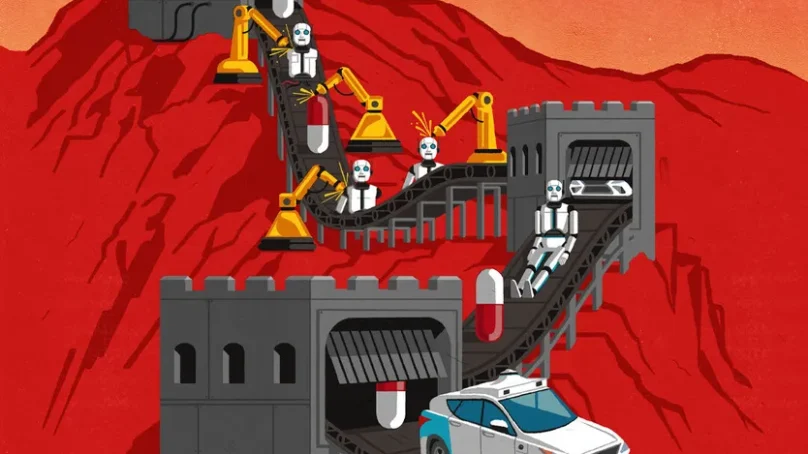
Old ideas take a long time to die. I am struck by how many people cannot let go of the assumption that Chinese companies innovate mostly by copying the West, stealing Western ideas and taking subsidies in order to compete unfairly.
All of those things happen, but they do not explain why Chinese industries are powering ahead. As this week’s issue explains, while many in the West are fretting about China’s presence in solar power, electric vehicles and artificial intelligence, they are missing its astonishing progress in two other frontier technologies: autonomous vehicles and new drugs.
A robotaxi revolution is gathering pace, which could reshape transport, logistics and everyday urban life. And in medicine China has turned itself from a copycat maker of generics into the world’s second-largest developer of new drugs, including those tackling cancer.
As these industries spread around the world, they will exemplify the power of Chinese innovation. The West should learn from China’s strengths. If it treats China’s success as just another example of unfairness, it will be left lagging behind.
Those who worry about how to cope with China’s leadership in technology –and there are plenty of them – think hard about electric vehicles (EVs), solar panels and open-source artificial intelligence. For such people, we have some bad news. This week we report how China is rapidly pressing ahead in two other frontier technologies, autonomous vehicles and new drugs. As these industries spread around the world, they will exemplify the power of Chinese innovation.
In our European editions we take Britain as a parable for how mainstream parties are struggling to govern. Britain’s productivity growth is paltry; the cost of borrowing is too high; and voters are unhappy. In response, the budget, presented on November 26, 2025, by Rachel Reeves, the Chancellor of the Exchequer, should have been a moment of radicalism.
Instead, Ms Reeves offered a bodge job. The chancellor failed to lessen Britain’s economic and political vulnerability. In 2029, the end of the government’s maximum five-year term, taxes will have reached 38 per cent of GDP, the highest in the post-war era. That is roughly the same as Germany today; it is higher than Spain and not far off Norway and Sweden.
The combined polling share of the populist-right Reform United Kingdom populist-left Green parties now exceeds that of Labour and the Conservatives, the duopoly that has dominated British politics for over a century. If this continues, change will eventually be forced on Britain by the financial markets or by voters stampeding towards the extremes. The tragedy is that, if only the country were better run, Britain’s economy would have plenty going for it.
Our Insider show this week is on the war in Ukraine. Amid a shocking corruption scandal in Kyiv and relentless pressure from Russia on the battlefront, the White House is pressing a new ceasefire plan. Zanny Minton Beddoes and I are joined by our colleagues to ask what peace would look like – and whether it is even possible.
- A Tell report / Reproduced from The Economist


About author