

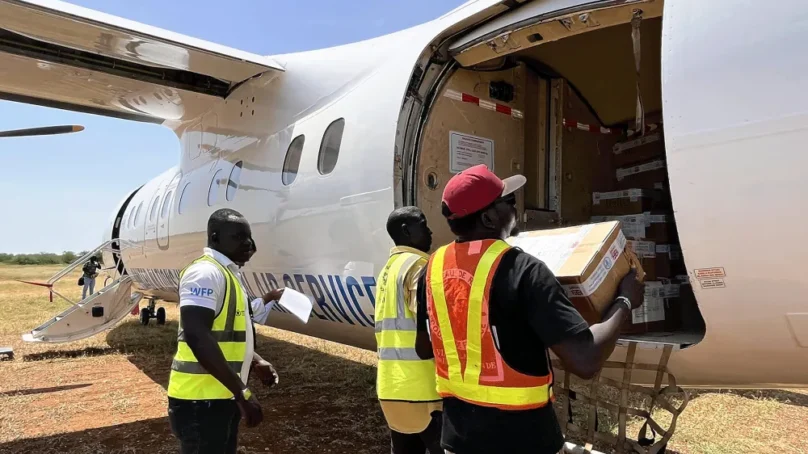
One morning in February, a team from the World Food Programme (WFP) arrived in the village of Mogok, in South Sudan’s Jonglei State. For the starving residents, it was a long-awaited visit.
The country’s peace agreement had fallen apart just over a year earlier, and the government had cut off opposition-held Mogok from aid. Supplies had run low and children had grown visibly thinner. “There is no sorghum here, no maize. Only fish and the roots of river plants,” one villager said.
In the weeks before the visit, Mogok’s inhabitants had repeatedly asked when WFP would come. After aid workers finally arrived, villagers offered them a precious goat.
That same morning, 20 kilometres south of Mogok, in the village of Pankor, expectations of an aid delivery were also running high. The situation in Pankor was just as dire, and the arrival of a government-aligned militia – following news of aid workers appearing nearby – spurred optimism.
The government has repeatedly denied humanitarian access to rebel-held areas, while directing groups to relocate their operations into state-controlled territory. The country’s protracted economic collapse means humanitarian groups have become major contributors to government revenue. The SPLM/A-IO, the country’s main rebel faction, is also exploiting aid where it can.
Millions of dollars’ worth of food and medicine intended for civilians has been stolen or diverted by fighters in recent months. Coupled with the decimation of humanitarian budgets, aid is now reaching fewer and fewer people.
Donor attempts to push back on aid manipulation and diversion may have ended up supporting the government’s counterinsurgency operations. Only days earlier, the local county commissioner, who hails from Pankor, had told community members that aid would soon arrive. “The UN agencies will come and bring for you everything,” he said.
Using a loudspeaker, the militia, known as the Agwelek, invited Pankor’s residents to gather in a hut to be registered for food aid. After the villagers assembled, fighters tied some of them up, and then opened fire. At least 22 were executed, according to two eyewitnesses.
Photos shared on social media after the massacre convey the consequences. In one, a rail-thin young man, his arms bound behind his back, lies face-first in the ashes of a cooking fire. In another, three women and two children lie together on the ground of the hut where they had gathered to register.
The events in Mogok and Pankor point to a wider pattern: Aid in South Sudan’s civil war is entangled in the conflict’s complex dynamics. From humanitarians being denied access to areas where people are starving, to the use of aid workers as bait for a massacre, assistance is being weaponised.
None of this should come as a surprise: Aid has long been central to warfare in the Sudans, and there are few countries that have been as closely studied for how conflict actors manipulate assistance. Yet history is now repeating itself with deadly consequences.
As conflict spreads, the South Sudanese government, which determines whether humanitarians can access different parts of the country, is pressuring organisations to withdraw from rebel-held areas and profiting from relief operations. The SPLM/A-IO, the country’s main rebel faction, is also exploiting aid where it can.
In recent months, the battle over humanitarianism has seen millions of dollars’ worth of food and medicine intended for civilians stolen or diverted by fighters, while dozens of NGO-run health facilities have been looted or destroyed, including by government airstrikes.
Coupled with the decimation of humanitarian budgets, aid is now reaching fewer and fewer people in South Sudan, even as the situation grows ever direr. Ten million people – the majority of the population – are currently in need of assistance, according to the UN’s humanitarian coordination arm (OCHA), and extreme levels of hunger and malnutrition have spread through areas affected by fighting.
The current civil war began in March 2025, when South Sudanese President Salva Kiir arrested one of his vice-presidents – the leader of the SPLM/A-IO, Riek Machar – for his alleged role in orchestrating an attack on a military barracks in Upper Nile State. The two men had formed a unity government in 2020 after a civil war between their forces cost over 400,000 lives.
The following month, a government memo divided up the parts of the country populated by the Nuer (South Sudan’s second-largest ethnic group and a major component of the SPLM/A-IO) into “hostile” and “friendly” counties.
What followed was a campaign of aerial bombardment that primarily targeted “hostile” counties, destroying medical facilities, markets, and homes, and displacing hundreds of thousands of people.
In December, after the government attempted to use political appointments to divide Nuer groups loyal to the opposition, the rebels overran a series of military garrisons in Jonglei. The following month, the government responded by launching a counteroffensive dubbed “Operation Enduring Peace”.
During the lead-up to the operation, the Agwelek’s leader, Johnson Olonyi, who is also a general in the South Sudanese army (the SSPDF), told his troops: “Do not spare an elderly, don’t spare a chicken, don’t spare a house or anything.” Government spokesperson Ateny Wek Ateny called Olonyi’s comments “a slip of the tongue” that were not indicative of government policy.
Yet at least some of Olonyi’s instructions were carried out. In the town of Akobo, an opposition stronghold where some of Jonglei’s residents had taken refuge, civilians described witnessing fighters loyal to Kiir’s regime razing villages, rounding up and killing their inhabitants, and deliberately destroying water sources.
The South Sudanese army is now entrenched in most of the country’s major towns, while opposition forces hold sway over large swathes of the countryside. Controlling humanitarian resources and denying access to hungry populations are once again proving powerful tools of war.
The government holds the upper hand in wielding these tools. In recent months, it has repeatedly denied humanitarian access to rebel-held areas, while directing aid organisations to relocate their operations into government-controlled territory, aid workers, UN officials and diplomats said.
This has caused a particularly acute crisis in a roughly 40-kilometre stretch of opposition-held territory in the southeast of Nasir County, in Upper Nile – a key battleground in the current conflict – where international aid organisations have been unable to deliver food aid for over a year.
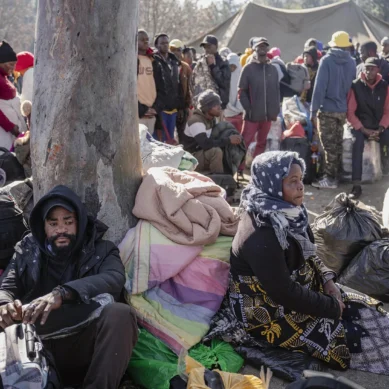
Government airstrikes and heavy fighting in Nasir have displaced tens of thousands of people into informal sites along the Sobat River. The Integrated Food Security Phase Classification – a UN-supported analysis body – warned in November that the county was at risk of famine, including more than 16,000 people at imminent risk of starvation.
Parts of northern Jonglei have also been placed under government siege.
Last August, humanitarian barges were held for over a week on the White Nile, preventing them from continuing their mission and delivering food to opposition-held areas. After negotiations, some places received food, but access to other areas continued to be blocked.
In January of this year, as the government announced its counteroffensive, it ordered all aid groups to vacate three opposition-held counties in northern Jonglei, an area roughly the size of Belgium.
In March, the medical group Médecins Sans Frontières said the government was preventing their staff from reaching the village of Nyatim, where, they said, dozens of civilians displaced by the fighting had starved to death or died from disease.
Humanitarian actors say their ability to push back and demand full access is limited because they are dependent on government permissions and fear losing their ability to operate in the country. But that fear offers scant comfort in places like Pankor, where hunger caused by government denial of humanitarian aid meant villagers were desperate and expectant when the Agwelek turned up in February.
The militia had what they felt was unfinished business with the Gawaar Nuer, a section of the Nuer ethnic group that lives in Pankor.
In 2022, the Agwelek had successfully taken crucial settlements along the White Nile to the north. The Gawaar Nuer, fearing they would be denied humanitarian access – and lucrative fees from checkpoints stippled along the river – mobilised for a counterattack. Community leaders told young Gawaar that they were attacking the government so the community could access aid in what was a more bellicose version of the daily struggles against the government for humanitarian access fought by aid workers in Juba.
Their counterattack, led by the charismatic Nuer prophet Makuach Tut, rampaged through the west bank of the White Nile into areas inhabited by Shilluk communities, from which the Agwelek draw support. There, Tut’s men killed and looted.
For the 30 or so Agwelek who travelled to Pankor on the morning of 21 February, the massacre was revenge for what had happened in 2022. The humanitarians were used once again, this time as a lure.
Humanitarian aid has long been central to waging war in the Sudans. During the second Sudanese civil war (1983-2005), fought between the government in Khartoum and the southern rebels (the SPLM/A) who would go on to lead an independent South Sudan, both parties diverted food aid to their troops and restricted access to enemy-held areas.
During the first South Sudanese civil war (2013-2018), the now-governing SPLM/A led by Kiir took up the same wartime playbook. In southern Unity State, for example, it declared certain areas “safe zones” and encouraged humanitarians to distribute aid there. Civilians flocked to these areas, where the government could control them and divert food aid to soldiers. The rest of southern Unity was declared hostile. Government-backed militias repeatedly rampaged through the region, razing villages, looting cattle and raping women.
As during South Sudan’s first civil war, access to opposition areas has not been entirely cut off during the current conflict. Some aid groups have managed to negotiate directly with local county commissioners and militia leaders, while permits from Juba have also ebbed and flowed with the rhythm of the conflict.
Late last year, WFP airdropped food for approximately 36,000 people in some areas of Nasir, according to an agency spokesperson, even as its efforts to access sites along the Sobat River remained stalled.
Yet the granting of humanitarian aid can also be part of the war effort, with access often allowed only once the government has captured a place.
In January, the government ordered aid groups and peacekeepers out of opposition-held Akobo, then invited them back once the town was captured by government forces. In April, when the town was recaptured by the opposition, it barred humanitarian flights again.
In May 2025, the government hired BAR Aviation, an Israeli-Ugandan company with close ties to the Ugandan military, which then subcontracted the US firm Fogbow to conduct food airdrops to Nasir town. The town had been recently recaptured by the government and was being used as a base to launch military operations toward opposition encampments near the Ethiopian border.
In an interview at the time, the humanitarian affairs minister, Albino Atak, said the airdrops were intended to bring the civilian population back to town. On the other hand, opposition officials, wary of civilians moving into government areas, told people – without evidence – that the food being dropped in Nasir had been poisoned.
In contested counties across the country, similar tactics are being used to control population flows and the humanitarian resources they often bring. “The civilians bring the aid workers,” explained one South Sudanese humanitarian based in Upper Nile, “and the aid workers bring everything else.”
While humanitarian aid has been denied to some of the country’s neediest belligerent forces have helped themselves. Last September, a government-allied militia looted a WFP barge in the town of New Fangak, in Jonglei. Asked about the incident, one of the generals who issued the order indicated that his soldiers were also hungry.
The government later made a placatory gesture and gave WFP food aid roughly equivalent to what was stolen, although this did not include the non-food items pillaged, nor did it help get the food to the populations for which it was originally intended.
Earlier this year, a 12-barge WFP convoy – worth approximately $2 million – transporting more than 1,500 metric tonnes of food to opposition-held areas of Nasir was looted while moving along the river next to Baliet County in Upper Nile. The government-appointed county commissioner organised the raid, which was carried out with the participation of the community, according to government officials in Malakal, the state capital, as well as two diplomats.
- A Tell Media report / By Philip Kleinfeld / Source: The New Humanitarian


About author