
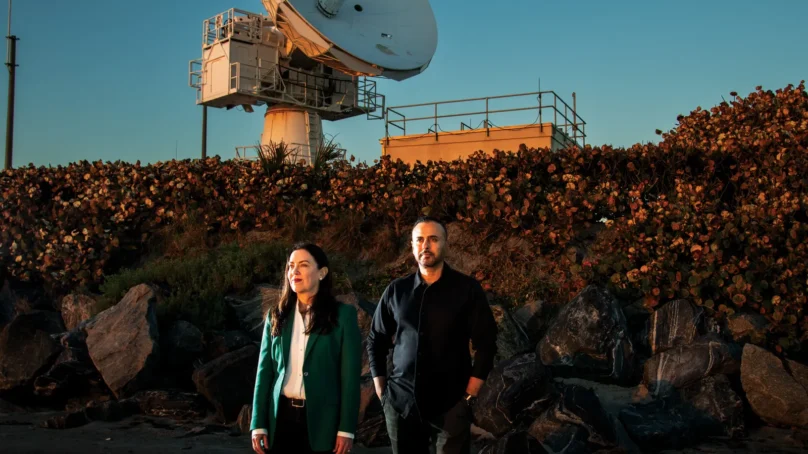
Like many a good Florida tale, this one begins in a watering hole with all the trappings of a Carl Hiaasen novel. The date was May 14, 2023, and Joseph Assad had taken his wife, Michele Rigby Assad, to the Sandbar Sports Grill in Cocoa Beach, a kitschy beachfront dive, to celebrate her 50th birthday.
Scattered clouds and a gentle breeze offered pristine conditions for a Hurricane (the rum and triple sec sort) and a late-night rocket lift-off.
A dozen miles north, looming along the Atlantic, was Cape Canaveral’s Space Launch Complex 40. As last call beckoned at the Sandbar, the crowd thinned out. Yet a few stragglers, drinks in hand, watched the horizon, waiting for ignition. When the Falcon 9 finally lit, it tore a bright seam through the night.
This was SpaceX doing what it now does best: lofting a stack of Starlink satellites into low earth orbit. That evening’s mission was a milestone. SpaceX sent up a record-tying payload (56 satellites at 17.4 metric tons), using its highly proprietary rocket, designed to fly again – separating, arcing back, and returning for a controlled landing.
For the Assads, rocket launches – routine to most locals – had never lost their lustre. The pair relished the fiery spectacle. And the intrigue. Often, the mission cargo is highly classified. The Assads had settled in Florida after a decade of working in the world’s hot spots – from Africa to Latin America to the Middle East – as a tandem couple with the CIA.
Assad was a counterterrorism case officer responsible for spotting, assessing and recruiting spies; Rigby Assad was a counterintelligence interrogator.
(Disclosure: In the 1990s I worked as a CIA attorney before becoming a journalist and producer.)
After leaving the spy game, the Assads founded a boutique security firm advising clients – sports teams, defence contractors, houses of worship – on how to confront potential threats. They bought a waterfront spec house, a speedboat, and cycled through a collection of Aston Martins and McLarens in eye-catching colours.
“It’s a little James Bond and a little ‘Florida Man,’ ” Assad told me.
The ex-spies blended in nicely among the engineers, techies, and tanned retirees from law enforcement and government-adjacent jobs. They’d adapted to life along the so-called Space Coast, a palm-dotted shoreline roughly 70 miles end to end, from Titusville down through Cocoa Beach and on past the guarded gates of Patrick Space Force Base, where NASA’s old infrastructure still hums, even as the privatized rocket era now sets the tempo.
At the centre of it all, with its estates and postcard vistas, is Merritt Island (population around 35,000), projecting an air of serene insularity. Florida’s tourism bureau bills it as “an ideal destination for space enthusiasts and outdoor adventurers.” They neglect to mention another, more invasive species drawn to the area: spies.
That night the Sandbar featured a 1980s cover band, six salty guys with dad bods. As they pounded out Tommy Tutone’s “867-5309/Jenny,” Assad excused himself for a bathroom break. En route, he noticed an attractive woman, whom he believed to be Chinese, striking up a conversation with one of the many “space nerds” crowding the bar. “Are you an engineer? Do you work at SpaceX?” he recalls her asking.
On his way back to the table, he spotted the same woman posing the same questions to a different guy. “What is this, a fucking census?” he muttered as he relayed the encounter to his wife.
“The Space Coast is like a small town where big-city things happen,” Rigby Assad later told me. “The guys, who literally wear their corporate affiliation on their sleeve, share an optimism bias. Why would anyone be interested in me or my company? But the reality is this is a target-rich environment.”
“The Chinese and the Russians are all over Florida,” said a veteran FBI counterintelligence agent. “They’re trying to steal whatever they can get their hands on.”
To the Assads, the timing was a tell. On the night of a major SpaceX mission, a stranger was working the room like she’d been tasked.
“She was cold-bumping men a stone’s throw from launch control,” Rigby Assad said, using spy slang for approaching someone without an introduction or cover. “It was blatant.” Blatant enough that they quietly snapped her photo and forwarded it to the authorities.
Counterintelligence – CI in trade-speak – has always been more art than science. For more than half a century, stateside espionage has been concentrated in what is now known as the Acela Corridor. Running from Washington to Boston, it’s a region thick with foreign intelligence officers posing as diplomats or academics, businessmen or scientists.
Representatives from hostile states like Russia, China, Iran and North Korea are circumscribed in their movements, typically limited to a small radius around their official posts – an embassy, a consulate, a permanent mission to the UN. Travel exceptions require approval from the State Department, informed by assessments from US intelligence.
Now, one of the destinations most frequently cited by “diplomats” seeking a brief escape is the Sunshine State. A recent report by the Defence Counterintelligence and Security Agency explains the lure with unusual candour:
“Florida is home to 21 military installations and three combatant commands, the world’s busiest spaceport, hundreds of cleared defence contractors and theme amusement parks, as well as other critical infrastructure vital to national security.”
Put simply, in DCSA’s view, “Florida poses a significant risk to collection from FIEs” – agency argot for foreign intelligence entities.
“The Chinese and the Russians are all over Florida,” a veteran FBI counterintelligence agent told me, speaking on condition of anonymity. “They’re trying to steal whatever they can get their hands on.” Both countries, he explained, are incessant collectors but their philosophies diverge. The Russians are old-school, valuing tradecraft and discretion, he said; the Chinese government, in contrast, has “an expectation that if you’re Chinese, you’ll help the intelligence services. It’s not a request. It’s a requirement.” The result, CI officials contend, is that while Moscow mainly dispatches pros, Beijing is willing to send, or accept, amateurs—people desperate to elevate their social standing, or that of their relatives back home.
“Walt Disney World is used as a hall pass for diplomats who aren’t supposed to travel,” said an official involved in vetting such requests.
“When we dig deeper, we rarely find they’re coming to see the Magic Kingdom. Disney is 100 per cent [the] cover for action.” Translation: Operatives cosplay tourists (collecting stuffed animals and family selfies) before embarking on their real objectives: probing vulnerabilities, swiping secrets or recruiting others to do the same.
In 2025 the Space Coast hosted more than 100 rocket launches. This year the schedule is even more ambitious. In the coming months, NASA plans to launch Artemis II, which would mark the first mission carrying humans to loop around the Moon since Apollo 17 in 1972. At the same time, there is a less conspicuous showdown: the battle of the billionaire rocket barons, Elon Musk (the head of SpaceX) and Jeff Bezos (who runs Blue Origin), now locked in a high-stakes duel over who will help build NASA’s next lunar lander. CI officials say America’s foes will be watching every launch, every delay, every incremental advance.
Space, they warn, is only part of the quarry. As vacationers pour into Port Canaveral to board cruise ships or spot manatees in the mangroves, few realise how much sensitive infrastructure sits just out of view.
The Navy’s Trident Wharf supports submarines from the Atlantic Fleet during port calls. It also houses the Naval Ordnance Test Unit, which evaluates sea-based strategic weapons systems. Minutes south lies a military nerve centre for electronic and cyber warfare, missile defence, and the clandestine monitoring of foreign nuclear tests.
In short, a sandy backwater that long served as NASA’s playground – the cradle of Mercury missions and Space Shuttle launches – has become, almost without notice, some of the most hotly contested coastal real estate in America.
“Oh, I remember the Sandbar incident,” Jonathan Cute said with a smile, recalling the May evening two years earlier when Joseph Assad forwarded a photo of the serial flirt. “I believe 100 per cent she was trying to ‘honeypot’ people from the space programme. I remember thinking, Oh shit, she’s trying to grab Intel.”
Cute, with a prestigious security position in the private sector, was forthcoming and blunt in our conversations. Shaved head, boxer’s build, he spoke in rapid bursts, his accent a relic of a hardscrabble upbringing in East Providence, Rhode Island.
Before trading a uniform for a suit, Cute spent decades with the Orlando Police Department. He worked hard-core narcotics cases and SWAT, then was tapped to lead the department’s intelligence unit. “I knew early on I wanted to be in law enforcement,” he told me. “I grew up with a violent dad who took it out on my mom.” The police, he remembered, were the only ones capable of keeping his father in check. “I wanted to help people who were really in trouble.”
He did just that on June 12, 2016, when his SWAT team breached the back wall of the Pulse nightclub and engaged Omar Mateen, an ISIS acolyte who was slaughtering members of Orlando’s vibrant LGBTQ+ community.
It would become the second-deadliest mass shooting in American history. Cute’s willingness to draw fire saved lives.
His next gig was with an obscure public-private consortium called the Central Florida Intelligence Exchange, where he served until late 2024. As deputy director of CFIX, he helped bring together federal, state, and local law enforcement to counter threats to tourism and critical infrastructure, working alongside private sector partners in aerospace, defence and tourism.
CFIX had been created in the early aughts with a narrow mandate: to protect residents and visitors by helping prevent terror attacks at theme parks, conventions and other public places. By the time of the Assads’ encounter at the Sandbar, however, that focus was expanding decisively to include counterintelligence.
Only months into the job, Cute received a call from a friend at CIA headquarters asking whether he’d meet a young case officer being sent to Orlando.
“She came in like she’d been shot out of a cannon,” he recalled. (The woman remained undercover; I’ll call her Sara Russo.) Her message: “The Chinese and the Russians are eating our lunch. Daily.”
At first Cute wasn’t convinced. “I was like, There’s no way this is happening. I couldn’t even spell CI before I met her.” Russo persisted. “She got our attention by drilling home that there was an existential threat here in central Florida and that we’re under attack by foreign adversaries.”
Cute took her concerns to Matt Butler, a former SWAT colleague who had risen to become CFIX’s director.
“It’s easy to hide in plain sight here,” Butler told me. “Chinese nationals, Russian nationals – people from everywhere. You don’t see that in South Dakota. You see it in Orlando, Titusville, the Space Coast.”
Law enforcement runs in Butler’s blood. He followed his father and brother into the Orange County Sheriff’s Office, working narcotics, then SWAT, then intelligence. When Butler was asked to take over CFIX, Russo’s warnings landed hard. “She was telling us, ‘There’s a lot we can’t say – but collection is happening. And ringing the bell at the bureau is getting tiresome.’ ”
CFIX had strong relationships with FBI field offices across Florida. But Butler and many experts I canvassed essentially described the bureau’s resident agency in Brevard County – the heart of the Space Coast – as “the single point of failure.”
According to Butler and several colleagues, the top agent there dismissed Russo as an alarmist and invoked “no DROG” – CI shorthand for the absence of derogatory information. Such a designation, evidently, would save agents from wasting time chasing phantoms.
“This mission,” Butler said, “belongs to the bureau. We weren’t about to piss in their lane. But I thought maybe we could rattle the cage long enough that they’d start paying attention.”
CFIX began discreetly mapping the threat. Cute’s team, using police dispatch databases, pulled reports of suspicious persons, vehicles, incidents. What emerged was hard to ignore. Officers were being sent, time and again, to sensitive national security locations, only to discover non-Americans whose presence raised more questions than answers. These weren’t misunderstandings.
Individuals of Chinese descent were flying drones over restricted sites. They were peering through windows. They were slipping into trees to aim listening devices at defence contractors. They were trying to breach off-limits areas by posing as delivery drivers.
The activity wasn’t confined to the Chinese. An immaculately groomed Russian family – straight out of The Americans – appeared at SpaceX’s Cape Canaveral complex, presenting themselves as tourists. CFIX later learned the same family had surfaced at a SpaceX facility in California under the guise of sightseeing.
Nor was that an isolated episode. Butler recalled a text from an off-duty deputy at a defence trade show at the Orange County Convention Centre. “There’s a Russian woman here,” the deputy wrote. “She’s rubbing up on admirals and generals – tracking them, asking questions.”
Butler dispatched plainclothes officers from the county sheriff’s intelligence unit to observe. The woman was polished: credentialed as a vendor and unusually attentive to the brass. To Butler’s mind, it did not resemble networking.
CFIX ran her through its systems. The picture soon resolved: Russian citizen, clean cover. A report was written. The handoff was made. “We gave it to the FBI,” Butler said. “Never heard another word.” The same held true, security officials told me, when CFIX forwarded a photo of the woman from the Sandbar. “It went into a black hole.”
In 2023, Butler convened a closed-door meeting of what he called the five families – CFIX’s public- and private-sector partners – to coordinate a response to what his team saw as a rapidly metastasising CI threat. The session barely got off the ground.
According to Butler – an account corroborated by two others in the room – the bureau’s man in Brevard, also in attendance, cut in early. “One, there is no collection happening in our [area of responsibility],” he said. “And two, even if it were, you wouldn’t recognize it.”
Butler knew a disc when he heard one. He said he told the G-man, point-blank, “Which TV show did you just step off of? Because that was textbook FBI typecasting.”
The FBI agent’s purported rebuke ran counter to the message coming out of Washington at the time. Then FBI director Christopher Wray was stating publicly that the bureau was opening new China-related counterintelligence cases at a breakneck pace – roughly one every 10 hours – and that nearly half of its active CI docket involved China. Surely such incursions were occurring up and down the Space Coast too.
Nearly three years later, things have only ramped up. Just weeks ago, authorities in Nevada searched a residence owned by a Chinese national, Jia Bei Zhu, which the FBI contends may have been an illegal biolab storing potentially dangerous pathogens.
Police discovered cold-storage units stocked with suspicious vials and containers. The same homeowner, according to law enforcement, may be connected to another property in California where detectives in 2022 found a cache of hundreds of samples marked HIV, TB, malaria, Covid and Ebola, as well as thousands of lab mice. (Zhu’s attorney has insisted his client “is not involved in any kind of biolab.”)
Chilling, to say the least. And other activities have raised further concern. When asked last year to identify the most significant domestic counterintelligence threat, Wray’s successor, FBI director Kash Patel, answered without hesitation:
“The PRC. The [Chinese Communist Party] engage[s] in the greatest level of espionage against the United States of America…. Particularly troubling is how they acquire lands and real estate in and around military bases.”
Indeed, Chinese-linked investors hold roughly 277,000 acres of American agricultural land, as evidenced by USDA Farm Service Agency reporting. That amount sounds negligible until you plot it out. Chinese firms or individuals hold parcels across 30 states, some properties close enough to sensitive infrastructure and military sites to revive a hard truth of modern espionage: that farmland can double as a listening post, a supply-chain tripwire, a hidden perch from which to watch.
For years, lawmakers warned this wasn’t just an economic story but a matter of national security; only recently did Washington shift from alarm to action. In July, Agriculture Secretary Brooke Rollins unveiled USDA’s National Farm Security Action Plan, pledging tougher limits on purchases by “foreign adversaries,” tighter disclosure, and potential moves to block – or claw back – high-risk land sales, under the banner of farm security as homeland security.
The house looked wrong.
Everything – from the squat, one-story structure to the station wagon parked outside – had been coated in the same uneven layer of white paint, as if someone had tried, hurriedly, to erase it from the landscape. Along the perimeter sat a series of bulky equipment boxes, also painted white, with cords snaking back toward the building. To a casual passer-by, it might have registered as a Florida eccentricity. To Christina Dowd, standing across the street that afternoon, it looked like a data centre masquerading as a rental property.
Dowd is not a spy. She’s never worked in intelligence, carried a badge or been taught tradecraft. She’s out of her depth. But she senses when something doesn’t track. A military brat, she’d grown up devouring her father’s collection of spy novels.
“Tom Clancy lit my brain on fire,” she told me, laughing. For security reasons, she asked that I use a pseudonym.
After a divorce, a remarriage and her youngest child headed off to preschool, Dowd decided she wanted in – if only experimentally – on the shadow world she’d read about as a teenager. Any foray into counterespionage, she conceded, would have to be freelance and local. This posed no obstacle, though; she knew that the Space Coast drew tech and talent – and the spies who trailed them.
“I’m a stay-at-home mom,” she said as we sat around a fire-pit on a cool December night. “And I was like, Let’s test it here – just for funnies.”
Dowd began with something tangible: real estate.
- A Tell Media report / Source: Vanity


About author