


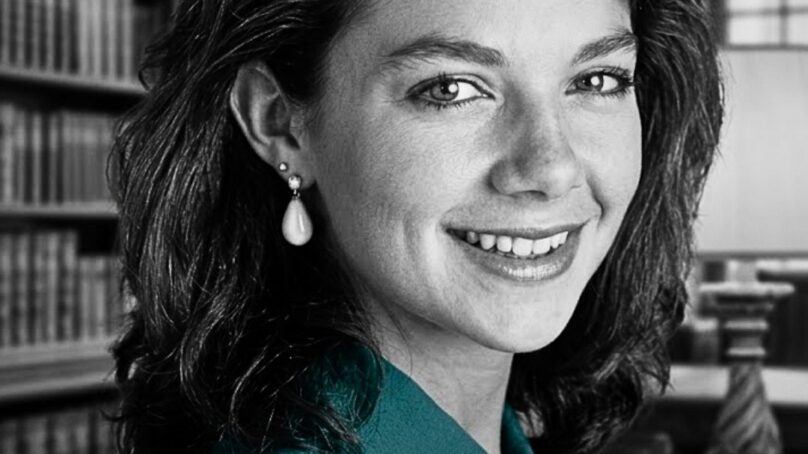
“She was seventeen years old and she had a plan. She’d gotten the recommendation letters. She knew which schools she wanted to apply to. She was ready.
Then a line producer at Paramount Studios sat her down and delivered the news with the casual cruelty of someone who didn’t understand what they were taking. She was under contract. She couldn’t leave. The decision was not hers to make.
The teenage girl who would spend the next seven years playing Mallory Keaton on one of America’s most beloved sitcoms went back to the set – and tried not to think about what had just been closed off to her.
Her name was Justine Bateman. And she would spend the next thirty years carrying that locked door with her.
Family Ties ran from 1982 to 1989, and Justine Bateman was at the centre of it — earning two Emmy nominations and a Golden Globe nomination for her role as the sharp, fashion-obsessed sister who turned what could have been a punchline into a fully realised person. Millions of Americans knew her face. Millions of teenagers saw themselves in Mallory.
When the show ended, she kept working. She appeared on screen alongside Julia Roberts and Liam Neeson. She took roles throughout the nineties and 2000s in television and film. She launched a clothing design company. She guest-starred on her brother Jason’s show, Arrested Development. She appeared on Desperate Housewives and Californication. She kept moving, kept building, kept showing up.
But she also kept thinking about the door that had been closed when she was seventeen. In fall 2012, at 46 years old, Justine Bateman walked onto the UCLA (University of California Los Angeles) campus as a freshman.
Not for a certificate. Not for a publicity story. Not to prove a point to anyone in particular. She enrolled in a full four-year degree programme in Computer Science and Digital Media Management – a customised independent major she designed herself, blending core computer science coursework with economics, technology policy, and digital media.
She sat in lectures alongside students who had been born the year she was nominated for her first Emmy. She coded. She studied engineering. She took on coursework that she later called “the most difficult thing I’ve ever done.” She designed her own curriculum. She pushed into territory the entertainment industry had never thought to prepare her for.
One of her first professors at UCLA, English professor Michael Colacurcio – who had been teaching for nearly half a century – called her “one of the most terrifyingly motivated students I’ve ever had.”
In 2016, at 50 years old, she graduated.
She walked across that stage with a degree that had taken thirty-three years to earn – not because she wasn’t capable but because she had been told, at seventeen, that her time and her future belonged to someone else. Then she kept going.
She wrote a book about fame – what it does to a person, what it costs, what it takes from you when it leaves. It became a bestseller.
She wrote a second book about aging – specifically about what happens when women dare to let their faces show the lives they’ve lived, and the industry that profits from their discomfort about it. That one became a bestseller too.
She wrote, directed and produced a feature film, Violet, which premiered at the SXSW Film Festival in 2021 to critical acclaim. She followed it with more films. She built a production company. She became a filmmaker in the fullest sense of the word – not in spite of starting at fifty, but with everything that starting at fifty had taught her.
And when the conversation about artificial intelligence reached a crisis point in Hollywood, she didn’t just speak – she built.
She founded CREDO23 – an organisation that certifies films and series made without generative AI, offering audiences and filmmakers a guarantee that the work they’re watching was created by human beings.
She turned her computer science degree into something the industry badly needed: a framework, a standard and a shield for the writers, directors, actors, and crew members whose livelihoods were being threatened by the very technology she had spent years studying.
She also became the festival director of the CREDO23 Film Festival, dedicating the platform entirely to AI-free work and returning all proceeds to the filmmakers themselves.
People sometimes ask what happened to Justine Bateman’s career. She is happy to answer.
She’s been acting for over forty years. She testified before the US Senate Commerce Committee on net neutrality. She graduated from UCLA. She published two bestselling books. She directed three feature films. She founded an organisation protecting artists from the most significant technological threat their industry has ever faced. She’s currently writing two more books. She’s casting her next film.
When people comment on her face – on the internet, as people do – she points them to the book she wrote about exactly that. When people ask if her best years are behind her, she notes that most of what she’s accomplished, she’s accomplished after 50.
“I’ve just barely begun what I was born for,” she has said. “What I do in the future will eclipse everything I’ve already done.”
At seventeen, a girl was told the decision wasn’t hers to make. She waited. She worked. She carried the dream quietly through decades of someone else’s headlines. And then, when the contract expired and the world moved on and everyone assumed her story was finished – she enrolled as a freshman. She studied. She graduated. She wrote. She directed. She built.
She didn’t fight her way back to where she had been. She built something entirely new – and made the thing they took from her look small by comparison.
The girl who couldn’t go to college at seventeen graduated at fifty. The actress told her best roles were behind her is now a filmmaker, author, and founder in her late fifties – and still, by her own account, just getting started.”
- A Tell Media report / Source: Incredible and Strange Everything


About author