


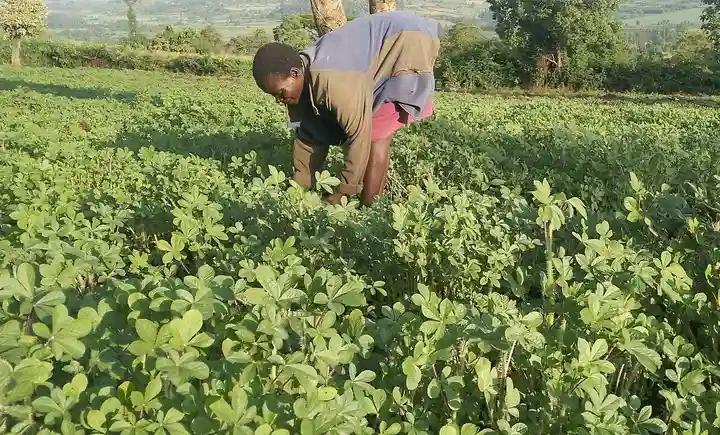
Indigenous vegetables once dismissed as “food for the poor” are rapidly making way back to dining table in western.
It is something akin to a leap faith in traditional systems, with sugarcane having lost the lustre it once had as a cash crop. Now indigenous vegetables are fast turning into the proverbial green gold coveted by smallholder farmers.
This is happening in a region where nearly every household in western, which holds the distinction of being the few parts Kenya that still have vestiges of local cultures that thy revere, with the Luhyia traditional foods dominating Kenyan culinary choices.
Now on strong rebound as exotic vegetables recede into near oblivion, indigenous vegetables are replacing sugarcane as the most lucrative crops for farmers in Lugari Sub-County, Kakamega County. This is spurred on by rising awareness of their nutritional and medicinal value that are driving demand beyond available supply.
Farmers cultivating black nightshade (lisutsa or managu), amaranth (murere), spider plant (tsisaga), cowpea leaves (likhuvi / shikhuvi) and liseveve (pumpkin leaves) say the crops now generate higher returns than exotic vegetables such as kale and cabbage due to their fast maturity, repeated harvesting cycles and ready market.
“I start harvesting within a few weeks of planting, and the vegetables rarely stay on the farm because traders buy everything almost immediately,” Peter Wekesa, a farmer in Lumakanda, says.
According to Wekesa, a 90-kilogramme sack of indigenous vegetables sells for between Ksh3,500 and Ksh5,000 depending on the season and variety, compared to Ksh1,500 to Ksh2,500 for a similar quantity of kale or cabbage. By comparison, a tonne of sugarcane fetches a farmer Ksh4,000 after waiting for more than 18 months to harvest.
The surge in demand has, however, created supply shortages across local markets.
Mary Nanjala, a trader at Lumakanda Market, says sourcing enough vegetables to meet the sky-high is difficult. She says the demand is driven by realisation of the health and nutritional benefits of indigenous crops.
“Five years ago, these vegetables were readily available because no one wanted to be branded backward. Kales and cabbages were associated with ‘high class’. Today we struggle to get enough stocks. And when we do, by 8am almost everything is sold out,” she says.
Lugari Sub-County Agriculture Officer Kakai Wekesa attributed the shift to changing consumer preferences, improved nutrition awareness and renewed appreciation of indigenous foods. Mr Wekesa says traditional vegetables are rich in iron, calcium, vitamins A and C, and are antioxidants, which makes them attractive to health-conscious consumers.
“More consumers are embracing healthier diets, making these crops highly attractive commercially,” he said.
The agriculture officer observes that the vegetables require fewer chemical inputs, mature faster than exotic varieties and allow multiple harvests, which enabling farmers to earn income throughout the year.
He noted that demand has also grown in hospitals, schools, hotels and urban households that now incorporate indigenous vegetables in their diets.
Despite rising demand, production has not kept pace, leading to a widening supply gap in the market.
Agricultural experts attribute the shortage to shrinking land sizes, prolonged dry spells, unreliable rainfall, limited irrigation, declining kitchen gardens and a shift by farmers to exotic vegetables.
Other constraints include limited access to quality seed, poor seed preservation practices and post-harvest losses that reduce overall output.
Kenya Agricultural and Livestock Research Organisation (KALRO) notes that African indigenous vegetables play a key role in improving household nutrition while offering smallholder farmers a profitable enterprise due to low production costs and frequent harvesting.
The institution further observes that many of these crops are more resilient to climate variability compared to exotic varieties.
Wekesa has been encouraging farmers in Lugari to embrace commercial production by adopting irrigation and forming producer groups to meet rising market demand.
“If farmers organise into producer groups and invest in irrigation, they can bridge the supply gap, increase household incomes and strengthen food security,” he says.
With demand continuing to rise, traditional vegetables are steadily shedding their subsistence label and emerging as one of Lugari’s fastest-growing agribusiness opportunities.
- A Tell Media / KNA report / By Linet Wafula


About author