
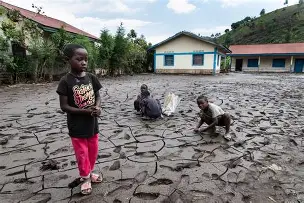
Many children in Eastern and Southern Africa face overlapping climate shocks that disrupt essential services, undermine children’s rights and deepen inequality.
This is according to UNICEF’s Children’s Climate Risk Report 2026 released on June 16, 2026 in commemoration of the International Day of the African Child. The report identifies drought, fire and heatwaves as the most prevalent trio of hazards.
It says that across the region, over 65 million children, close to one in four are already exposed to three or more overlapping climate hazards from droughts and fires to floods and tropical storms.
These climate shocks are increasingly affecting the essential services that children rely on for survival, health and learning, including critical water and sanitation systems.
Using advanced geospatial analysis, the report maps children’s exposure to the eight most frequent climate threats as well as two climate-sensitive hazards: air pollution and vector-borne diseases such as malaria. For the first time, the report reveals exactly where and how intense, multiple and overlapping climate threats are affecting children and overwhelming essential services.
Commemorating the Day of the African Child, Etleva Kadilli, UNICEF Regional Director for Eastern and Southern Africa said the report is a timely reminder that the climate crisis is increasingly becoming a child rights crisis.
“When climate disasters strike, the impact multiplies. Water systems fail. Schools close. Clinics are damaged. This is how inequality deepens and children’s futures are put at risk,” Kadili said in a press statement.
Further, the report combines children’s exposure to climate hazards with their vulnerability, including access to healthcare, clean water, education, nutrition and social protection, helping identify where risks are greatest and where investments will be most effective.
Specifically, the report indicates that Somalia and Madagascar are among the countries with the highest overall exposure to multiple climate hazards globally, meaning children face a wide range of recurring climate threats.
Children in South Sudan, meanwhile, are among those most exposed to multiple high-intensity hazards, when climate shocks are particularly severe.
In addition, access to safe water and sanitation is one of the factors used by the report to assess children’s vulnerability to climate risks. In 2024, one in three people in the region still lacked at least basic drinking water, while two in three lacked basic sanitation and hygiene services.
As the African Union marks 2026 as the Year of Water and Sanitation, the report highlights the critical role climate-resilient water and sanitation services play in protecting children’s health, learning and wellbeing.
Likewise, investments such as flood-protected infrastructure, diversified water sources and solar-powered pumping can help keep schools, health facilities and communities functioning during climate shocks.
Kadili pointed out that water systems are under immense pressure pointing out that when boreholes dry up or floods contaminate water sources, children lose access not only to clean drinking water, but to safe schools and functioning health facilities.
“Climate-resilient water and sanitation services are not a luxury; they are a lifeline for children’s health, learning and future opportunities,” she affirmed.
In the meantime, without urgent reductions in greenhouse gas emissions, the report predicts that climate hazards will become more frequent and severe, placing even greater strain on public budgets and threatening children’s survival, development and future opportunities.
Nevertheless, the report says there is an urgent need to protect children’s rights from climate threats and help them adapt to growing environmental changes.
“Collective action is needed to prioritize children in climate adaptation programming, ensuring that health, nutrition, water and sanitation, education, child protection and social protection systems are climate-resilient and fully integrated into National Adaptation Plans, Nationally Determined Contribution plans and disaster response strategies,” the report partly reads.
Additionally, the same action is required to direct climate finance to where children’s risks are highest, including mobilizing resources for fragile and high-risk contexts, along with simplified approval processes for smaller, high-impact resilience investments.
Also, action is collectively needed to leverage emerging financing mechanisms, including the Fund for Responding to Loss and Damage (FRLD), to rebuild and climate-proof child-critical services such as clinics, schools, water systems and shock-responsive social protection programmes.
“Financing must match the scale of the threat. Investing in climate-resilient, critical essential services is not just about managing disasters; it is about protecting children’s rights today and safeguarding Africa’s future prosperity,” Kadilli said.
- A Tell Media / KNA report / By Michael Omondi


About author