
This article argues that in contemporary Uganda, money has been transformed from a neutral medium of exchange into a potent political and cultural weapon. This weapon is wielded by an exogenous power structure – the National Resistance Movement-Uganda Peoples Defence Forces (NRM/UPDF) establishment – that captured state instruments in 1986.
Its purpose is the systematic conquest, capture and destruction of the time-tested traditional cultures that constituted the foundational nations of Uganda. By tracing the trajectory from the 15 self-governing traditional cultural nations encountered by British colonialism to their current fragmentation into bantustanised districts, this article demonstrates how money is deployed to devalue indigenous forms of capital, exclude authentic community leaders, dismantle clan-based social security, manipulate demographics and alienate indigenous peoples from their ancestral lands.
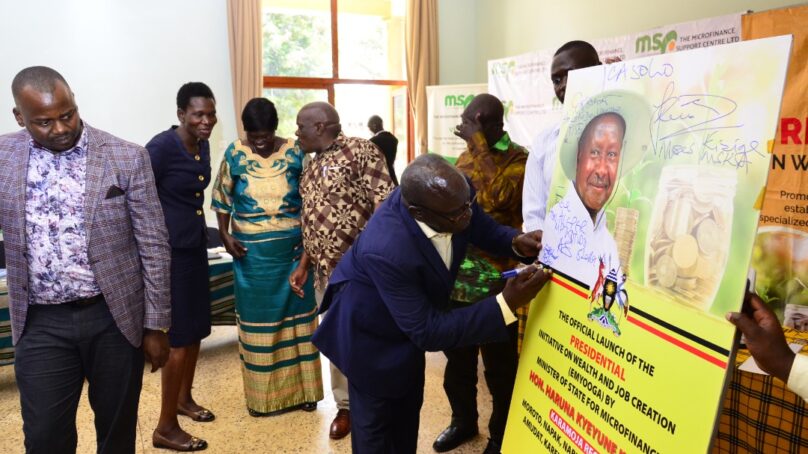
Special attention is given to government programmes such as Emyooga and Operation Wealth Creation (OWC), which, under the guise of economic empowerment, function as instruments for individualising society and eroding the extended family system.
Ultimately, this paper posits that Uganda is suffering from a “money curse,” deployed to entrench a hereditary, exogenous ruling class and dismantle the very cultural fabric necessary for a sovereign and sustainable future.
Keywords: Money curse, traditional cultures, extended family system, Emyooga, Operation Wealth Creation, bantustanisation, exogenous power, Uganda.
Antecedent reality: A nation of nations
When the British colonialists began establishing the Uganda Protectorate in 1894, they did not enter a political vacuum. They encountered a sophisticated tapestry of 15 self-governing traditional cultural nations: Acoli, Ankole, Buganda, Bugisu, Bukedi, Bunyoro, Busoga, Karamoja, Kigezi, Lango, Moyo, Sebei, Teso, Toro and West Nile (Mamdani, 1996; Karugire, 1980).
These were not mere ethnic groups but cohesive political and cultural entities with their own systems of governance, justice, land tenure, and social organisation – systems that had evolved over centuries to ensure stability, identity, and sustainability.
The colonial project, and later the independence movement, wove these nations together into a Commonwealth realm (1962) and then the Republic of Uganda (1963), a process that began their systematic dismantling (Jorgensen, 1981).
Today, these foundational nations have been “bantustanised” – fragmented into numerous, economically unviable political enclaves called districts. This process of fragmentation, or “ultra-bantustanisation,” extends down to sub-counties, villages, and constituencies.
By 2024, Uganda had grown from 33 districts at the time of the NRM’s capture of power to over 146 districts and administrative units (Uganda Bureau of Statistics, 2023). This deliberate dismantling serves a singular purpose: to serve the economic, social, political, cultural, and environmental gains of a group of men of exogenous origin.
This group, having used the gun to destabilise Uganda from 1981 to 1986 and capture the instruments of power in Kampala, now organises itself as the National Resistance Movement-Uganda Peoples Defence Forces (NRM/UPDF). Their current rhetoric of “Protecting Our Gains” (Museveni, 2018) reveals the true nature of their project. The “gains” they seek to protect are not for Uganda but for themselves: political dominion, social supremacy, economic exploitation, cultural hegemony, and the perpetual capture of land and the nation’s future.
This article will demonstrate that the primary tool for capturing and protecting these gains is money. Money in Uganda is no longer simply a medium of exchange; it has been weaponised to conquer, capture and destroy the time-tested traditional cultures that once formed the bedrock of this nation.
Conceptual framework: Culture as a holistic property and money as a pollutant
To understand the depth of this destruction, we must first appreciate what is being destroyed. A time-tested indigenous culture is not merely a collection of songs and ceremonies. It is a holistic, integrated system – an ecology and an environment (Oweyegha-Afunaduula, 2022a). It is the foundation of belonging, survival, identity, continuity and sustainability.
It embodies the ethics, morality, solidarity and values of a people. It is, in the truest sense, the most important natural property of the indigenous traditional-cultural communities of Uganda. It is a repository of generational knowledge and wisdom – a form of genealogical, biological, environmental and intellectual capital (Mbiti, 1990; Wiredu, 1996).
In my earlier article, ‘Money in Politics in Uganda as Environmental Pollution’ (Oweyegha-Afunaduula, 2022b), I argued that money functions as a pollutant across the four dimensions of Uganda’s environment: the ecological-biological dimension, the socioeconomic dimension, the sociocultural dimension, and the temporal (time) dimension.
This article extends that argument to the socio-cultural dimension. Money acts as a foreign pollutant that devalues all other measures of prosperity. Knowledge, wisdom, insights, social capital, ethical capital and ecological capital are rendered subordinate to the accumulation of currency (Nabudere, 2000; Oloka-Onyango, 2004).
This foreign pollutant is now cast as the sole genuine measure of prosperity and the only legitimate pathway to the future. Consequently, an individual without money – regardless of their wisdom, integrity, or cultural value – is despised and marginalised. Education itself is devalued, as it no longer guarantees a future in a system where political access and economic opportunity are bought, not earned.
Weaponisation of money: Mechanisms of cultural dissolution
Money is wielded with precision by the exogenous power structure to dismantle the pillars of traditional culture.
Devaluation of indigenous capital
The traditional Ugandan economy was rich in non-monetary capital. A person’s wealth was measured in their knowledge of clan history (genealogical capital), their role in resolving disputes (ethical capital), their stewardship of shared resources (ecological capital), and their network of reciprocal obligations (social capital) (Wamala, 2004; Ssemakula, 2011). The weaponisation of money has systematically devalued these forms of capital. The elder who holds the clan’s history is now ignored in favour of the youth with a motorcycle purchased through political patronage. The community leader of proven integrity is overlooked for a leadership post because they lack the money to “grease the wheels” of the political machine.
Emyooga, Operation Wealth Creation, Parish Development model and the assault on the extended family system
Two government programmes, introduced under the banner of economic empowerment, have become critical instruments in the destruction of the extended family system: Emyooga and Operation Wealth Creation (OWC). These programmes, while presented as development initiatives, function methodically to individualise society and sever the collective bonds that have sustained traditional communities for centuries.
Emyooga (a term derived from the Runyankore/Rukiga word for “enterprise”) was launched in 2019 as a presidential initiative aimed at providing revolving funds to 18 categories of “special interest groups,” including boda boda riders, market vendors, taxi drivers and persons with disabilities (Museveni, 2019). On the surface, it appears to be a poverty alleviation programme.
However, its deeper function is to disaggregate communities into interest-based, clientelistic groups that are directly dependent on the presidency for their economic survival (Green, 2021; Atukunda, 2022). The traditional clan structure, which organised society along kinship lines and ensured collective responsibility, is thereby displaced by a system of individualised, vertical patronage.
The clan elder loses authority to the Emyooga “savings group” chairperson, who is often appointed or approved by the ruling party’s local structures. The collective security of the extended family is replaced by the conditional, revocable favour of the state.
Operation Wealth Creation (OWC), launched in 2013, is an even more direct instrument of this transformation. OWC placed serving and retired military officers in charge of distributing agricultural inputs – seeds, livestock, and tools – to farmers across the country (government of Uganda, 2014). This programme effectively militarised agricultural extension services and replaced the traditional systems of communal farming, labour-sharing (obutaka in Lusoga, okuteera omukono in Runyankore, bulime in Luganda) and mutual support with a top-down, individualised model. Families that once cultivated together, shared harvests, and supported each other during times of need are now transformed into individual beneficiaries competing for military-distributed inputs (Muwanga, 2017; Kasfir, 2019).
The message is clear: your security comes not from your clan or extended family but from your relationship with the military and the presidency.
The combined effect of Emyooga and OWC is the systematic atomisation of society. The extended family system – universally evolved across the traditional-cultural nations of Uganda to provide social, economic and health security to the weak, poor, and vulnerable – is being dismantled from within. Its functions are being transferred to the clientelistic state, rendering the individual vulnerable, dependent and isolated (Mamdani, 2018; Ocan, 2021). When a person’s livelihood depends on a presidential initiative rather than on their kin, the power of the clan dissolves, and with it, the cultural foundation of the community.
Exclusion and marginalisation
Money is being used as an explicit tool of exclusion. The poor, weak, and vulnerable are systematically excluded from meaningful participation in the leadership and governance of their own communities. Their communities have effectively been taken over by “exogenes” – individuals with no historical, ecological, biological, or ethical attachment to the area (Oweyegha-Afunaduula, 2022c). These exogenes, armed with money or supported by public funds controlled by the central power structure, stand for local leadership posts. They are not accountable to the cultural community but to the power centre in Kampala. They function not as leaders but as contaminants, polluting the traditional body politic and serving as agents of the exogenous state.
Manipulation of governance structures
The NRM/UPDF power structure uses money to manipulate the consciences and mind-sets of legislators. By controlling public finances and wielding illicit funds, they ensure that laws are passed not for the public good but to help power destroy an open society (Oloka-Onyango, 2020; Human Rights Watch, 2022). The goal is to build a closed society – one where information is controlled, dissent is punished, and the instruments of the state serve only the ruling coterie. This legislative manipulation is a direct assault on the autonomy and self-determination that once defined the traditional cultural nations.
Geopolitics of money: Recolonisation and demographic warfare
Beyond the social mechanisms, the weaponisation of money has a clear geopolitical dimension aimed at permanently altering the demographic and territorial reality of Uganda.
Territorial alienation
Money, combined with state power, is being used to sever the “ecological belonging” of indigenous communities. Parts of lakes and vast tracts of traditional land are being grabbed by those in power and their associates (Nuwagaba, 2019; Green, 2021). This is done under the guise of “development,” but its effect is the destruction of the sacred and economic linkages between a people and their land. When a community loses its land, it loses its history, its identity, and its means of survival. The Uganda Land Commission, heavily politicised, has facilitated the allocation of public land to individuals with connections to power, often displacing indigenous communities who have occupied that land for generations (ActionAid Uganda, 2020).
Demographic manipulation
A more sinister and long-term strategy involves the manipulation of population dynamics. Public money is being used to finance the official settlement of refugees and nomadic pastoralists within the territories of settled indigenous communities. This includes refugees from Rwanda, Mulenge in Eastern DRC, Somalia, Eritrea and Ethiopia – regions that are also the distant origin of many East African pastoralists (UNHCR, 2023).
While humanitarian aid is a noble principle, its selective and concentrated application in this context functions as a tool of demographic engineering, altering the political and cultural landscape of indigenous territories without their consent. The concentration of refugee settlements in specific regions, such as the Rwenzori area and northern Uganda, has been accompanied by the displacement of indigenous communities and the transformation of local political dynamics (Bakewell, 2020; Mwenda, 2022).
Export of youth
The same exogenous interests that control money are involved in a more brutal form of cultural destruction. Moneyed firms engaged in commercialising and trading in humans are exporting young Ugandans, especially girls, into modern external slavery (US Department of State, 2023; Uganda Human Rights Commission, 2022). This act does not just represent a human rights tragedy; it is a direct assault on the biological reproductive capacities of indigenous communities.
While young indigenous people are exported to the Middle East and elsewhere under the guise of labour export, young exogenes remain in the country, reproducing themselves. This is a calculated, long-term strategy to weaponise population dynamics against the traditional cultural nations.
Emerging apartheid system
These mechanisms collectively point to the establishment of a formidable apartheid system—or an apartheid-like system—in 21st-century Uganda (Oweyegha-Afunaduula, 2023). This is not a system based on skin colour but on a more insidious form of exclusion: a political and economic hierarchy where a group of exogenes and their descendants are constituted as a permanent ruling class, while the indigenous natives are reduced to subjects in their own land, stripped of their cultural sovereignty and economic self-determination.
Conclusion: Curse of money and the future of Uganda’s cultures
Just as Nigeria has suffered from an oil curse since the late 1950s – a curse that culminated in the destruction of the Ogoni people’s culture and environment (Saro-Wiwa, 1995; Okonta and Douglas, 2001) – Uganda is now in the grip of a money curse. This curse is not an accident of nature but a deliberate construct of power. It is the primary instrument for conquering, capturing and destroying the time-tested cultures of our diverse nations.
The ultimate goal is singular: to ensure that the men who captured the instruments of power in 1986, along with their children and their children’s children, can perennially control, dominate and rule the indigenous natives (Oweyegha-Afunaduula, 2022c). This is achieved through a system of hereditary politics, buttressed by laws and a culture of monetary servitude that benefits only the exogenous rulers and harms the natives and their cultures.
The dismantling of the 15 traditional cultural nations into bantustanised districts was the first step in this project. The weaponisation of money through programmes like Emyooga and Operation Wealth Creation represents the final, most devastating phase. These programmes, designed to individualise society and destroy the extended family system, are not development initiatives but instruments of cultural genocide. The devaluation of our knowledge, the destruction of our clans, the alienation from our land, and the manipulation of our demography are all signs of a deeper malaise.
The question that remains for the indigenous peoples of Uganda is whether we can reclaim our cultural capital, our ecological belonging and our collective identity before the money curse renders them extinct. The future of Uganda – as a sovereign, stable, and culturally rich nation – depends on our ability to answer this question with courage and conviction. The traditional cultural nations that the British found in 1894 are not merely historical artefacts; they are living repositories of wisdom, solidarity, and sustainability. Their survival is Uganda’s survival.
- A Tell Media report / By Oweyegha-Afunaduula. The writer is a retired Ugandan scholar and elder who has witnessed and analysed Uganda’s political evolution from colonialism through independence to the present day.


About author