

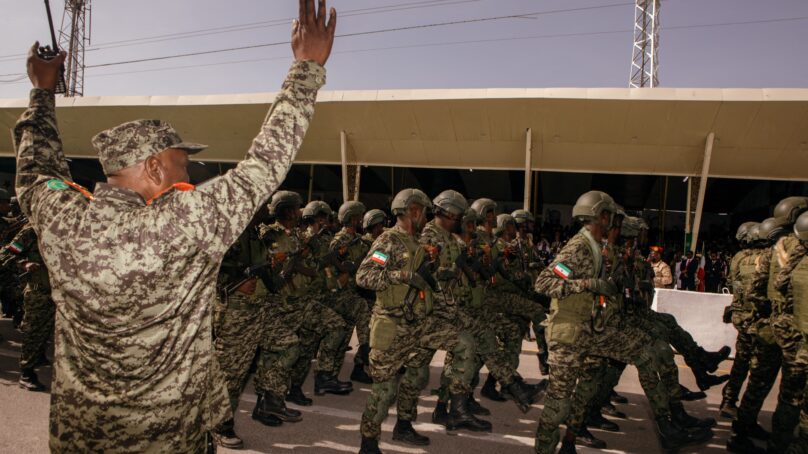
The city of Hargeisa, the capital of a breakaway territory known as Somaliland, was recently witness to a sight rarely seen in a Muslim-majority country: the public waving of Israeli flags – not in protest, but celebration. Videos shared on social media from Somaliland’s day of independence on May 18 showed Israelis dancing in the streets of Hargeisa alongside locals, with blue and white stars of David flying beside Somaliland’s red, white and green tricolour flag.
The decision to recognise Somaliland’s independence in December made Israel the first UN member state to establish full diplomatic ties with the territory after more than three decades of Hargeisa’s lobbying.
“This is the first time we’re commemorating May 18 as the recognised Republic of Somaliland,” said President Abdirahman Mohamed Abdullahi, known locally as Irro, at an anniversary speech.
The most symbolically charged moment of the celebrations was the presentation to Irro of a fragment of an Iron Dome interceptor – the Israeli air defence system used to intercept rockets and drones fired by Iran and its regional allies – by a visiting Israeli delegation.
The embrace between Israel and Somaliland has deepened since the formal recognition at the end of last year. Israel has now established an intelligence presence in Somaliland, several officials including one from the Somaliland government and a senior Somali official told Drop Site, and news reports suggest that an Israeli military base is under discussion.
The base in question would allow Israel a military foothold on a crucial waterway near the Bab al-Mandab Strait – a maritime chokepoint comparable in importance to the Strait of Hormuz for exports from the Red Sea.
Yemen’s Ansarallah already closed the Red Sea to Israeli ships, and has threatened to close the strait entirely in the context of the US-Iran negotiations and Israel’s war in Lebanon.
Some analysts point to Berbera International Airport as a possible host to an expanded Israeli presence in the territory as part of an emerging alliance that would include Somaliland alongside Tel Aviv and Abu Dhabi. The United Arab Emirates has had an agreement since 2017 for a military base at Berbera International Airport that was linked to Emirati operations in the Yemeni civil war.
Earlier this year, Djibouti’s president, Ismail Omar Guelleh, whose country neighbors Somaliland to the west, described the UAE as “Israel’s vanguard” and said its intentions were “anything but peaceful.”
In an interview with a Somali media outlet on June 12, Somalia’s president, Hassan Sheikh Mohamud, also said that Israel had approached his government several times about establishing relations but that Somalia had rejected those overtures. Referring to Somaliland’s ties with Israel, Mohamud warned that “a big problem will come from this,” adding that “some signs are already visible.”
Somaliland has a coastline of more than 800 kilometres along the Gulf of Aden and directly across the sea from Yemen, where the Ansarallah movement has emerged as one of Israel’s most persistent and hard-to-reach adversaries. Since October 2023, the group has fired sustained volleys of missiles and drones at Israel, and previously targeted Israeli-linked ships, in a de facto naval blockade in solidarity with Gaza.
The operations forced the closure of Israel’s Red Sea Port of Eilat and exposed critical vulnerabilities in the country’s air defences. Israeli strikes from more than 2,000 kilometres away, including operations that killed several Ansarallah leaders, did little to degrade the group’s capacity and will to strike.
A Somaliland official close to the president told Drop Site that in talks between the two sides prior to the establishment of diplomatic ties, Israel raised its security challenges in the region as a factor. “It was a key issue for them,” another Somaliland official told Drop Site. Both spoke on condition of anonymity to candidly discuss the issue.
The talks began last April at a meeting held in Ethiopia’s capital Addis Ababa. Somaliland was prepared to engage Israel’s concerns, one of the officials said, but only if it could receive what it wanted first: recognition.
“Hargeisa’s political class was searching for any partner that could shift the diplomatic arithmetic,” Jethro Norman, an expert on the region at the Danish Institute for International Studies says. “For Somaliland it is the gamble of trading legitimacy in the Muslim world for a recognition that no other UN member state has yet done.”
After several rounds of negotiations, Israel agreed to meet that demand, and, when it did, it acquired significant leverage and goodwill in Hargeisa. In April, President Irro praised Israel at a state-of-the-nation address to parliament saying that it had proven itself a “reliable partner,” drawing almost the entire chamber of lawmakers to their feet in applause.
He has repeatedly praised Israel’s decision.
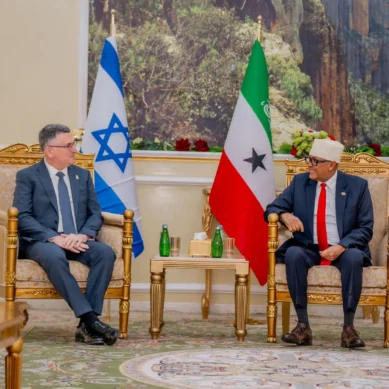
In January, Israeli Foreign Minister Gideon Sa’ar was dispatched to Somaliland, where he also visited Berbera, the country’s largest coastal city of 70,000 people, and said Israel was seeking defence cooperation and a “strategic partnership,” without elaborating on what that would mean. Berbera has historically hosted the Ottomans, the Soviet Union, and the US, owing to its large natural harbour and strategic position at the gateway to the Red Sea.
Hussam Radman, a research fellow at the Yemen-based Sana’a Centre for Strategic Studies, told Drop Site that Israel’s confrontation with Ansarallah, also known as the Houthis, had provided a pretext to establish a military presence in the breakaway territory.
“Operationally, the presence of a military-intelligence base in Somaliland would enable Israel to project power against the Houthis with greater ease and with broader access to information,” he said. “It is also to extend Israeli geopolitical influence in a sustainable manner south of the Red Sea, and to gain leverage over one of the world’s most important straits: Bab al-Mandab.” Radman noted that Israel would exploit the international neglect of Somaliland’s desire for recognition to secure strong political cover.
“I will not be silenced and no amount of intimidation will change my course,” he wrote on X. Dafac has more broadly supported the relationship, but said a Jerusalem embassy would weaken Somaliland’s case for wider recognition of its statehood.
Earlier this year, two clerics were arrested for criticising the relationship with Israel, along with several others.
The tension between Somaliland’s aspirations and the costs of pursuing them was perhaps most starkly framed by Sheikh Mustafa Haji, one of Somaliland’s most prominent Islamic preachers earlier this year.
While acknowledging the country’s right to seek recognition, he drew a direct line between Somaliland’s own history – when the now-autonomous territory suffered tremendous violence at the hands of the central government during a civil war in the 1980s – and what it now risks enabling.
“Escaping the injustice you are facing,” he said, “should never lead you to support the greatest oppressor, who is killing Muslim people to this day.”
- A Tell Media report / Source: The Drop Site

About author