



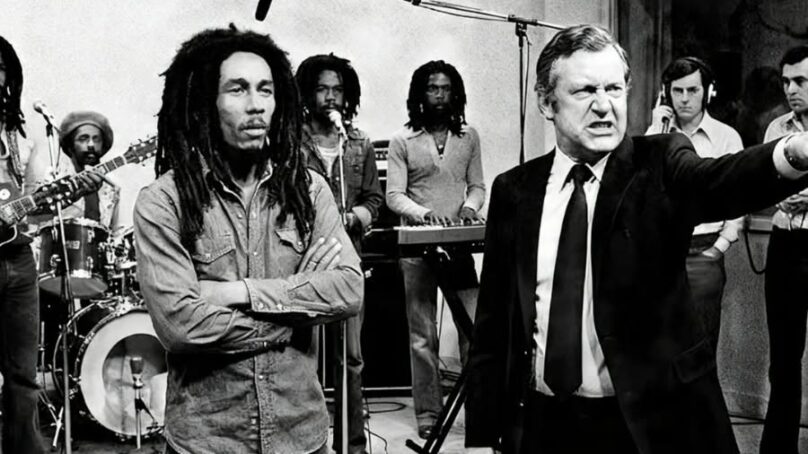
In 1975, Bob Marley walked into the BBC studios in London for his first major British television appearance. The white producer took one look at him and his band and said:
“We can’t have all these Black men on camera. It’ll scare the audience. Pick two to stay. The rest can wait backstage.”
What Bob did next didn’t just save that television appearance. It changed British television’s hiring policies forever.
The producer’s name was Gerald Witmore. He was 52 years old and had been with the BBC for 27 years, and had very specific ideas about what British audiences wanted to see. And seven black men with dreadlocks, wasn’t it?
Gerald had fought against booking Bob Marley from the beginning. Reggae is too ethnic, he told his superiors. Too foreign. Our viewers won’t relate. But Bob’s single, No Woman, No Cry, was climbing the UK charts, and the network wanted the publicity. So Gerald agreed to the booking, but with conditions.
Conditions he was about to make very clear. Bob and his band, the Whalers, plus additional musicians, had arrived two hours early for sound-check. They were professional, prepared and excited. This was their chance to reach millions of British viewers. But when Gerald walked into the studio and saw all seven black men setting up their instruments, his face went red.
“Stop! Everyone stop!” Gerald shouted. The band stopped playing. Bob looked up from tuning his guitar.
Is there a problem?” Bob asked calmly.
“Yes, there’s a problem,” Gerald said, walking toward the stage. “I was told it would be you and maybe two others. Not this many.”
“This is my band,” Bob said. “We perform together.”
Gerald shook his head. “Not on my show. You can pick two members to stay on camera with you. The rest can play from backstage where the cameras won’t see them.”
The studio went silent. Bob’s band members looked at each other, then at Bob.
Carlton Barrett the drummer spoke up, “You want us to hide like we’re something shameful?”
“I want to give the audience what they can handle?” Gerald said coldly. “And seven black men is too much. It’ll frighten people.”
Bob set down his guitar slowly and walked to the edge of the stage. He looked Gerald directly in the eyes.
“Mr Whitmore, is that your name?”
“It is,” Gerald said.
“Mr Whitmore. I want to understand something. Are you saying my brothers are too black for British television?”
Gerald shifted uncomfortably. The way Bob phrased it made his racism impossible to disguise. “I’m saying there’s a comfort level we need to maintain with our audience. By hiding Black people,” Bob asked.
“By presenting artists in the most appealing way possible,” Gerald countered.
“And you think Black people are not appealing? Bob pressed.”
Gerald’s face flushed. “I’m not having this debate. Either you pick two band members to stay or we cancel the entire segment.”
Bob nodded slowly. “Okay, let uh me ask you a different question. Who’s the most popular band in Britain right now?”
Gerald looked confused by the change of subject. “I suppose the Rolling Stones or maybe the Rolling Stones have five members, correct?”
Bob interrupted. “Yes, but Led Zeppelin has four. The Who has four. Pink Floyd has four or five depending on the tour.”
“Yes.” Gerald saw where this was going. “That’s different. Why? Bob asked simply. Because they’re…”
Gerald stopped himself, realising he was about to say exactly what he was thinking.
“Because they’re what? Mr Whitmore?” Bob asked gently. “Because they’re white.”
The crew members in the studio were frozen watching this unfold. Nobody confronted Gerald like this. He had the power to end careers with one phone call. But Bob wasn’t backing down.
“This is about practical television,” Gerald said, his voice rising. “About camera angles and stage presence and what works visually.”
“So, seven white musicians work visually, but seven black them. Musicians don’t?” Bob asked.
Gerald was trapped. Every answer exposed his prejudice more clearly.
“I don’t have time for this,” Gerald snapped. “Make your choice or leave.”
Bob turned to his band. They looked at him waiting. Some looked angry. Some looked hurt. All of them looked to Bob to decide their next move.
“Okay,” Bob said, turning back to Gerald. “I’ll make my choice.”
Gerald relaxed slightly, thinking he’d won. “Good. Who are the two staying?”
“All of us,” Bob said. “Or none of us.”
Gerald’s jaw dropped. “Excuse me.”
“You heard me,” Bob said calmly. “Either my whole band performs or we all leave right now.”
“No compromise. You’ll lose this opportunity,” Gerald threatened. “You’ll never appear on British television again. I’ll make sure of it.”
“Then that’s what happens,” Bob said. “But I won’t ask my brothers to hide their faces so White audiences feel comfortable. I won’t tell them they’re only acceptable in small doses.”
“I won’t participate in our own eraser.” Carlton stood up from his drum kit. “Bob, if you need to do this without us.”
“No, Bob said firmly,” not taking his eyes off Gerald. “We’re a band. We rise together or we don’t rise at all. The other band members stood in solidarity.”
Gerald looked at them, his face purple with rage. “You’re making a huge mistake.”
“Maybe,” Bob said, “but it’s our mistake to make.”
Gerald stormed off to his office. The band started packing their equipment. Bob’s manager, Don Taylor, pulled Bob aside.
“Bob, this could destroy our UK breakthrough. This performance was supposed to reach 15 million people.”
“I know,” Bob said. “But what’s the point of reaching 15 million people if we have to deny who we are to do it?”
Twenty minutes later, as the band was loading equipment back into their van, a young BBC assistant producer named Sarah Mitchell ran out.
“Wait, please wait.” The band stopped. Sarah was breathless. “Mr Marley, can I speak with you?”
“Of course,” Bob said.
Sarah looked around nervously, then lowered her voice.
“What Mr Whitmore did in there was wrong. Completely wrong. And I want you to know that not everyone at the BBC thinks that way.”
“Thank you,” Bob said. “But that doesn’t change the situation.”
“No, but this might,” Sarah said. “Gerald Whitmore doesn’t have final say. He thinks he does, but he doesn’t. The executive producer, James Thornton, does. And James is actually a fan of your music. He’s the one who pushed to book you.
Bob’s interest peaked. “Where is this James?”
“In a meeting right now, but if you can wait 30 minutes, I can get him.”
Bob looked at his band. They were tired, frustrated, angry.
“What do you think?” Bob asked them. “Should we wait for 30 minutes?”
Carlton said. “Yeah, we can wait.”
Bob nodded to Sarah. “We’ll wait.”
Sarah ran back inside. The band sat on the curb outside the BBC building, instruments scattered around them. Pedestrians walked by, staring at these dreadlocked men sitting on the sidewalk. Some recognised Bob and stopped to talk.
Others just stared with suspicion or fear.
“This is what he meant,” Bob said quietly.
“What who meant?” asked Aston Barrett.
“The bass player, Gerald, when he said seven black men would frighten people. Look at how they’re looking at us right now.”
The band looked around. Bob was right. White Londoners were crossing the street to avoid walking past them. Parents were pulling their children closer.
“We’re not doing anything wrong,” Aston said. “We’re just sitting here.”
“That’s the point,” Bob said. “We don’t have to do anything wrong. Our existence is treated as a threat.”
Twenty-five minutes later, Sarah returned with a man in an expensive suit. “Mr Marley, this is James Thornton, our executive producer.”
James extended his hand. Bob shook it.
“I understand there was an incident with Gerald Whitmore.”
“There was,” Bob confirmed.
“And I apologise for his behaviour,” James said. “But I want to be clear. Gerald was speaking for himself, not for the BBC.”
“He seemed pretty confident he was speaking for the BBC,” Bob said. James sighed.
“Gerald has been with us a long time. He has certain outdated views, but his views don’t dictate our programming decisions.”
“So, what are you saying?” Bob asked.
“I’m saying I want you and your entire band to perform on camera exactly as you planned.”
Bob studied James’ face, looking for deception. “Why the change?”
“Because Gerald was wrong,” James said simply. “And more importantly, he was operating on fear. Fear of audience reaction, fear of change, fear of difference. I won’t let fear dictate what art we show.”
“What about Gerald?” Bob asked.
“What about him?”
“He threatened to destroy our British career.”
James smiled grimly.
“Gerald doesn’t have that power anymore. As of about 10 minutes ago, he’s been removed from this production.”
The band members looked at each other shocked.
“You fired him?” Carlton asked.
“Suspended?” James corrected, “Pending a review of how many other artists he’s discriminated against. But yes, he won’t be working on this show.”
Bob was quiet for a moment. “Mr Thornton, I appreciate what you’re doing, but I need to know something. Are you doing this because it’s right or because you’re afraid of the publicity if we walk away? It was a fair question.”
James thought carefully before answering. “Honestly, both. Yes, I’m concerned about the optics of a famous black artist walking out citing racism, but more than that, I’m ashamed. I’m ashamed that someone on my team thought it was acceptable to ask you to hide your band members. I’m ashamed that our institution enabled that thinking, and I’m determined to do better.”
Bob looked at his band again. They nodded.
“Okay,” Bob said. “We’ll perform, but I have conditions now. Name them,” James said.
“I want a written guarantee that no artist will ever be asked to reduce their band or hide members based on race.”
James hesitated. “That’s a significant policy change.”
“It’s the right policy,” Bob said. “If you truly want to do better, prove it. Put it in writing.”
James thought for a long moment, then nodded.
“I’ll have legal draft something. It’ll take a few hours.”
“We can wait,” Bob said. And they did. The band waited in the BBC cafeteria while lawyers drafted a new anti-discrimination policy for artist bookings. Word spread through the building about what was happening. Other BBC employees, many of them people of colour who’d experienced similar treatment, came to thank Bob quietly.
A black cameraman named Winston shook Bob’s hand. “You just did something we’ve been trying to do for years. Thank you.”
An Indian sound engineer named Priya brought them tea. “Gerald Whitmore told me I should work behind the scenes where I belong. You standing up to him means more than you know.”
Bob listened to their stories, grew more and more angry at what he heard.
By the time the legal documents were ready, Bob had heard about dozens of incidents of discrimination within the BBC. James returned with the documents. Bob read them carefully, had his manager review them, then signed.
“This goes into effect immediately?” Bob asked.
“It does, James confirmed. And I want you to know we’re also launching an internal review of our employment practices. Your stand today is going to create change beyond just this one show.”
The performance happened that evening. All seven band members on camera playing No Woman No Cry with a passion and intensity that came from the day’s events.
When Bob sang Everything’s Going to Be All Right, it felt like a promise, a declaration.
British audiences watching at home saw something many had never seen. Black musicians, dreadlocks, and all, creating beautiful art without apology or compromise. The switchboard lit up, but not with complaints. With calls from people wanting to know more about this band, this music, this message.
No Woman, No Cry shot up the charts. The album went gold. Bob Marley became a household name in Britain. But more importantly, that policy Bob demanded, it became a model. Other networks adopted similar policies. Artists unions used it as a template. Five years later, in 1980, Bob returned to the BBC for another appearance.
James Thornton greeted him personally.
“Welcome back, Mr Marley.”
Bob smiled. “How’s that policy working out?”
“Beautifully,” James said. “We’ve booked more diverse artists in the last five years than in the previous 20. And you know what? Audiences love it. Turns out Gerald was wrong about what people could handle.”
“People can handle the truth.” Bob said, “It’s the lies they struggle with.”
- A Tell Media report / Source: Life Story


About author