
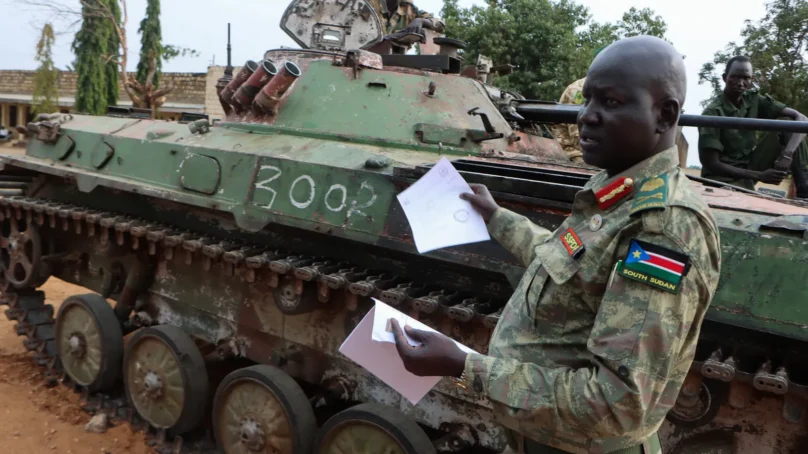
Some of the stolen food by South Sudan military and government officials was then taken to Malakal for sale; the county commissioner has not been arrested or removed for his role in the raid. He could not reached for comment.
In one incident, government soldiers looted hundreds of boxes of medical supplies from a humanitarian-run facility near Ayod town in January, shortly after recapturing a nearby military barracks, according to an NGO incident report and multiple interviews. The facility was stripped bare.
Health facilities have been singled out during recent fighting. Since the beginning of the year, 28 facilities have been looted or damaged in Jonglei alone, according to the UN.
In one incident, government soldiers looted hundreds of boxes of medical supplies from a humanitarian-run facility near Ayod town in January, shortly after recapturing a nearby military barracks, according to an NGO incident report and multiple interviews. The facility was stripped bare. Solar panels, doors, and the cool boxes used to store vaccines were all taken by the soldiers.
Opposition fighters have also looted, according to more than half a dozen sources. Last September, fighters loyal to Tut, who supports the SPLM/A-IO, seized WFP and UNICEF aid in Ayod. Opposition-allied fighters also stripped humanitarian-operated health facilities as they retreated during the counteroffensive last month, intent on leaving nothing behind for government forces.
As well as food and medicine, other humanitarian assets like Land Cruisers and Starlink internet terminals have become valuable resources for waging war.
At least 14 humanitarian Land Cruisers were seized by fighters from both sides during recent fighting in Jonglei, one senior aid worker reported. Some were then used to transport heavy weaponry.
One NGO director in Jonglei laughed when asked whether his organisation’s assets had been used by any of the belligerent parties. “Even the internet that the opposition is using to speak with you now – that’s our internet!” they said.
The institutional benefits of humanitarian agencies extend beyond outright theft. As people enter areas seeking assistance and populations grow, traders begin to import food and other goods to meet growing demand. Commercial airlines open new routes. Civilians become exploitable labour, so soldiers no longer need to spend hours each day cutting their own firewood or doing other mundane chores.
Thanks to South Sudan’s protracted economic collapse, humanitarian organisations have also become major taxpayers in Juba, and at the state and county level, where they are often the principal source of funds.
Two aid workers in Jonglei said their staff pay 10 per cent of their monthly salary to local authorities in the areas they control, all off the books. Another recalled how families in Ayod complained that government officials had collected 10 kilogrammes of sorghum from each family’s 50-kilogramme sack after a recent food distribution.
“When the food is given by WFP, they tax, they tax, they tax – every family,” he said. “They get a lot of food for themselves that way, both sides.”
The SPLM/A-IO, cash-strapped and bereft of financial support, is also aware that NGOs represent valuable sources of cash, and has developed parallel administrations in the areas under its control. Still, it is the government that benefits the most from the infrastructural advantages and tax base that the humanitarians provide. It goes to great lengths to control aid agencies’ areas of operation.
It does this by restricting where flights can land, arresting aid workers who work in opposition-held areas and threatening to take away humanitarian organisations’ operating licenses, which are provided by officials in Juba.
Eight aid workers who spoke to The New Humanitarian said their organisations had faced significant pressure from authorities to relocate their operations from opposition areas, where most of the war-affected civilian population now resides, to government areas. They, like others who were interviewed for this story, spoke on the condition of anonymity out of fear that their organisations would face retaliation.
Last June, Justin Nhial Batoang, the government-appointed commissioner of Ulang County, another opposition stronghold in Upper Nile, gave humanitarian organisations 72 hours to relocate their operations to the government-controlled county headquarters or have their licences revoked and be labelled “the enemy of peace”.
“The authorities of Ulang will not be responsible if anything happens to an organisation” that continues “operating under the territory of the SPLM-IO or any other political party,” he warned in a statement.
Opposition officials have issued similar ultimatums, although with far less authority to back them up. “Ultimately, the green light for access comes from Juba,” one aid worker said.
Some recent attempts to push back on aid manipulation and diversion have been controversial. On January 8, the US government announced that it was suspending all foreign assistance to Ayod County, barring humanitarians from spending American money there. Yet far from admonishing Kiir’s regime as the Americans intended, the diplomats may have ended up supporting its counterinsurgency.
The suspension occurred after a series of incidents in Ayod town, the county headquarters, involving aid workers being detained and humanitarian assets being seized by the government-appointed commissioner, James Chuol Jiek.
During one incident, construction equipment hired by the UN for the rehabilitation of roads was used by the commissioner to dig trenches for the army. Contacted for comment, Jiek’s office denied that these incidents had occurred, while saying an apology letter had been issued.
The suspension of aid was supposed to demonstrate “US resolve to forcefully respond when South Sudanese officials take advantage of the United States instead of working in partnership with us to help the South Sudanese people,” the US embassy said in a statement.
While this means government-held Ayod town is denied US-funded humanitarian aid, it has both a functioning market and an airstrip. The rural opposition-held areas of Ayod, in contrast, are facing flooded fields and government attacks, and have little means to import desperately needed food supplies, said humanitarians who had recently visited the area.
Aid agencies with US funding were forced to look for other donors, in a landscape of extremely restricted humanitarian financing, in order to comply with the American directive.
Among aid workers, the American decision has been divisive. Critics say the move punishes a civilian population that is itself harassed by the government and not a beneficiary of its actions. Others acknowledge that a firm stance towards the regime was overdue, even as they fear the decision’s adverse effects.
“In principle, [the US directive] is the implementation of an actual red line, which has been needed in South Sudan, albeit in an uncoordinated way with a complete disregard for outcomes,” said Chris Newton, an analyst with the International Crisis Group.
Aid workers in South Sudan have also criticised a recent allocation of roughly $100 million by the US into the South Sudan Humanitarian Fund (SSHF), a country-based pooled fund controlled by the United Nations Office for the Coordination of Humanitarian Affairs (OCHA).
OCHA had a relatively short six-month window in which to spend the funds and an overwhelming number of “priority 1” counties or areas with the highest severity of humanitarian needs. It decided to omit many parts of the country held by the opposition and impacted by recent fighting, including Nasir and much of northern Jonglei.
The head of OCHA in South Sudan David Carden confirmed that his agency did not allocate the US funds to opposition-held counties most affected by the violence but said $11.4 million was set aside for Akobo, Nyirol, Uror and Nasir over the past four months through other sources.
Nonetheless, many humanitarians fear donor requirements to spend funds quickly risk trumping real humanitarian needs and rewarding government-held territories at the expense of difficult-to-access, opposition-held areas.
For communities facing the brunt of state violence, such decisions are unlikely to ease the perception that aid is aligned with those in power.
“Why,” the Nuer prophet Tut asked The New Humanitarian in July 2025, “are the humanitarians always supporting the government?”
- A Tell Media report / By Philip Kleinfeld / Source: The New Humanitarian


About author