


One-hundred-and-fifty lashes for dancing without a written permit. That was the price on Horace Overstreet’s plantation in Harrison County, Texas.
But he remembered something else too. A man who knew the trees could outrun a patroller on horseback. The shirt was made from the same cloth as the cotton sack.
That is the detail Horace Overstreet remembered eighty years later, sitting on a porch in Beaumont, Texas, in 1937, telling a government worker about what it felt like to be property.
Not the whippings, not the overseer, not the war. The shirt.
The fabric was called “lowers,” his word for Lowell cloth, a coarse, rough cotton textile originally manufactured in Lowell, Massachusetts, and sold by the bolt to slaveholders across the South. Its primary purpose was not clothing at all, but industrial, made for cotton picking sacks that would be dragged through the fields from sunup to dark.
The same material that held the harvest held the harvester. Horace wore it against his skin every day of his childhood in Harrison County, Texas, the wealthiest slaveholding county in the entire state.
Harrison County sat at the heart of East Texas cotton country, and by the 1850 census it ranked first among all Texas counties in total population. More than six thousand of its nearly twelve thousand residents were enslaved, making up over fifty-two per cent of the people who lived there. By 1860, those numbers had swelled to nearly nine thousand enslaved people, roughly sixty per cent of the population. No other county in Texas held more.
Horace was born in 1856, near Marshall, the county seat. His mother’s name was Jennie, his father’s name was Josh. The man who owned them both was called M.J. Hall. He was a lawyer by trade, which meant he could draft the documents that made human ownership look orderly and ordinary.
He bought more people every year, expanding a plantation that Horace remembered as at least two hundred acres. By his estimate, around five hundred enslaved people worked it.
That number may have been high, or it may have reflected how large that world seemed to a child. What is certain is that Harrison County’s plantations were massive by Texas standards and its enslaved population was dense enough that by the 1850s, white mechanics in Marshall had organised to protest that skilled enslaved labourers were taking their work.
Hall kept a white overseer and a Black driver beneath him. The driver was an enslaved man given authority to push other enslaved people harder, a position that sat at one of the cruellest intersections slavery could produce.
When someone was caught in what the plantation called disobedience, they were tied down and whipped. Horace said it plainly, without elaboration, because plainly was how it happened.
He was spared the field, though. He was raised around the big house, kept close, what the plantation called a “favourite,” which was a word for a child whose proximity to the family was a kind of currency, not protection.
Inside the slave quarters, the furniture was almost nothing. Bedsteads were nailed to the walls, and seating was rough benches and stools built by hand from whatever wood could be scavenged.
The rations were salt pork, cornmeal, and sorghum molasses. Grown people received shoes, but the children went barefoot, their soles thickening against Texas clay and sawgrass until the skin cracked and hardened like leather.
And the clothing was that shirt, cut from Lowell cloth. The same bolt that made the sacks for picking cotton.
The Lowell Manufacturing Company in Massachusetts was one of the firms that produced this fabric specifically for the enslaved market, selling it back to the very planters who shipped their raw cotton north to be milled. The cloth went south, got stitched into sacks, got dragged through fields by the people wearing that same cloth on their bodies.
The entire economy was a closed loop, and the enslaved person stood at every point of it. Producing the cotton, wearing the cotton, filling the cotton sack, all in cloth designed to be as cheap as the system thought their lives were.
Former enslaved people across the South remembered Lowell cloth the way you remember a bruise. They described it as feeling like needles against the skin, coarse enough to scratch and stiff enough to chafe in the heat.
But twice a year, something broke through. On Christmas and the Fourth of July, the enslaved people on Hall’s plantation were allowed to dance.
It was called a breakdown, and it was theirs. Some danced Swing the Corner, a partner dance with roots that stretched back across the Atlantic, while others moved to the centre of the floor and cut the chicken wing, a solo display of footwork that showed what the body could do when the body belonged to itself.
They had banjo pickers. The sound would have carried across the quarters, past the cabins, into the trees.
Horace said his people seemed happy when the dancing started. That word, “seemed,” carries a weight he may not have intended and probably did, because he was a child watching adults find a few hours of joy in a system designed to take everything.
But the joy had a border. Without written permission from the slaveholder, any gathering of enslaved people was illegal, and the patter-rollers, slave patrols made up of armed white men on horseback, would descend on an unlicensed dance like dogs on a scent.
The punishment was one hundred-and-fifty lashes. A number that could strip flesh from bone, which could kill.
Horace remembered the scattering, the way the people would fly apart when the patter-rollers came. He told it almost like a boast, that a man with a head-start could outrun a patroller on horseback because terror made you fast.
It is one of the oldest memories in the Black experience, the knowledge that your body could save you if your legs were fast enough and the trees were thick enough. The same body the system claimed to own was the body that outran the system’s enforcers.
Then the war came. Horace saw soldiers, plenty of them, their uniforms so filthy he could barely tell what they were; the colour visible only in spots where the mud and sweat and powder hadn’t soaked through.
They were Union soldiers. Some of them stopped in Marshall and took control of the courthouse, which had served as a Confederate administrative centre throughout the war.
Marshall had been a major seat of Confederate power in the Trans-Mississippi West, housing the Confederate Post Office Department and serving as the government-in-exile for Missouri’s secessionist legislature. When the Union soldiers arrived on June 17, 1865, it was two days before the force that reached Galveston and produced the moment now remembered as Juneteenth.
Harrison County, with its thousands of enslaved people, was one of the last places in America where slavery still functioned as a daily reality. And then it didn’t.
What happened next is what always happened next. The formerly enslaved people of Harrison County had to decide whether to stay or leave, with nothing but the clothes on their backs, clothes made from the same fabric as a cotton sack.
Horace Overstreet left. He made his way to Beaumont, about 150 miles to the south, a lumber town on the Neches River where Black workers would eventually make up fifty-five per cent of the sawmill labour force.
He settled there and stayed for the rest of his life. When the WPA interviewer found him in 1937, he was eighty-one years old, one of more than two thousand formerly enslaved Americans whose voices were recorded by the Federal Writers’ Project before they were gone forever.
The interviewers were almost all white Southerners. The transcriptions they produced were filtered through their own ears and their own assumptions, rendered in an exaggerated dialect that historians have spent decades debating.
The words that survive are not exactly Horace’s words. They are Horace’s words as heard by someone who may not have been fully listening. But some things came through anyway. The shirt made from cotton sacking, the bedstead nailed to the wall, the breakdown dance and the banjo picker, the patter-rollers and the one hundred and fifty lashes.
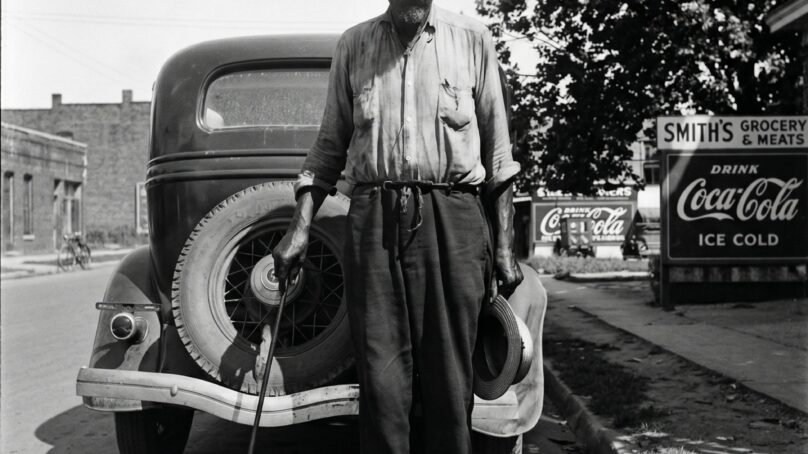
The Library of Congress holds a photograph of him, taken that same year in Beaumont. A gelatin silver print, three and a quarter inches by five inches, a small rectangle of an old man’s face looking directly into the camera.
He is wearing a shirt, his own shirt, bought or sewn by someone who chose it. Not Lowell cloth, not cotton sacking.
Eighty years earlier, the shirt on his back had been the same material as the sack he would have filled if they had sent him to the field. A child wrapped in the raw material of his own exploitation.
He outlived the system, the war, and the man who owned him. He outlived the plantation and the patter-rollers who rode the roads at night. And in 1937, an old man in Beaumont sat on his porch and told a stranger everything he could remember. Not because anyone made him, but because he chose to.
The shirt was his. The story was his, and both of them, finally, belonged to no one else.
- A Tell Media report /source: Horace Overstreet, WPA Slave Narrative Collection, Federal Writers’ Project, 1937, Library of Congress


About author