

Choices have consequences. In just less than week, Ugandans will be making a choice – to slip further down the drain or re-anchor the country to the often fogey promise of democracy.
This article is my last before I celebrate my 77th year. I count myself lucky. The tempestuous period since independence in 1962 claimed millions people because of bad politics. I am a first-hand witness of what life was like during the reign of President of Milton Obote (what is known in Uganda as Obote I and Obote II). I lived through the massacre of millions of Uganda by Dictator Idi Amin.
More than half of my 77 years of sheer luck and God’s grace have been under ‘perennial’ President Yoweri Tibuhaburwa Museveni. I would have wished to taste a different presidency, different democracy and different politics.
January 15, Ugandans’ date with destiny. They will chose (or be forced to retain) President Museveni or dump him for Bobi Wine (Kyagulanyi Ssentamu). In Ugandan context, though, it is said, “history teaches us that we don’t learn from history.” Museveni is the still point of a turning wheel.
The period 1986-2026 reveals a tragic arc: a movement that promised fundamental change has, through the culture of sycophancy, constructed a state that is its very antithesis – increasingly illiberal, militarised, and dynastic. The final, grotesque achievement of the sycophant is to use the language of democracy to bury it, to cheer as the republic is converted into a family franchise.
The current generation of Ugandans stands on a historic precipice. The evidence is laid bare. The warnings from history are clear. The task now is not merely to critique but to act with courageous conviction. We must dismantle this ecosystem of sycophancy and resurrect the independent, robust institutions envisioned in the Constitution.
Sycophancy is the antithesis of democracy in Uganda; it is the engine of militarisation, heredity and decay from 1986-2026.
Therefore, I pray this article be my last on the political governance of Uganda from 1986-2026 before my 77th birthday. I want it to be an article for all seasons, which present and future generations of Ugandans, Africans and citizens of the world should regard as a priceless resource in the struggle for democratic governance and development.
I will start with themes of ecology, environment and community.
Captured stool of state
Imagine democracy as a sturdy, three-legged stool: the Executive, the Legislature and the Judiciary, each independently supporting the weight of the nation. In Uganda, a pervasive corrosion has sawed through two legs, leaving the state precariously balanced on the singular will of the Executive. Worse, this remaining leg is now buttressed by two foreign, anti-democratic crutches: the gun of militarisation and the bloodline of hereditary succession.
The corrosive agent that has enabled this wholesale institutional capture is neither ideology nor mere corruption but something more fundamental: systemic sycophancy.
Over the past four decades from 1986 to 2026, sycophancy – the replacement of institutional duty, critical thought and public accountability with feigned admiration and personal loyalty – has transformed Uganda’s democratic promise into a personalist autocracy. It is the cultural and operational lubricant that has greased the slide towards a militarised state and the unthinkable: the institutionalisation of hereditary rule in a nominal republic.
This article argues that the sycophancy epitomised by figures like speaker of Parliament Annet Anita Among is not a superficial flaw but the core engine driving Uganda’s democratic decay. By examining this pathology through Uganda’s reality and the sobering parallels of collapsed states, we issue a stark prognosis: without a deliberate, generational effort to dismantle this system, Uganda will bequeath to its future not a nation, but a ruin.
Cancer defined – sycophancy as an enabling culture
In political theory, sycophancy is the anti-citizen. Where democracy demands debate, it offers applause. Where accountability requires scrutiny, it offers blind loyalty. Where institutions need stewardship, it offers personal servitude. Within a “personalist party” like the National Resistance Movement (NRM), sycophancy becomes the dominant political currency. Promotion, protection and patronage flow not to the most competent or principled, but to the most demonstratively loyal. This creates an ecosystem where the survival instinct of the individual politician aligns perfectly with the erosion of the institution. The sycophant does not strengthen Parliament; he weakens it to strengthen the president and by extension, his own position. This behaviour is the essential operating system upon which grander schemes of state capture are built.
Ugandan anatomy: Sycophancy as the builder of a new political order
- Legislature undone: The theatre of servitude speakership of Annet Anita Among stands as a textbook case of sycophancy’s institutional violence. Parliament, designed to be the people’s forum, has been transformed into a theatre of servitude under her gavel. Her infamous characterisation of public funds as “Museveni’s money” and parliamentary allocations as the “President’s generosity” is more than a slip of the tongue; it is a philosophical surrender of the legislature’s power of the purse—the very foundation of democratic accountability.
This sycophantic narrative has direct, corrosive consequences. It justifies the distortion of the national budget, where State House receives allocations dwarfing those of universities and key ministries. More insidiously, it disarms Parliament from questioning the ever-bloating security budget. When the speaker, who should champion oversight, instead leads the praise for presidential “generosity,” she actively dismantles the checks on executive power. Her transformation of parliament into a campaign arm of the NRM, standing beside the President as if the state itself were campaigning, marks the final stage: the legislature is no longer a pillar of the state but a fan club at its centre.
- Gateway to militarization: Applauding the securitised state
Sycophancy provides the political cover for the militarisation of civilian life. In a system where loyalty is supreme, the most reliable instruments are those of coercion. Thus, the military and security apparatus are progressively purged of professional, non-partisan officers and filled with those whose primary allegiance is personal. Sycophants in parliament and the executive do not challenge this; they legitimise it.
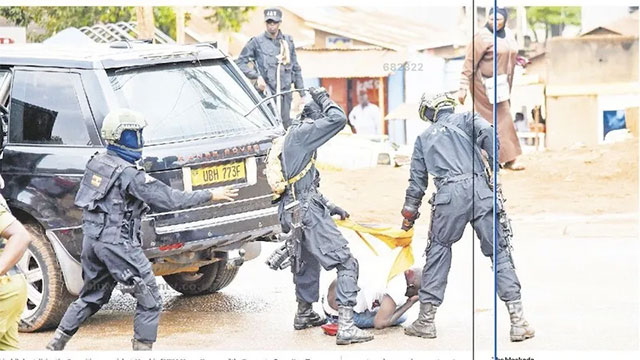
They frame the appointment of military officers to key civilian posts in diplomacy, administration and parastatals as “efficient” and “disciplined.” They cheer the expansion of security agencies, their budgets opaque and unchallenged, as necessary for “stability.” Dissent is re-categorised from political expression to a “security threat,” a reframing eagerly endorsed by the sycophantic chorus. The result is a securitized state—a state where the logic of the garrison replaces the logic of the republic. The sycophant’s applause is the sound of the prison door locking on civil liberties.
- Midwife of hereditary politics: Building a dynasty to preserve a court
- The most tragic evidence of sycophantic success is its latest project: the normalisation of hereditary succession. For the sycophant whose entire political existence depends on the patron, the leader’s mortality is an existential threat. Their solution is not to build resilient institutions that can survive leadership transition, but to ensure the leader’s political DNA survives in a successor from his own bloodline.
Thus, sycophants become the most vocal architects of a dynasty. They praise not just the president, but his family, framing them as the natural, divinely-appointed custodians of his “legacy.” They facilitate the use of state resources to build political profiles for family members, applaud their appointments to strategic positions and ruthlessly silence any discourse against hereditary rule as “disrespectful” or “un-African.” Their aim is clear: to ensure that when the founding president exits, the system of patronage – and their place within it – remains intact. The sycophant, in a final betrayal of republican ideals, becomes a royal courtier, trading the sovereignty of the people for the continuity of the court.
Mirror to misery: Global reckoning of sycophantic regimes
History offers no comfort, only warning. Uganda’s path is not unique; it is a well-trodden road to ruin.
- North Korea: Kim dynasty represents the terminal stage of this disease. Sycophancy (“Juche” and worship of the Kims) is the state religion that enables total militarisation and the world’s most rigid hereditary dictatorship. The people are reduced to cogs in a machine of perpetual adoration and poverty.
- Syria under the Assads: Hafez al-Assad built a regime where sycophancy within the Ba’ath Party and security apparatus was mandatory. This culture allowed him to bequeath power to his son, Bashar, transforming the republic into a monarchy. The sycophantic silence over corruption and brutality made the state brittle; when challenge came, it could only respond with catastrophic violence, leading to civil war and collapse.
- Azerbaijan: A contemporary example where sycophancy within a tightly controlled political system smoothed the transition from Heydar Aliyev to his son, Ilham. Parliament, judiciary and media, staffed by loyalists, provided a veneer of constitutionalism for what was, in effect, a dynastic succession.
The pattern is unmistakable: sycophancy hollows out institutions, concentrates power, and ultimately, either fossilizes the state into a stagnant tyranny (Zimbabwe) or primes it for violent disintegration (Syria).
- Orphaned Nation: Consequences of a captured future
The trilogy is now complete: Sycophancy enables militarisation and breeds hereditary politics, producing an orphaned nation.
This system leaves citizens politically orphaned. With parliament a cheering squad, the judiciary compromised and the media cowed, there is no independent institution to appeal to. Policy is dictated by patronage, not planning, blurring any coherent national future. Hope for peaceful, generational change is extinguished, replaced by either numbing apathy or simmering desperation. In this environment, as witnessed, truth is slaughtered at the altar of lies. The president, surrounded by “greedy and shameless sycophants,” makes hundreds of unfulfillable promises – from poverty eradication to term limits – that are met with roaring applause, not accountability. This cycle of false promises is not politics; it is, as you rightly term it, a form of human abuse, degrading the very essence of the social contract.
- Crossroads of generations: Republic or ruin?
If we fail in this duty, we will be remembered not as the generation that endured, but as the generation that, seeing the abyss, chose to smile and applaud all the way down. We will bequeath to our children not a nation to build, but a fortress to besiege – sand the siege, tragically, will be from within. The choice is between a republic reclaimed, and a ruin inherited. For the sake of Uganda’s soul, let this generation choose to rebuild the stool of state, restoring its legs of justice, liberty, and accountable governance.
For God and my country.
- A Tell report / By Oweyegha-Afunaduula / Environmental Historian and Conservationist Centre for Critical Thinking and Alternative Analysis (CCTAA), Seeta, Mukono, Uganda.
About the Centre for Critical Thinking and Alternative Analysis (CCTAA)
The CCTAA was innovated by Hyuha Mukwanason, Oweyegha-Afunaduula and Mahir Balunywa in 2019 to the rising decline in the capacity of graduates in Uganda and beyond to engage in critical thinking and reason coherently besides excellence in academics and academic production. The three scholars were convinced that after academic achievement the world outside the ivory tower needed graduates that can think critically and reason coherently towards making society and the environment better for human gratification. They reasoned between themselves and reached the conclusion that disciplinary education did not only narrow the thinking and reasoning of those exposed to it but restricted the opportunity to excel in critical thinking and reasoning, which are the ultimate aim of education. They were dismayed by the truism that the products of disciplinary education find it difficult to tick outside the boundaries of their disciplines; that when they provide solutions to problems that do not recognise the artificial boundaries between knowledges, their solutions become the new problems. They decided that the answer was a new and different medium of learning and innovating, which they characterised as “The Centre for Critical Thinking and Alternative Analysis” (CCTAA)


About author