
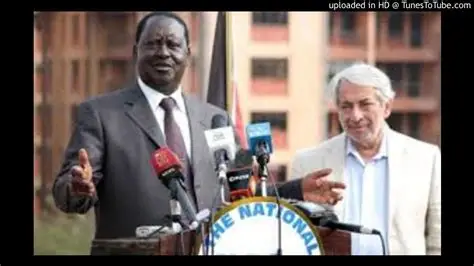
I was in the United States on March 9, 2013, when at about 3 am, Nairobi time, the Kenyan media reported that the election commission had declared Uhuru Kenyatta winner of the presidential election.
Not too long after, I was startled to see a phone call coming in from Michael Gichangi, the head of the National Intelligence Service. He had been my tormentor after the December 2007 election, but after the Kofi Annan Accord, we interacted without difficulty a few times in the Kibaki-Raila Grand Coalition Government.
Why was he calling now? I could not recall the last time we had spoken. It had to be in connection with the election announcement. Neither Uhuru nor Raila nor any of their aides in Nairobi had said anything to the media yet, so it was possible he was hoping to influence Raila’s or my response.
But I had already spoken. The New York Times had called me about what Raila’s response would be to his loss, and I was only too happy to lay out his specific next steps. The media knew that I would always convey Raila’s views accurately.
(https://www.nytimes.com/2013/03/09/world/africa/kenyatta.html)
I doubt Gichangi had seen the Times, and from our conversation, which I am reporting here loosely, it did not look like he had. In any event, he wanted to know what Raila intended to do next. I said he will not concede the election, since there were many irregularities in the tallying of votes, but he will urge his followers to stay calm. Mass protests were not needed, since he was going to challenge the outcome in the Supreme Court, an avenue that had not been available in the previous election.
I thought that Gichangi would be pleased to hear this but I was stunned with his next remark: He did not think it would be wise for Raila to go to court, since even that could create unrest and instability. He urged me to ask Raila to consider that. I said I would pass on his concern, and I did.
I was mystified – surely Gichangi did not believe that he could dissuade Raila from challenging the outcome in court? Recourse to an independent court was one of the pivotal elements of our new Constitution as it offered hope of redressing any rigging, averting the resort to violence. Maybe Gichangi was worried that the Willy Mutunga-led court was likely to uphold Raila’s election petition.
My having spoken to The Times on the very subject that Gichangi had called about reflected its extreme sensitivity. Both these were examples of the complete trust Raila had in me, which gave me the ease and freedom I needed to articulate his thoughts in a way I thought would be effective.
That trust was built around Raila’s deeply-held conviction about media freedom. I asked him more than once that in a media landscape so heavily tilted against him, frequently demonising him even, and where many leaders such as Daniel arap Moi, Kenneth Matiba, Uhuru Kenyatta and William Ruto had their own media, would it not help to get some well-off supporters to invest in a media house? But such a media would not be free, would it, he would say.
The call with Gichangi lasted maybe five minutes or a bit more. I have written 500 words trying to understand its significance but I could easily have written a few thousand, given its importance and implications. There are so many aspects and dimensions that adhere to even small incidents and events, leave alone such a call, so recording them is vital to the history of that period.
Life with Raila was always full of such episodes and exchanges which revealed a lot about him but also about the world around us, given the role he played in creating it.
And so we come to another media issue, it’s boycott by Raila’s supporters in the aftermath of the rigged 2007 election. That violence had crushed the vast hope which was unleashed by Kenya’s first-ever free and fair election in 2002. President Daniel arap Moi had honourably let the outcome stand, with a broad-based opposition coalition led by Kibaki and Raila toppling KANU after its four decades of over-centralised dictatorship that began with Jomo Kenyatta from Day One of Kenya’s independence. That helped create the extreme inequality we live under, with a large living in unspeakable opulence – and wanting more and resisting change of any serious kind. Heads buried dangerously in the sand.
As the post-election violence in 2008 raged in the heartland from Nairobi westwards, all sorts of boycotts were part of the battle then. One of these hit the Daily Nation, which as the voice of elite interests at that time, was adamantly supporting the Kibaki regime’s holding on to power. I was basically handling a frantic communication regime essentially by myself, assisted by my invaluable colleague John Onyando, with no office except a Blackberry and my day often starting at 5.
So, I had not realised how widespread and effective the boycott was until I got a telephone call from a very senior Nation official I knew. He sounded totally distraught and said the Nation was being literally killed, as virtually no one was buying the paper west of Naivasha. Could I please recommend to Raila to have the boycott called off?
The Nation had always been the paper I related to, its having been started to support freedom and a free press, with The Standard till the late 1950s still being the voice of the various political shades of settlerdom. In addition I had won a generous scholarship in the first official government to government US airlift in 1961 thanks to an advertisement in the Nation!
When I first returned from the US in 1966, it was the Nation and in particular Philip Ochieng who fired me up about the power of a free media to inspire people to fight for greater freedoms through sharing ideas and information.
So, Raila and I discussed the Nation boycott, our views were identical, and he agreed we should help out. It was a very sensitive subject, of course, so we could not just call it off, it had made ordinary people feel the power they possessed of a peaceful protest option which did not result in their being shot at.
So, I suggested that at the coast hotel where Raila was staying, he could be photographed reading the Nation as he lounged by the poolside. He had a hearty laugh! Shortly thereafter, the photograph was taken and carried on the Nation’s front page – and the boycott began tapering off.
The Nation subsequently asked me to be a keynote speaker at a retreat it held at Maanzoni Lodge in Machakos to better prepare for covering the 2013 election. I spoke very candidly, going beyond election coverage to other ills that plagued our media. I was surprisingly well received.
How did I end up being Raila’s spokesman?
By a very circuitous route! In late 2003, as I was retiring from the United Nations as a Director of Communications, my friend Justice Minister Kiraitu Murungi was in New York and he invited me to dinner with his colleague Msafiri Kombo. They wanted to discuss politics and communications for the new government and I was happy to have an audience for my pet subjects!
A few weeks later, I got a call from Information Minister Raphael Tuju telling me I had been approved as Government Spokesman through a cabinet resolution, which President Kibaki had signed off on! The Nation carried a prominent story about my offer. I went to Nairobi for discussions, but when I sought clarifications on precise responsibilities, I was told if they knew these, they would not need me! I was able to get them to agree that to be effective, the Spokesman’s office would be in the State House so as to be close to the president and his inner team.
Just as my wife and I were leaving New York for Nairobi with our house sold and belongings already shipped, I got an angry call from my friend Anyang’ Nyong’o, who as Planning Minister had arranged my appointment through a UNDP support programme. He wanted to know why I had demanded a higher salary than the one I had agreed to. I told him that this was an utter lie by the Kibaki wing, I had never even raised a question about my salary!
But that is what the cabinet had been told, as was the media, that I had demanded double my agreed salary! That false story was needed to explain why Alfred Mutua had been appointed instead.
Their change of heart about my being spokesman occurred because the differences in 2004 between Raila and Kibaki’s team were becoming more open. With Raila now being seen as an opponent, it was thought that I would be more sympathetic to Raila’s side than the president’s as the government spokesman! So unceremoniously, and without even a call or email, my offer disappeared.
It was very difficult to live off one salary (my wife’s) in Nairobi, so I discussed with my dear friend Pheroze Nowrojee about suing the government, since my appointment was approved by the cabinet and the president. Pheroze said that it would be a very tough case to mount, plus cabinet discussions are confidential, so no minister could testify. I was depressed for a few months.
But in hindsight, I was extremely happy that my spokesman’s appointment was yanked – since I would have left pretty fast. I could not have possibly been its mouthpiece. Not because of Raila, but for the reason anti-corruption czar John Githongo had left – the growing crimes of the Kibaki regime.
After the retracted job offer, a Standard director who was a good friend took me out for lunch and said they were looking for some fresh blood and Mzee Moi, who owned an interest in the media house, had proposed they put “the young man” from the UN on the board. I was definitely interested but it did not work out, no offer came. How different my life would have been if it had!
Fast forward to 2008. After Kofi Annan’s Accord was agreed, there was a huge homecoming rally for Raila at Moi Stadium in Kisumu. As he arrived with his Pentagon partners, there was a roaring welcome of a kind I had never heard before. But I was stunned during the speeches that in this core and enchanted Raila stronghold, the ovations for William Ruto and Charity Ngilu had been distinctly louder than Raila’s.
There was a reason: Ruto and Ngilu were demanding President Kibaki act on a number of pressing issues, especially the release of youth who had been arrested in the post-election tumult. Raila, with his new responsibilities, did not want to take a harder line at that time. I was truly astonished at the ability of his Nyanza/Western supporters to not automatically give their messianic hero the greatest acclamation. I developed a new respect for Raila’s home grown supporters’ political maturity.
- A Tell Media report / Republished with the permission of the author, Salim Lone


About author