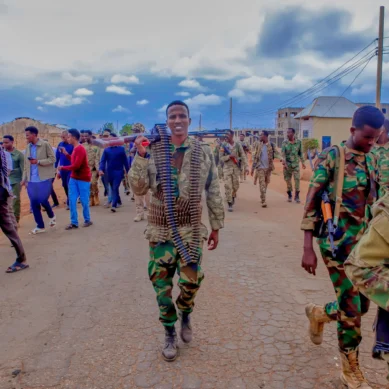


As Raila Odinga and I departed from Moi Stadium in Kisumu 2008, I noticed some youths were following me. When Raila and his security peeled off, the youths following me kept surging and started roaring various slogans in a growing crescendo:
Saalim Lone!!! Msemaji!!! Spokesmaan!!! But the clincher was Dawa ya Mutua!!!! Again and again. How very clever. Totally spontaneous. How creative our young are. I would love to know who thought of that marvellous Dawa (cure) slogan.
I could not stop laughing at its allusion, but I was also profoundly touched by this affection. People had come to have a better – a much better – understanding of what a spokesman’s job was supposed be inn supporting a leader.
But my driver/security was getting agitated and urging me to hurry away, anything could happen he said. The crowd had grown to at least 200, but nothing untoward happened – except the driver, slowed by the traffic jam out of the stadium, was zigging and zagging at enormous speed out and somehow back into the line at enormous speed, bumping a few cars! Did he know something I did not?
He only said that I should always be super-careful of crowds of supporters because they provided excellent camouflage for anyone who wanted to harm me.
I had been aware of the extreme peril I was in from early January 2008. ALL of my friends were telling me that I was being stupid, risking my life by threatening the power of a fully established state in which thousands of people had an intense stake – and these people, including some friends, were letting me know how angry they were about my endeavours.
One of them, a major entrepreneur and friend, told me at the Intercontinental Hotel as I was going up for a Kibaki-Raila meeting, that he would kneecap me if I continued on my path. The goal of such campaigns is political power, but less addressed is the financial dimension that motivates turns some of the president’s backers into fiends.
When walking in town in January, when essential, I was invariably mobbed by fans, but seeing the cause of the commotion, a hostile group could also form. It was a very tense time for me and the family. My mother, an ardent Raila supporter, was convinced both he and I would be fine as she had embarked on a short Muslim prayer of safety that has to be uttered about 125,000 times. (I forget the precise number). She was convinced that it was her prayer that Raila become prime minister.
Amid that tension, there were some wonderful and unexpected moments of support from Kibaki supporters who knew a bit about me and my political past. One beautiful moment occurred when the family and I were at petrol station in Naivasha. A driver from another car came over and said, “I support Kibaki but I know what you are doing is not just for Raila but for Kenya.” That was a very powerful affirmation that I will always cherish.
I initially did not believe that I was playing such a crucial role in resolving the crisis equitably but I gradually came to realise that the other side definitely thought so. When Raila nominated me as his liaison person to the Kofi Annan negotiation team, Martha Karua, a good friend who led the Kibaki team, objected to my being given that role. I told Raila he should withdraw my name; it was not worth fighting over.
Once Raila became prime minister, he finally told me that Cabinet Secretary Francis Muthaura had agreed to give government appointments to all the names he had submitted, except for me! Even the super-disrupter government nemesis Miguna was given an appointment!
Raila’s immense popularity and his wide regional alliances from across all the regions except central were driving the campaign for electoral justice and winning growing support and international diplomatic backing. But I finally realised that my friends were right, my media interviews, diplomatic briefings and ODM statements had an impact and created the high-level threats and real danger.
It was so bad that once, as I waited with Raila at County Hall for Kibaki to arrive, a very senior security chief, within hearing distance of Raila, said I was dividing Kenyans and that could not be tolerated.
Almost all western diplomats before the election were pro-Kibaki, convinced that he enjoyed popular majority support because the “economy” was doing well. They were also wary of Raila because of his supposedly anti-business views but were stunned by the level and passion of his support from across the country and had begun to recognise Raila needed to be part of the government for the country’s stability.
But the group around Kibaki was not budging and naming new ministers, while rejecting all African and international mediation proposals. It insisted any mediation had to begin with an acceptance that there would be no dilution of presidential power. They were convinced in that stance by the fact no “elected” president in Africa had ever had to share power.
Meanwhile my worries about my safety were growing so I convened, with my wife Pat, a meeting with Raila, Mudavadi, Ruto and Orengo, over dinner at Nairobi Club late January. Raila said they would not dare touch me, it would cause a huge international backlash. But Orengo quietly said it is not worth taking that risk.
To depart safely, the next evening, Dutch Ambassador Laetitia van den Assum, the immensely knowledgeable, committed and clear-thinking diplomat to ever serve in Kenya, drove me to the airport. On the way there, we stopped for dinner at a small restaurant with Maina Kiai and his friend Cyril Ramaphosa. I was keen to meet Ramaphosa as he was one of the leaders the African Union was considering as the mediator and I thought I could brief Raila on anything that stood out in our meeting.
Eventually Kofi Annan was chosen, who of course did a magnificent peace-making job – except for his bringing the International Criminal Court into the fray. That ICC discussion is for later.
So I flew to the US. The great Joe Nyaga, one of Kenya’s smartest and most likeable politicians whose small Embu base prevented him from becoming a much greater player than he was, happened to be in the US too. We wasted little time meeting whatever political leaders in Congress and outside would see us. Democrats were putting together a non-binding resolution sympathetic to us in Congress. We also liaised with Diaspora groups organising support for that.
A big breakthrough came when Deputy Secretary of State John Negroponte, who had been previously US Ambassador to the United Nations, agreed to meet us. That such a high official was seeing us meant that Washington was clearly reassessing its ritual support for Kibaki and opposition to Raila.
With Secretary Negroponte as note-taker was Assistant Secretary of State for Africa, Jendayi Fraser. She had flown right away to Kenya as violence broke out, arriving 4 January 2008. Raila and I met her twice at Ambassador Ranneberger’s residence, where she tried to persuade Raila to give up his claim to having won the election, and instead take the lead as Kenya’s reformer in Parliament, in which role he would enjoy full US support for reform and a new Constitution. She was a sharp, forceful advocate, plus, as I made sure to mention to Secretary Negroponte, close to the Kenyatta family, who were big backers of Kibaki.
In the end, Fraser’s strong pro-Kibaki stance began to be diluted from even within the State Department, thanks in part to David Gordon, Secretary Condoleezza Rice’s Director of Policy Planning, who knew Kenya well, having spent time here. I had happened to know him while I was at the UN, but I had not seen him for a few years.
Eventually, as we know, Secretary of State Condoleezza Rice flew to Kenya to meet with Kibaki and Raila. She told Kibaki decisively he had to share power with Raila.
To conclude, it would be a gross understatement to say I never met any other leader in my very long career with whom I had so much in common. Raila’s entire being, his compassion and identification with ordinary people, but most of all his human-centred values which galvanised people across the country in a way no other leader ever did. In essence, it was not so much that I was working for him, it was like I was working for all his people.
I still feel unmoored without being able to turn to Raila. I cannot imagine how a Kenya without the hope and promise Raila always held out for the struggling millions will hold together. I pray wise heads will to a common cause in the short term at least.
- A Tell Media report / Republished with the permission of the author, Salim Lone


About author