


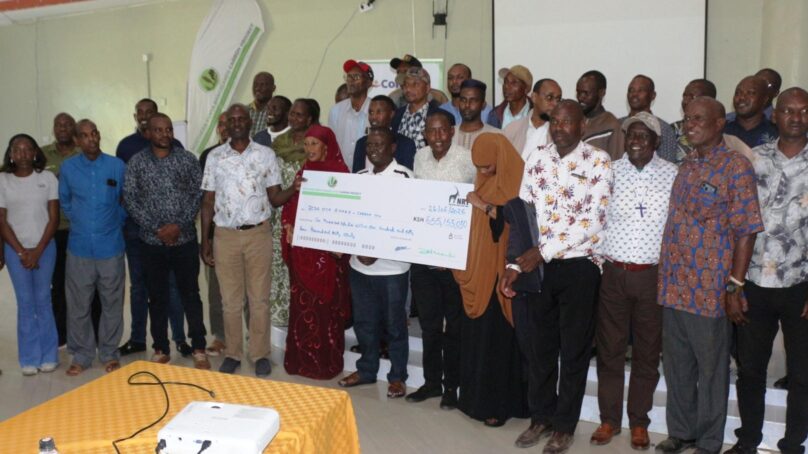
Pastoralist communities in four counties in northern Kenya have received Ksh655 million ($5.05 million) in carbon credit earnings under a community-led rangeland conservation programme.
The beneficiaries are members of community wildlife conservancies in Isiolo, Marsabit, Samburu and Laikipia Counties working in partnership with Northern Rangelands Trust (NRT).
The funds were disbursed through the Northern Kenya Rangelands Carbon Project (NKRCP) that allocates carbon credit revenues to participating conservancies.
Speaking during the cheque presentation ceremony in Isiolo, NRT Chief Operations Officer Osman Hussein, representing Chief Executive Officer Vimal Shah, said nearly 60 per cent of the funds would be paid directly to designated community groups within the conservancies.
He said the remaining 40 per cent would be shared equally between rangeland conservation and management activities and operational costs for the conservancies. Mr Hussein said conservancies in the four counties have received more than Ksh3 billion in carbon credit revenues since 2022.
The NKRCP Board Chairman Andrew Dakhole said the cheques received on behalf of communities are earnings accrued from protecting and restoring grazing lands and added that their efforts have contributed meaningfully to reducing carbon emissions.
Although the carbon credit programme began in 2013, communities only started receiving financial returns in 2022. According to Dakhole, the programme experienced a setback last year after Verra, an organisation that administers standards for climate action and sustainable developments suspended carbon credit issuance over concerns about governance, integrity and transparency in fund management.
“We were not able to sell our carbon credits from January last year because of the suspension. However, after thorough investigations and governance reforms, we have been readmitted in the market,” Dokhole said.
The conservancies are now undergoing a three-year transition to become fully autonomous in managing the carbon project, with NRT providing technical support and capacity building during the period.
Earlier this year, NRT began aligning the conservancies with Kenya’s carbon market laws by transferring governance of the carbon project to a community-owned Special Purpose Vehicle (SPV), a corporate structure that will manage the programme independently.
The transition follows amendments to the 2021 Project Implementation Agreement, giving conservancies full responsibility for managing carbon credit activities while ensuring compliance with the 2023 Climate Change (Amendment) Act and the 2024 Carbon Market Regulations.
As part of the process, NRT launched the Free, Prior and Informed Consent (FPIC) process across the 22 participating conservancies.
Through the SPV, the conservancies will have their own management and board with representation from all stakeholders. Mr Dokhole said each conservancy would hold stakeholder meetings to determine how the funds would be spent.
Five conservancies in Laikipia received a combined Sh.126.6 million, with Il Ngwesi Conservancy receiving the largest allocation of Sh. 30 million.
Eight conservancies in Samburu received Sh248.8 million, conservancies in Isiolo received Sh. 258.8 million, while Malako Conservancy, the only participating conservancy in Marsabit County, received Ksh30 million.
The previous carbon credit earnings had funded community development projects, including education, water and livelihoods.
For example, Westgate Conservancy from Isiolo spent Sh. 9 million on bursaries for needy students last year, while additional funds were used to drill boreholes and pay salaries for intern teachers.
Former Nasuulu Conservancy chairperson Saadia Mohamed said carbon credit revenues had helped establish businesses for women and youth in Burat Ward.
“The carbon credit funds have transformed the lives of many pastoralist women. Many are now trading livestock during market days, while others have started small businesses in town,” she said.
Unlike previous years, county governments will no longer receive a share of carbon credit revenues. In 2024, the county governments of Isiolo and Samburu each received Ksh11 million as levies from conservancies, an increase from Ksh9 million in 2022.
The payments have been discontinued under governance reforms introduced after the programme’s suspension.
The reforms recognize that community land in pastoral areas is held communally under Kenya’s 2010 Constitution, replacing the previous arrangement under which defunct county councils held the land in trust.
Mr Dokhole urged conservancies to use the funds prudently, with priority given to environmental conservation and sustainable rangeland management.
- A Tell Media / KNA report / By David Nduro


About author