


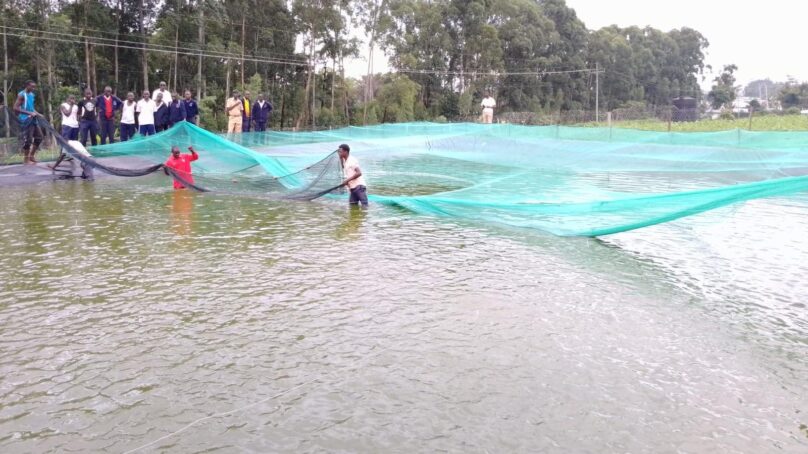
Nyang’ori Boys High School in Vihiga County has harvested its first batch of fish under the NORAD-funded Advancing Resilient Nutrition Sensitive Aquaculture (ARNSA) project.
A total of 886 fish, each averaging 350 grams, were harvested from the school’s integrated fish-poultry-vegetable aquaculture system, with students actively participating in the exercise. Going by the current cost of fish per kilogramme, the students earned Ksh51,397.5 or $400.
Speaking during the harvest, a Form Four student and member of the Young Farmers Club Joshua Alembi said the project had equipped him with practical skills in fish rearing that include handling fingerlings and harvesting.
“I am now able to handle various challenges related to fish farming,” Alembi said, adding that he hopes to use the knowledge to help address food shortages in the country.
Alembi encouraged fellow students to join the Young Farmers Club to acquire skills in aquaculture, noting that such knowledge would be beneficial in future.
Another student, Kaicy Ned, a form three, said the project had given him his first experience in fish farming, having previously engaged in livestock farming. He highlighted the benefits of the integrated system, noting that poultry waste is used to fertilise fish ponds, while Black Soldier Fly larvae are reared as fish feed.
Ned said he aspires to venture into agriculture in future, terming it as the backbone of the country’s economy and key to food security.
School Principal Peter Lunani said the harvest marked a major milestone since the inception of the project, noting that it had significantly enhanced practical learning among students.
“The students have greatly benefited from this programme, especially under the Competency-Based Curriculum, where they acquire practical agricultural skills,” Lunani said.
He noted that membership in the Young Farmers Club had grown from about 15 students to approximately 200 following the introduction of the project.
Lunani added that the school has attracted interest from various regions, among them were visitors from Mozambique and Meru, due to its success in aquaculture.
He affirmed the school’s commitment to sustaining and expanding the project to ensure its long-term success.
- A Tell Media / KNA report / By Yvonne Misango


About author