
Ndombolo ya solo! A cultural revival is in progress in eastern DR Congo despite Ebola setback
Editors choice
A packed crowd pressed against the stage of a cultural centre courtyard as a musician walked on for the first concert held in many months. A microphone crackled and the artist smiled as if to ward off fear. Then he announced with pride: “Hello Goma!”
For the past year, Goma, the largest city in eastern Democratic Republic of the Congo, has been under the control of the Rwanda-backed M23 rebel group, whose insurgency has fuelled one of the worst security crises in the country in decades.
Alongside massive displacement and regional instability, the rebellion has disrupted the area’s usually vibrant cultural scene, known for biting slam poetry and innovative music and dance.
Yet, after months of readjustment under the new authorities, artists say a small cultural revival is now beginning to take shape, with events like the one at the Goma Cultural Centre in January serving as early signs of a fragile reopening.
Across cities under rebel control, artists say they are restarting live performances, returning to recording studios, and bringing back suspended festivals, school competitions, and workshops.
“The war has not only destroyed infrastructure, it has also broken the social bonds between communities. Through art, we are trying to rebuild these bonds for peace and coexistence.”
The artists say their efforts underscore the resilience of cultural expression in a conflict often reduced to a story of survival. They say it also shows the role art can play in mitigating some of the worst social and psychological impacts of war.
“The war has not only destroyed infrastructure, it has also broken the social bonds between communities,” said Augustin Mosange, the director of the Goma Cultural Centre. “Through art, we are trying to rebuild these bonds for peace and coexistence.”
Still, the revival is brittle. Even as venues reopen, artists say censorship has altered creative habits. Metaphors have replaced direct speech, audiences are wary of gathering and some productions aren’t being released for fear of repression.
Funding for events is, meanwhile, even scarcer than before the M23 took control – a result of wider cuts in humanitarian and development spaces. Insecurity is also shortening opening hours in venues and making it harder for people to travel.
The challenges, however, have not deterred those pushing for the reopening, said Patricia Kamoso, a slam poet and cultural worker from Bukavu, the second-largest city in the east, which is also under M23 control.
“We had to change venues, adapt our schedule and even create new activities but despite that we continue to create and produce everything,” she said. “We can say that we’ve been resilient, even if things aren’t quite the same as before.”
The M23 began its rebellion in late 2021. It swept through large chunks of eastern DRC, claiming a revolution, before entering Goma and Bukavu in early 2025, seizing both cities from the Congolese army and pro-government militias.
While the humanitarian impact of the rebellion is vast, less noticed has been its impact on cultural spaces. Artists have been driven underground or decided to leave DRC, which has long been known as an African music and creative powerhouse.
For months, vital events at the Goma Cultural Centre – a major performance space and art school in the city – vanished, along with many other activities across Goma and Bukavu.
Yet the centre has now made a comeback, restoring events like the one in January – Sanaa Weekend – with a diverse monthly programme focusing on promoting, sharing, and showcasing talent through live performance.
At the reopening, crowds thronged the large stage, illuminated by spotlights. There were no chairs and everyone was standing as new talents in music and slam poetry performed, alongside established artists.
Jenny Paria, a well-known slam poet, performed two tracks from his album Jibu – meaning Answer in Kiswahili. The songs addressed identity and reconnecting with one’s roots. For the few minutes he was on stage, the conflict seemed suspended.
“A year after the rebel occupation, I find myself on the main stage of the Sanaa Weekend. It’s a reminder that culture is always present and that it endures,” Paria said afterwards.
Magic Pinokio, a singer and vocal coach, sat backstage before his performance at the second Sanaa Weekend of the year, and said being able to perform again felt like a return to life.
The city has been under occupation for a year. For a long time, we were confined, unable to perform or release new works. For an artist, not being able to express themselves is almost like not existing,” he said.
Besides Sanaa Weekend, the Goma Cultural Centre has also restarted Art’Elite, an inter-school arts and ideas festival bringing together students to compete in public speaking, music, slam, dance, comedy fashion and other talents.
The festival was cancelled last year due to security concerns and other logistical constraints. But at the beginning of March, it returned under the theme “Our Voices, Our Rights, Peace for Tomorrow.”
Backstage, students rehearsed lines and adjusted costumes on the day of the festival. On stage, participants performed across different disciplines, while a young girl delivered a poignant text that stunned the crowd.
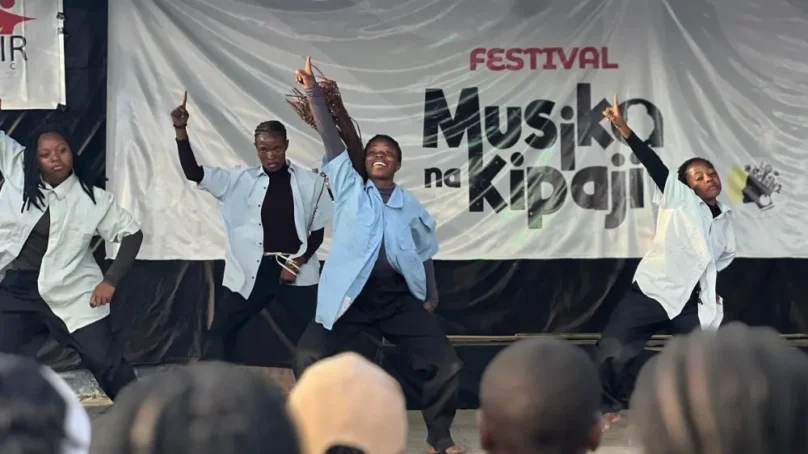
That same month in Goma, the Musika Na Kipaji festival also emerged as another symbol of the city’s cautious cultural revival. Under a blazing sun, one of the country’s largest women’s festivals – if not the only of its kind – took place.
The festival was born out of the closure of civic space, conceived as a “free zone” where women can express themselves without restrictions. In a region where violence has disproportionately affected women and girls, the visibility matters.
“This stage gives a voice to all the young girls who feel their talents have no place,” said Julie Kahindo, 22. On stage she performed Heal the World to an attentive audience who were mouthing the lyrics as they lit up their phones with flashlights.
“Artists won’t stop creating, even if we don’t yet see clearly where we’re headed.”
Just a few hours from Goma, artistic expression has also resumed in Bukavu, much of it led by a collective of slam poets who use the art-form for self-expression and social commentary.
“After a year without performing, we relaunched our workshops in January and resumed our bi-monthly slam nights at the Bukavu Comedy Club,” said Achilles Argus, a member of the Bukavu Slam Session collective.
Marcel Puzzle, another slam poet from Bukavu, said training projects for young people in schools also restarted at the beginning of this year after a pause of several months, even without sufficient resources.
For Puzzle, slam performance spaces offer a vital outlet in Bukavu. “We do it to lighten the mood for the audience and to allow us to get back to our lives. It’s a space where people come to put their worries aside.”
When The New Humanitarian visited the Bukavu Comedy Club, a play titled The Trial of the Trash Can was also being performed. It explored questions around environmental management and collective responsibility, staged against a set made of plastic bottles.
“Artists won’t stop creating, even if we don’t yet see clearly where we’re headed,” said Kamoso, the slam poet and a performer in the play. Achilles added: “We are condemned to be resilient or else disappear.”
Despite the events taking place, challenges abound in Bukavu. The security situation forces organisers to hold activities during the day and some artists say they can no longer express themselves as freely as before.
“Today, we censor ourselves. Sometimes, even talking about what’s happening in your neighbourhood becomes difficult,” said Basubi wa Basubi, another slam poet. “We use stylistic devices in our writing to survive.”
Money is also a problem. Several cultural centres have closed, including the French Institute, a key supporter of local arts. Banks have also been shut down by the Congolese government seeking to disrupt M23 governance.
To keep going, financial solidarity has taken over: “We pool our money to organise activities, because we’re passionate,” said Marcel. “We make do with what we have to keep art alive.”
Similar problems are occurring in Goma, said Mosange, the director of the Goma Cultural Centre, who cautioned that initiatives like Sanaa Weekend rest on a precarious foundation.
“Before, we were supported by international partners, but since the war, this support has ceased,” said Mosange. “Today, we operate with whatever resources we have. The consequences are visible: limited equipment, and symbolic or non-existent fees.”
Like in Bukavu, Mosange said there is the fear of artists saying the wrong thing. “We don’t censor the artists. But we talk with them so they understand the risks. It’s about promoting socially engaged art, but also about allowing artists to protect themselves.”
Behind the scene at Sanaa Weekend, the caution was palpable. Lyrics were read and reread, words were carefully picked over, and metaphorical lyrics and prose were used as a way of circumventing censorship.
“We can’t say everything so we use metaphors,” said Magic Pinokio, who deployed symbolism and allegory heavily when recording his latest album. “Those who need to understand will understand.”
Despite the challenges, Aiglon Makasi, an aid worker and singer who performed at Sanaa Weekend, said the cultural scene must endure. On stage, he performed his song Never Give Up, offering a simple message that spoke to the moment.
“Through ‘Never Give Up’, I tell people not to lose hope despite the difficulties,” Makasi said. “If we maintain a positive message, it helps us move forward.”
- A Tell Media report / Source: The


About author