

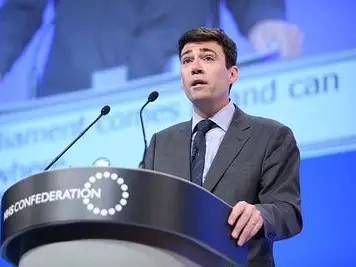
Andy Burnham became Britain’s new prime minister on Monday after King Charles III invited him to form a government during an audience at Buckingham Palace, completing a rapid journey from regional government back to the centre of British politics.
Burnham has entered Downing Street with a political identity shaped by nearly a decade as mayor of Greater Manchester. He has promised to give cities and regions greater control over their economies and public services.
The question now is whether an approach forged in local government can withstand the pressures of national office and whether Burnham can use it to reshape British politics.
Burnham, 56, was born in Aintree, near Liverpool, in January 1970 and grew up in Culcheth, Cheshire.
He studied English at Fitzwilliam College, Cambridge, before working as a parliamentary researcher, an official at the National Health Service (NHS) Confederation and an adviser in the Department for Culture, Media and Sport. He entered Parliament as the Labour MP for Leigh in 2001 and rose through the governments of Tony Blair and Gordon Brown.
His senior posts included chief secretary to the Treasury, culture secretary and health secretary. He ran for the Labour leadership in 2010 and 2015 – both times unsuccessfully.
Burnham left Parliament in 2017 to become mayor of Greater Manchester. The move allowed him to build a political base away from Westminster and associate himself closely with the region’s transport system, housing policies and demands for greater local powers. He was re-elected in 2021 and 2024 by wide margins. He returned to Parliament by winning the Makerfield by-election on June 18.
On Friday, he was formally declared Labour leader after securing nominations from 379 of the 403 Labour lawmakers, with no rival reaching the threshold required to enter the contest.
Burnham’s politics begins with the argument that Britain has concentrated too much authority in Whitehall, the country’s central government apparatus. His proposed “No.10 North” in Manchester would oversee a wider transfer of responsibility for transport, housing, skills, energy and investment to local leaders.
Under his approach, cities and regions would be given greater control over both policy decisions and the funding needed to implement them, rather than repeatedly competing for short-term grants from the central government.
Burnham has argued that local leaders are better placed to identify the needs of their economies and coordinate policies across housing, transport, education and employment.
According to Burnham, the plan aims to shift away from Britain’s centralized model by giving regions a stronger role in long-term development and national decision-making.
“No. 10 North” would help coordinate investment and economic planning between central and regional authorities. Greater Manchester’s Bee Network offers the clearest example of his approach. Local government determines bus routes, fares and service standards under a publicly controlled franchising system, while private companies continue to operate the buses.
Burnham presents the arrangement as evidence that the state can set direction while local governments carry out implementation. Stuart Wilks-Heeg, a professor of politics at the University of Liverpool, said Burnham was best understood as a classic European social democrat, accepting private enterprise while using the state to redistribute wealth and protect basic living standards.
In a late-June analysis, the British think tank Institute for Government said that experience of running a city-region would not fully prepare Burnham for national office, where the scale, trade-offs and fiscal pressures are far greater.
Burnham inherits an economy marked by weak productivity, slow income growth and limited fiscal room. Britain’s Office for Budget Responsibility said this month that public debt had risen from 37 per cent of GDP in 2005 to 95 per cent in 2025, increasing exposure to borrowing costs and economic shocks.
The Institute for Fiscal Studies said in May that Britain faced high debt, elevated borrowing, rising taxes and strained public services. The Resolution Foundation said in February that official forecasts pointed to real wage growth of only about 0.3 per cent per year between 2025-26 and 2029-30. Those pressures will complicate Burnham’s plans for housing, transport, social care and greater public control of utilities.
His devolution agenda may also face resistance from Whitehall, uneven local capacity and concerns that public-service standards could diverge across England.
Ian Scott, a professor at the University of Manchester, cautioned that a model shaped by Manchester’s institutions and Burnham’s personal political drive may prove harder to reproduce in places such as Norfolk, Cornwall or West Wales.
A Sunday opinion column in the Financial Times argued that Burnham’s “radical devolution” is “not a panacea.” “Details of Burnham’s devolution strategy are scant and, given the record of the past couple of decades, a new push seems likely to underwhelm,” it said.
- A Tell Media / Xinhua report


About author