
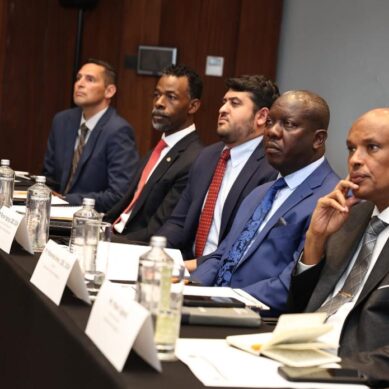


Kenya and the United States have stepped up cooperation in fight against transnational organised crime, with senior criminal justice officials from the two countries holding talks on stronger intelligence sharing, joint investigations and coordinated prosecution of criminals operating across borders.
The meeting took place against the backdrop of reports that United Nations in Kenya and international humanitarian organisations in the country are behind cross-border crime. Working in concert with criminal networks, the international agencies are accused of infiltrating Kenya Ministry of Interior, National Police Service, Immigration Department and Office of the President, which enables them to acquire Kenyan national identity cards and passports for aliens at hefty fees.
Director of Public Prosecutions Renson Ingonga held talks with representatives of the United States Federal Bureau of Investigation (FBI) alongside key Kenyan criminal justice agencies as the two countries explored ways of strengthening their response to increasingly sophisticated criminal networks.
The meeting was attended by officials from the Directorate of Criminal Investigations (DCI), Ethics and Anti-Corruption Commission (EACC), Asset Recovery Agency, Kenya Revenue Authority (KRA) and Financial Reporting Centre.
Multiple reports have identified Nairobi and Mombasa in East Africa as the nexus of transnational human trafficking, drug, ivory and illicit gold trafficking.
According to a Global Initiative Against Transnational Organised Crime (GI-TOC) research findings published in 2025, Kenya has surpassed Western African organised crime dispersion points and become a conduit for illicit arms and light weapons movement in the region.
Light weapons and small arms that are used in ongoing conflicts in Somalia, South Sudan, Democratic Republic of Congo (DRC), Sudan, Uganda, cattle rustling and banditry in northern Kenya are tracked to criminal networks in Kenya that operate in cahoots with counterpart in Middle East (particularly the United Arab Emirates), Eastern Europe, Asia and Latin America.
According to the GI-TOC findings, organised crime agencies, in collusion with multiple UN bodies in Nairobi – United National High Commission for Refugees, International Organisation for Migration and humanitarian organisations are at the centre of organised crime in Kenya.
The talks focused on emerging threats posed by transnational criminal organisations and the need for closer cooperation between Kenya and the US to disrupt networks that exploit international borders, technology and differences in legal systems.
Ingonga said the growing sophistication of organised criminal groups required stronger partnerships between law enforcement and prosecution agencies, both locally and internationally.
“Tackling transnational organised crime requires joint efforts, strong partnerships and coordinated action among all actors in the criminal justice system,” the DPP said.
He noted that criminal networks were increasingly exploiting technological advancements and porous borders to facilitate illegal activities, making international cooperation critical in preventing offenders from escaping justice by moving their operations or proceeds across jurisdictions.
The DPP called for enhanced intelligence and expertise sharing between Kenyan and US agencies, better coordination of investigations and prosecutions, and stronger mechanisms for cross-border cooperation.
He said the partnership with the FBI provides Kenya with an important avenue for strengthening the capacity of its criminal justice institutions to investigate and prosecute complex crimes with international dimensions.
The engagement also highlighted the importance of cooperation among Kenya’s various law enforcement, financial intelligence and asset recovery agencies in building a coordinated national response to organised crime.
Ingonga reaffirmed the commitment of the Office of the Director of Public Prosecutions (ODPP) to working with US and other international partners to strengthen Kenya’s criminal justice system and ensure that suspects involved in cross-border crimes are brought to justice.
The DPP said sustained partnerships with international criminal justice agencies would remain essential as Kenya confronts criminal threats that increasingly transcend national boundaries.
The latest engagement underscores the growing importance of the Kenya-US security partnership, particularly in tackling crimes whose planning, financing and execution often involve multiple countries.
- A Tell Media / KNA report / By Joseph Ng’ang’a


About author