


To have a 100 hectares of land under your name is a feat a many Kenyans would only dream about. To put the same acreage solely under animal feed production is something many would take a second thought before trying.
Yet this is precisely what Githaiga Kihara did after closing down his printing business in Nairobi a decade ago. Today he is grateful for taking this seemingly unpopular decision.
When we visited one of his farms at Chorong’i village in Nyeri Central Sub-County, we were met with an army of workers preparing nappier cuttings for sale. Here, just like in his other farms in Nyeri, you will find workers either harvesting nappier cuttings or preparing fodder for the local market or for export to other countries.
Here one comes across neatly tendered rows and bushes of Australian napper grass (pennisetum purpureum), Guinea grass (panicum siambasa), Guatemala grass, juceo grass (cenchrus fungigraminus), super k vine and signal grass (branchairia basilisik) and Nacedero (trichantera giganthera).
It’s from these fodder species that Kihara has carved a name for himself locally and also globally.
“I started this enterprise about 10 years ago in Gakindu, Mukurwe-ini Sub-County, out of a need because I had some dairy goats that did not have enough feed. When I did some research, I realised that I could get better feed and I went for it,” he says.
Kihara started off by planting signal grass with help from then Kenya Agriculture Research Institute (now KALRO) station at Katumani in Machakos County. It is this single trial that eventually opened a floodgate for the introduction of other fodder species such as Australian Red nappier that has become a key product in his enterprise.
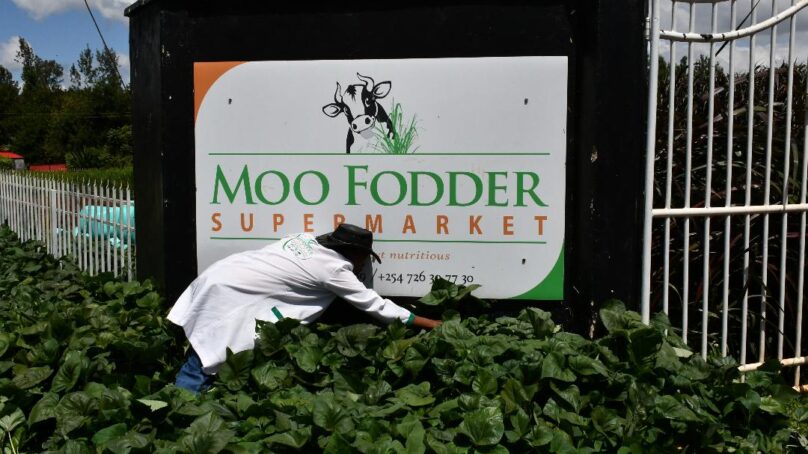
Today, his farm is exporting red nappier cuttings to farmers in 12 other African countries that include Nigeria, Democratic Republic of the Congo and Sierra Leone. But this breakthrough, according to him, could not have been possible without the help of social media platforms such as Facebook, WhatsApp, Instagram and Tik Tok where the business goes by the tag name Moo Fodder Supermarket.
“When I started posting my products on my Facebook page, inquiries started trickling in and it became a business. This went on and on until I got what I can call a breakthrough when I got an order of one million splits,” he narrates.
Having succeeded in getting his first clients, Kihara went further and sourced for another variety of fodder and introduced the super nappier, which he attests did quite well.
He also used this expertise to sensitize the neighbouring communities on the need to grow their own fodder for their livestock as one way of improving productivity and cutting down dependence on commercial feeds that costed heavily.
Today, his efforts are paying off handsomely with effects reverberating in virtually all counties in the form of silage or cuttings to individual farmers. But from all the animal feeds in his farms, none has done well like the Australian Red nappier, which has become a darling for many.
However, that does not lessen the importance of other feed crops such as juanca grass and nacedero that have been in high demand due to their high protein content and ability to ward off livestock diseases.
For instance, a cow that fails to eject the placenta after giving birth is fed on nacedero leaves to cure the complication.
“The Australian red nappier, which is also known as Australian purple nappier has elicited massive interest from in the country. We have also sold it to other countries and I can say it is doing well. Most of these products are good because of their high crude protein. For instance, the Australian Red nappier has the highest crude protein product among all the nappiers in this country. The crude protein in Australian red nappier is between 20 to 24 per cent,” Kihara explains.
Apart from its high nutritional value, Australian Red nappier is unrivalled in terms of productivity. For instance, a single acre of land can yield between 180 and 200 metric tonnes of biomass per year. Besides, it has a high growth rate compared to traditional nappier varieties where one can start harvesting his first crop between 45 to 60 days after planting.
Besides selling cuttings, Kihara also specialises in silage preparation with bulk of this product going to dry and far-flung counties such as those in the former North Frontier District and parts of Rift Valley. However, some of the silage is sold to local farmers for use in feeding their livestock during the dry season.
A 70-kilogramme bail of silage goes for around Ksh1,050 and can last for as long as three years if stored under the recommended conditions. On the other hand, a single split of red nappier goes for Sh50 for retail purchases and Ksh15 for those buying in bulk. However a client can negotiate depending on the number of cuttings one needs.
“We usually do silage for super nappier but we are yet to start for the red nappier. We have about 75 hectares in Mweiga where we are doing silage. Out of that we have established outlets for our sales. We started with this one here on Ruring’u-Kiandu road and then went to Gatitu, Karatina, Chaka Milimani and Sasini. We are also planning to establish another farm in Othaya opposite the deputy county commissioner’s office in coming days,” he added.
Besides selling animal feeds, the farm also trains individuals and groups on best farm practices on growing fodder. The farm has also opened employment opportunities for many youths who work as marketers on a part time basis.
A dozen other workers serve on a daily basis in tending the farms while others are often called upon to work as casuals during the harvesting and packaging of splits for sale.
“Our market is on social media since it’s the largest marketing platform in this world. It is the place where you get to meet people from diverse backgrounds. Here we get customers even from Diaspora-Kenyans living in the UK, the US, Switzerland and Canada. Customers can then place their orders and then send their money either using Western Union or Send Wave before we fly their products to their various destinations,” Kihara explains.
As we concluded our visit at the farm, it was clear Moo Farm Supermarket will remain the main investment for this former printer for many years unless another goldmine opens up. For now, he is content to continue working in the farms rearing fodder for animals while the rest of the country grow food crops to feed the nation.
Kihara is also grateful that farming has enabled him not only to take care of his family but empower the immediate community into becoming their own masters by tiling the land.
“This business has given me a lot of money. I have never seen any other business that can potentially give you the kind of money this fodder business has given me. I have been able to educate my three children up to university level and I am happy they are doing productive work without bothering me,” he said as we wrapped our visit.
“I have also been able to build a house and I am now planning to build another one for my retirement in Mukurwe-ini. We have also been able to buy land besides importing two silage halers from China, still using proceeds from this business,” he says.
- A Tell Media / KNA report / By Samuel Maina and Stephen Nderito


About author