



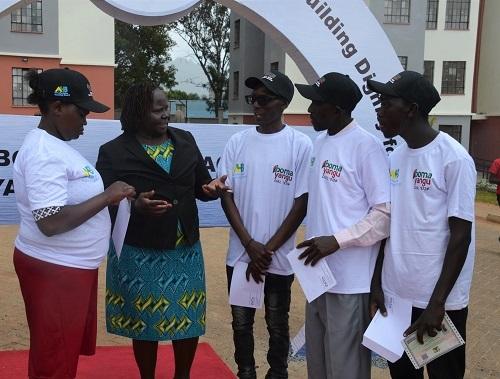
As the world marks World Youth Skills Day 2026 under the theme “Skills for a Shared Future,” Kenya’s Affordable Housing Programme (AHP) is emerging as more than a housing initiative, it is becoming a platform for skills development, youth employment and workforce certification.
At an AHP construction site, a young mason can judge the quality of a wall by touch, knowing whether the mortar mix is right and whether the structure will endure for decades. Yet, despite years of experience, many artisans lack formal qualifications that recognise their expertise.
Bridging this gap between practical skills and formal certification is at the heart of Kenya’s evolving approach to workforce development.
In the decades following independence, Kenya focused on expanding access to higher education. University places were limited, and earning a degree was widely regarded as a pathway to stable employment in both the public and private sectors.
Over time, the country significantly increased university capacity through the expansion of public institutions, the elevation of constituent colleges to university status and the growth of private universities.
According to a statement from the Affordable Housing Programme, University Statistics Report 2024/2025 shows that degree enrolment reached 628,541 students in 2024, reflecting one of the country’s major educational achievements.
However, the rapid growth in graduate numbers has outpaced the expansion of the labour market, creating new challenges for young job seekers. Education experts now argue that success should no longer be measured solely by enrolment and graduation rates but by graduates’ ability to meet the demands of today’s economy.
Employers increasingly seek candidates with practical experience, digital skills, communication abilities, teamwork, problem-solving capacity, safety awareness and the willingness to continually learn and adapt.
The same expectations extend to Technical and Vocational Education and Training (TVET) institutions, whose strength lies in producing graduates with occupational competence.
Rather than viewing universities and TVET institutions as competing pathways, education stakeholders say both should produce competent, ethical and adaptable workers.
University students require greater exposure to industry through structured internships and workplace learning, while TVET trainees need access to modern technologies, entrepreneurship training and clear opportunities for career progression.
The Affordable Housing Programme is demonstrating how national development projects can serve as centres of skills development.
Beyond constructing homes, AHP sites provide hands-on training in masonry, carpentry, plumbing, electrical installation, steel fixing, finishing, site safety and modern construction techniques.
Working in partnership with the National Industrial Training Authority (NITA), the programme also enables experienced artisans to receive formal recognition through the Recognition of Prior Learning (RPL) framework.
More than 1,200 artisans have already been assessed and certified under the programme, giving nationally recognised value to skills acquired through years of practical work. Recognition of Prior Learning allows workers to have their knowledge and competencies assessed regardless of where or how they acquired them.
Instead of requiring experienced workers to return to full-time classrooms, the system enables them to present evidence of their experience, complete practical assessments, address any identified skills gaps and earn nationally recognised qualifications.
For many artisans supporting families, this approach is particularly valuable. Traditional training often requires workers to leave employment temporarily, reducing household income. Under the work-based model, construction sites become both workplaces and classrooms that allow workers to earn an income while upgrading their skills.
The resulting qualifications improve employment prospects, increase earning potential and create opportunities for entrepreneurship and work beyond a single construction project.
As Kenya commemorates World Youth Skills Day, the Affordable Housing Programme illustrates how infrastructure projects can also become investments in human capital.
The programme reflects the broader vision behind this year’s theme, “Skills for a Shared Future,” by combining practical training, industry partnerships and formal certification.
Going forward, education success may increasingly be measured not only by the number of students entering universities or graduating, but also by competence, employability, productivity and the dignity of work.
When graduates can apply their knowledge, artisans receive formal recognition for their experience and young people can continue learning without sacrificing their livelihoods, education becomes more than a certificate – it becomes a foundation for stronger communities, sustainable livelihoods and shared national progress.
- A Tell Media / KNA report / By Joseph Ng’ang’a


About author