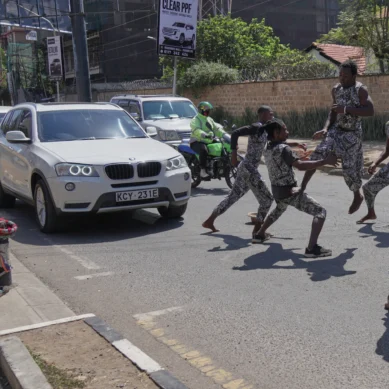




Acrobats are materialising at traffic stops in and around the Kenyan capital of Nairobi, providing entertainment to motorists stuck in jams.
As the light turns red at a busy intersection in the Kenyan capital, a young man costumed in leopard print emerges into the street to perform somersaults. He is joined by five others, dressed similarly, as they execute a combination of acrobatic stunts.
One of them, juggling woven hats, breaks away and approaches the drivers of vehicles that have come to a halt. He’s hoping for generous tips as he presents his hat to driver after driver while his mates continue their routine. The group breaks away as soon as the traffic lights turn green.
Nairobi’s street acrobats first began appearing in 2020 during the Covid-19 pandemic, and they have since become normalised at traffic stops in and around the city, with acrobats taking advantage of gridlocks to perform in exchange for cash tips. It is how they earn a living.
Mohammed Nyale, 22, said he started doing acrobatics hoping for a life-changing occupation.
“I have always loved acrobatics since I started performing at 15 years old,” he said.
Nyale and others in his group left their rural homes on the Kenyan coast with dreams of on-stage careers and sold-out theatres, but they have so far settled for the streets, performing their stunts for motorists in Nairobi’s never-ending traffic.
Nyale’s group gathers in the early mornings in an abandoned field in Nairobi’s impoverished neighbourhood of Kawangware to rehearse their routines. Next, they move into the streets as traffic starts to build up during the morning rush hour.
“We say a prayer before changing into our costumes,” Nyale said.
They usually perform until noon, taking turns to collect tips from motorists. The amounts given tend to be small, usually no more than 50 shillings (about 40 US cents). Because many Kenyans keep money in mobile wallets, the acrobats also hand out slips of paper with their phone numbers to which tips can be sent.
On a good day they might each earns roughly $6, enough to look after their basic needs, though on some days they make more. That is equal to the daily wage of most casual labourers in construction or agriculture in a country where unemployment is widespread.
The youth unemployment rate stood between 4.9 per cent and 9.9 per cent in 2024, according to figures from the Kenya National Bureau of Statistics.
Earning money from street performances “is what enables us to live in Nairobi because we moved here from quite far and no one is helping us to pay rent,” Nyale said.
They have rivals. Acrobatic troupes have materialised in other parts of the city. Across town, a group including 28-year-old Jackson Okoth entertained motorists along Lang’ata Road.
“There are no opportunities for us that we can go to, so we like it when we are here because it keeps us busy and it keeps us fit also,” Okoth said. “Instead of staying at home and doing reckless things, we decided to come here and perform for motorists and pedestrians.”
Okoth dreams of playing in a professional circus and touring the world.
“I am still on my way, I am still trying, I am still working hard so that one day things might go well and I may find myself in Europe performing in a circus show,” he said.
Some motorists see the acrobats as a nuisance. Others welcome the distraction.
“They are a source of entertainment here on the road. They entertain us and we feel good,” said Geoffrey Kioi, a Nairobi entrepreneur who regularly gives tips to the acrobats. “They are young people. They need to hustle. They are like my sons.”
- An AP report

About author