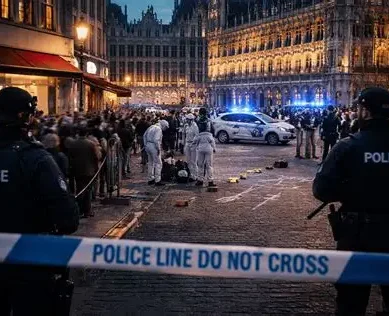

Gun violence has surged again in Brussels, with six shootings reported over just four days in the Midi police zone in late August and poses a challenge to the security in the Belgian capital.
Brussels Chief Prosecutor Julien Moinil said at a press conference on August 28 that the capital recorded 102 shootings in 2025 and another 69 in 2026 so far.
Several recent incidents have been linked to conflicts between drug trafficking networks, while Interior Minister Bernard Quintin has described the situation as a “national emergency.”
Moinil warned that the violence was no longer confined to criminal circles and that ordinary residents were increasingly at risk.
“Any citizen can get shot,” he said, citing the case of a father with no known links to criminal activity who was left paralysed after being shot. The latest wave included an attack on a police facility in the Midi police zone. Prosecutors have linked some of the recent violence to retaliation between two drug trafficking networks.
However, they said no link has yet been established between that conflict and the attack on the police facility. Moinil called the incident “a direct attack on the state.”
Belgium’s National Drugs Commissioner Ine Van Wymersch recently told Belgian media, citing an estimate by a Brussels police official, that a single street-level drug-dealing point can generate between 50,000 euros and 80,000 euros (about $58,000 to $93,000) a day for criminal groups. She said rival groups once maintained relatively stable territories when cannabis dominated parts of the street drug market.
As the more lucrative cocaine trade became more prominent, dealing points grew more profitable, increasing the incentive to fight for territory.
Prosecutors said criminal networks are increasingly recruiting young people as street-level operatives. Belgian media investigations have also found that some networks use social media and messaging platforms to recruit people for violent assignments.
Some gang leaders operate from abroad, while others remain capable of directing criminal activity from prison. Moinil cited a shooting case this summer in which a suspected organiser was in prison and used a smuggled mobile phone to communicate with people outside. He has called for tighter controls on prison communications, including mobile-phone signal jammers in areas housing organized crime figures.
The drug economy extends well beyond street dealers. Federal police investigations have uncovered networks involved in drug supply, storage, packaging and distribution.
Brussels prosecutors said about 203 million euros ($235 million) in criminal assets have been seized since the beginning of 2025, while hundreds of businesses linked to drug trafficking have been closed. The gun violence has also renewed debate over the fragmented structure of policing in Brussels.
The capital’s 19 municipalities are currently divided among six local police zones. Following the latest shootings, Brussels mayors agreed to place anti-drug violence operations across the six zones under a single “Gold Commander.”
Separately, legislation approved earlier this year provides for the six zones to be merged into a single Brussels police zone on Jan. 1, 2028. Local media reported that the Brussels region is also expected to appoint a regional commissioner for security and drugs within about 40 days. The Brussels prosecutor’s office currently has 49 prosecutors, compared with an authorized staffing level of 63.
Moinil has called for around 10 million euros ($11.6 million) in additional resources, while stressing that judicial action alone cannot solve the problem and that prevention, public health and youth policy must also form part of the response. Quintin and Justice Minister Annelies Verlinden outlined additional measures in parliament on September 2.
Quintin said authorities had “too often looked away” from drug-related violence in the past and that investigative tools must evolve as organized crime changes. He also acknowledged that there was “no miracle solution.”
Earlier measures included deploying 40 additional federal police officers, installing 20 mobile cameras in drug-trafficking hotspots and strengthening coordination among police, prosecutors and municipal authorities.
On August 28, more than 600 personnel, including over 450 police officers and at least 60 military personnel, took part in a large-scale operation. It marked the first time the military had joined this type of integrated security operation. Police detained dozens of people and seized weapons, drugs and cash.
Quintin said the operation was intended to send the message that Brussels’ streets and metro stations belong to residents. He stressed that no single measure would be enough to dismantle organised crime linked to drug trafficking.
The latest shootings point to a criminal economy that goes beyond isolated incidents, linking local dealing points to wider networks, prison-based coordination and substantial illicit profits.
“Shootings may come and go in waves, but the drug trade behind them remains,” Moinil said. Despite months of raids, seizures and reinforced patrols, the trade continues to sustain the conditions in which such violence can recur.
- A Tell Media / Xinhua report

About author