
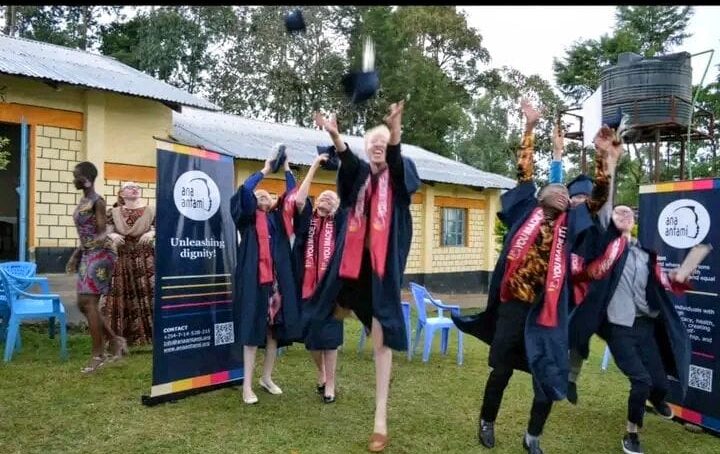
This is not simply the launch of an organisation nor is it only merely the transition of Ana Antami from a community-based organisation (CBO) to a fully-fledged registered NGO but hope and future for many learners with albinism within the region.
As former British Prime Minister Winston Churchill once said, “The price of greatness is responsibility ….” This can be demonstrated by what we are celebrating today. It is a moment carved out of courage, born from tears that were once shed in silence, and shaped by years of quiet resilience.
For too long, children born with albinism have stood at the edges of classrooms and playgrounds, at the edges of conversations about their own future. They have been stared at before they were understood.
Judged before they were known, branded names, whispered about before they were welcomed, bullied around and about their colour and above all doubted if they were real human like the other children bearing in mind that their skin pigmentation singled them out from the other lot…..it is this stigmatization that one little girl then had to endure the pain of being told you’re not one of us like us, are you even a living thing or a spirit.
“We have even been used as scaring beings for the crying and nagging babies where our purported presence was expected to frighten the child and stop them from crying.”
Worse still is the pain of being raped and or defiled by victims of HIV/Aids as it is believed that the infected person will get cured of the disease if they sleep with persons with albinism and this has seen many albinos having been infected with the disease resulting from the harrowing rape ordeals with South Nyanza recording the highest number of albinos infected with HIV/Aids.
“Many women with albinism have been raped and infected with this disease and this myths and misconception has seen surging numbers being high in South Nyanza, which has quite a high population of people with albinism, this is physical and mental trauma being inflicted on them,” she said.
She observed that through this kind of exclusion and stigmatisation, many of the people with albinism are meek and have low self-esteem because of the traumatic ordeals they undergo throughout their lives while the other part they are very angry and aggressive as a protection measure against their tormentors.
“At one point a fellow pupil acting from curiosity and stories she had heard from her parents narrate about albinism, she grabbed my arm and slit it with a razor blade just to prove if I had red blood like the rest of the pupils as she had been told albinos had green blood instead of red and were not humans but spirits.” she quipped.
Many years later after her arm was slit and she bled red, she was secluded from the public by her fellow pupils who found her different and always trying inventory theories on her just to prove that indeed she was human.
The little girl is now a grown woman and founder of the Ana Antami Community a nongovernmental organization (NGO) that trains and accommodates learners with Albinism.
Welcome to the World of Sharleen Tunai Lumumba, founder of Ana Antami – an NGO that runs a training college for learners with albinism.
She talked to Tell Media writer Isaiah Wakhungu Andanje on her journey of being segregated from her childhood friends to shield her from stigma to her new found stardom where she can stand up and defend persons living with Albinism through her foundation.
What is Ana Antami? It is Arabic for I Belong, which means ‘She has agreed to be who she is and she is proud’ as it is not a sin to be born with the skin condition hence it is not right for one to judge, demean or define them by the colour of their skin.
The NGO situated in Malava town, some 30 kilometres north of Kakamega town in western Kenya, is committed in working on four thematic areas including health, skin cancer prevention and treatment, eye care to persons with albinism, education and livelihoods.
In education, the organisation has rolled out ‘Hatua Mpya’, Kswahili for ‘New Beginning’ programme targeting to train learners with albinism in fashion and design where they apply art to make the difference in the finished products and she is working on how she will expand the program by further introducing more skilled courses so that she can reach out to more learners who needs to diversify their learning.
Sherleen is also planning on how she will offer a conducive environment to the learners from classrooms, learning materials to dormitories considering that most of them are myopic (short sighted) and needs special reading glasses, laptops and blackboards that will conform to their conditions.
On livelihoods, the NGO has ensured that the graduates are linked to jobs besides being trained in business start-up skills to enable them be self-employed.
The founder has also taken it upon herself to educate the learners on the need to know their legal rights and justice as a means to protect themselves against any forms of injustices leveled against them.
“The experiences we have had from our families and society has led to many of us being self-centred as it has also affected how view ourselves and the response has been gradual and we still doubt ourselves if we are r3ally doing the right thing and even with this training we care having a low cohort turn up as many are not sure of what we are doing if it is the right thing and fear that they could be getting duped for them to end up being sold.
She has noticed that during the application of the course, which is free many applicants sign up for the courses but when it comes to reporting time only half show up as many are afraid of the unknown expectation.
“We are giving this free scholarship to them as most of the children born with albinism come from very humble backgrounds, hence education becomes a tall order and this is what has prompted us to begin this campus to equip them with necessary learning and survival skills to fend for themselves,” she explained.
Also, they have been encouraged to be able to mitigate and respond to effects of climate change as it directly affects their wellbeing as persons with albinism.
The Malava campus is up and running. Already the first cohort graduated in February this year and already the next intake is ongoing.
“I started this initiative to assist learners with this condition after it became evident that they were being side-lined and mocked in mixed learning institutions as the government is yet to start assisting them by constructing special schools for them among other assistance.”
The derogative name-calling, albinism made-up stories, the side-lining and stigmatisation is what motivated Ms Lumumba to prove to the world that despite their skin colour they were normal human beings after all.
She reveals that all the stigmatisation stories by persons with albinism are similar because they cultures they are born in are similar.
As the campus continues to create more impact it is yet to gain any governmental support despite being recognised by it and also the non-governmental board has applauded our efforts but it is only the Kanthari Switzerland foundation has stepped in as the main sponsor to ensure that the campus has office, training space and materials to commence the training process.
Their future plans is to grow the initiative from a CBO to an NGO. According to the census statistics, the population of people with albinism in hr jurisdiction is above 9,000 but she refutes the sum noting that they are way too many only that many fear to come out to be counted as they are scared of being identified where they live be attacked.
During campaigns period, people with albinism start to disappear as politicians, especially in Coast region, believe that the body of an albino used in witchcraft will bring good fortunes will hand them election victory, riches and the power to succeed in all spheres of life, especially politics. This indicates that they do not believe in the government for their own protection and have to hide lest they abducted and murdered.
“Our main objective is to give them that free space to life to access employment, social amenities, resources, create more impact especially in rural areas to give them self-acceptance as they’re just like the other human beings.
“Through this training we are re-instilling confidence in them so they can also feel part of the society through true equity and without marginalisation and even run for the political positions, which is their five per cent reserve as per the constitution that has set aside for persons living with disability (PLWD).
According to the Ana Antami prospectus, fashion and textile design trainer Grace Achieng, has mastered the art of equipping the trainees with practical and creative skills in fashion design, garment making and textile techniques preparing them for employment and entrepreneurship in the fashion industry.
Her journey as a trainer has been successful as she celebrated the first batch of graduates last month where she mentored them in fashion and textile design, garment cutting and construction, pattern making and basic tailoring skills.
“It is so satisfying to see the learners evolve from beginners to confident designers and professionals, and this has been my most rewarding part of my career” in the 10-month training programme, where theory is seven months while the remaining three are for internship after which they graduate and are awarded their certificates.
The college is open to youth and adults who are interested in building skills towards employment or starting their own fashion business.
“To join this college, learners should show passion, commitment and basic literacy skills as no prior experience is required as they are trained starting from the beginner level,” she pointed out.
However, limited resources and equipment to meet the growing numbers has been one of the many challenges despite them working hard to continue providing quality training and hands on experience to produce well competitive graduates within the fashion industry.
The trainer maintained that at Ana Antami training college, empowering learners with practical skills, creativity and confidence to build sustainable careers in the fashion and textile design was their core business of the day.
The guest of honour was Nathan Ochunge, executive director of County Splash Development Programme (COSDEP) lauded the launch of the NGO, which was also acting as a training college for persons with albinism.
“As we launch this NGO and celebrate the graduation of our first cohort, we gently but firmly move them from the shadows of the margins into the warmth of the centre of our shared humanity. Today, we speak not with pity, but with pride – declaring that beauty is not measured by conformity, but by the courage to be comfortable in your own skin, because no child, no woman and no man should ever be judged, diminished or defined by the colour they were born with.
“Beauty is the quiet confidence of a child walking into a classroom without fear of whispers behind their back. Beauty is the smile of a young person who has finally learned that their reflection is not something to hide, but something to celebrate”
The director said persons with albinism are not made vulnerable by their bodies but by societies that have failed to protect their dignity, failed to challenge their myths, and failed to build systems strong enough to hold every child safely under the same sky.
Their vulnerability is not biological, it is social. It is written not in their genes but in our silence. It is carved not in their skin, but in the gaps of our protection, in the absence of our empathy and in the distance between what we know and what we choose to act upon.
As Winston Churchill once said, “The price of greatness is responsibility….” This can be demonstrated to what we are celebrating today. It is a moment carved out of courage born from tears that were once shed in silence, and shaped by years of quiet resilience.
“Today, we choose differently, we choose light over fear, knowledge over myth, inclusion over exclusion. We have choose to see persons with albinism not as fragile lives needing protection alone, but as powerful stories waiting to lead, to create, to design, to speak and to change the world because dignity is not granted by society, it is restored when the society finally learns to see every human being as equal in worthily in dreams, and in destiny.
“Today,” he pointed out, “we declare with clarity and conviction that persons with albinism are not as an afterthought in our national story. They are not a footnote in our development agenda. They are not a symbol of superstition or silence. They are sons and daughters of this soil. They are dreamers. They are artists. They are leaders in the making…
According to the 2019 Kenya Population and Housing Census conducted by the Kenya National Bureau of Statistics (KNBS), there are 9,729 persons living with albinism in Kenya, representing approximately 0.02 per centof the country’s total population.
Behind that number are children who once felt invisible, families who carried fears in silence and communities that are slowly learning to replace myth with knowledge. Yet, even this official figure tells only part of the story.
Data from disability advocacy outreach shows that the National Council for Persons with Disabilities (NCPWD) has registered about 3,800 persons with albinism, meaning thousands more remain unregistered, uncounted for in formal support systems and still searching for access to essential healthcare, education support and protection.
Some advocacy voices suggest that the real number could be higher, reminding us that statistics are not just numbers and they are lives waiting to be seen.
The scribe hailed the transition from a CBO to NGO as not just about paperwork but about permanence, building structures that are strong enough to protect dignity and sustain hope. It is about saying that compassion must become policy that empathy must become budget lines and that awareness must become action.
“Ana Antami is proof that pain can become purpose. That exclusion can become empowerment. That one voice (Sherleen Lumumba) when it refuses to be silenced can gather many others and form a movement,
And as we gather here to witness this new chapter, we are not just launching an organisation but lighting a beacon,” Ochunge said.
In his captivating speech the director reminded the masses that around the world, respected voices have echoed their voices reminding us that albinism is not a mystery to be feared but a human condition deserving understanding and protection. The late Sameera Moussa once said, “We are not ghosts. We are human beings.”
It is on record that those simple words capture a painful truth that too often, persons with albinism have been dehumanised by myth and superstition.
Similarly, Ikponwosa Ero, the first United Nations Independent Expert on the enjoyment of human rights by persons with albinism, reminded the global community that “Albinism is a genetic condition, not a curse,”
Her advocacy at the United Nations elevated what was once seen as a local stigma into an international human rights issue.
These voices echo what Ana Antami represents today: That albinism is not inability; it is identity. Not weakness, but uniqueness. Not limitation, but leadership waiting for an opportunity to thrive.
Despite the many efforts to care for children born with albinism, Kenya is still grappling preventable skin cancers because sunscreen is often inaccessible and this has many of them struggle in classrooms because visual impairments are not accommodated.
“These are not natural outcomes, they are systemic gaps. When a child cannot access dermatological care that is a health system issue. When a learner cannot see the blackboard that is an education policy issue. When discrimination goes unpunished, that is a justice issue.
“Ana Antami has demonstrated that change must be comprehensive. Through Hatua Mpya, economic empowerment restores confidence. Through Nihamasishe, myths are replaced with knowledge. Through Maliza Cancer, lives are protected. Through Linda, rights are defended. Through Nilivyo, climate inclusion ensures that vulnerability is not ignored in times of crisis. This is not fragmented charity, it is structured dignity.
“As this organisation grows, so must our collective responsibility. I call upon the Ministry of Health to strengthen access to sunscreen and dermatology services and to recognise sun protection as essential healthcare. I call upon the Ministry of Education to deepen inclusive education reforms so that no child with low vision is left behind.
“I urge closer collaboration with the National Council for Persons with Disabilities to ensure policies translate into measurable outcomes at county level.”
He called on parents to support their children and assured them that parents gathered their children are not a symbol of misfortune but symbols of resilience.
Encouraging those with the condition, “And to the young people with albinism listening today, you are not defined by stigma. You are defined by your talent, your intelligence, your creativity and your courage.
“Let Malava be remembered as the place where a community chose understanding over fear, inclusion over exclusion and action over silence.
“Let this launch mark the beginning of stronger partnerships between civil society, government and community leaders. Ana Antami is more than an NGO, it is a movement aligned with a global call for human rights, equality and dignity.
May its light grow brighter. May its advocacy shape policy. May its programs save lives. And may every child born with albinism in Kenya grow up knowing not only that they are protected, but that they are celebrated.” he said.
- A Tell Media report / By Isaiah Wakhungu Andanje


About author