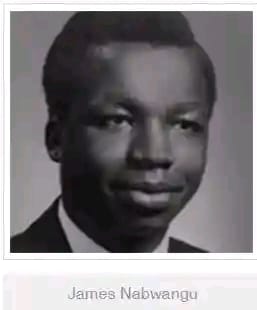


Dr James Nabwangu, a neurosurgeon in the Dakota was the first student of African descent to graduate from the Johns Hopkins Medical School, and the first doctor of African descent to complete training as a neurosurgeon.
Yes, Kenyans do things in style! He graduated from Alliance High School where his academic performance set records across the entire British Commonwealth – 54 countries – and was part of the Kennedy Air Lift programme.
After completing his basic medical training, Dr Nabwangu elected neurosurgery as his specialty and studied under the pioneers of modern neurosurgery, such as Dr Wilder Penfield at the Montreal Neurological Institute. There he met and married Dr Marie Joubert, a French Canadian paediatric neurologist after whom the “Joubert Syndrome” is named.
Dr Nabwangu up to 2008 he was still practising neurosurgery in Rapid City, South Dakota.
He published a book titled Of Race, Intelligence, Africa and Dr Watson: A Personal Perspective, an autobiographical expose that was undertaken in the light of Dr Watson’s comments.
When he was a freshman in college, James Nabwangu read an article in Life magazine about how difficult it was to gain entry to the Johns Hopkins School of Medicine. Nabwangu didn’t know at the time that the school had never accepted a student of African descent. He simply viewed attending Johns Hopkins as another potential challenge in his life.
He had already overcome the challenge of moving from a rural village in Kakamega, West Kenya, to attend college in Indiana. And he had already proved wrong a college counsellor who told him that despite his outstanding high school academic record, he was not well-suited for a career in medicine or the sciences.
Nabwangu did, indeed, contradict the naysayers, and in 1967 became one of the first two blacks – and the first African – to graduate from the Johns Hopkins School of Medicine.
Although he could not get a haircut or eat in restaurants around the school, Nabwangu enjoyed his time at Hopkins. He found that many of his classmates did not know what to think about his African heritage. He also found that the university supported him when a Kenyan ambassador attempted to prevent his study of neurosurgery because of Kenya’s need for generalists not specialists.
After Johns Hopkins, Nabwangu moved to Canada for postgraduate studies at the prestigious Montreal Neurological Institute. A fellow of the Royal College of Surgeons of Canada and a diplomate of the American Board of Neurological Surgeons, Nabwangu practised neurosurgery in Rapid City, South Dakota.
Source: The Indispensable Role of Blacks at Johns Hopkins
The first Kenyan man and woman to be admitted at the prestigious Harvard University were from western Kenya – Yes you got that right.
Hilary Ng’weno: Joined in 1957, graduated with a degree in nuclear physics. A Kenyan from western Kenya and first African was studying a degree in nuclear physics in 1957 at Harvard University!
Julia Ojiambo: Enrolled at the Harvard School of public health in late 1968, making her the first Kenyan woman to be admitted to the institution. Prof Julia Ojiambo was the first African woman to graduate with a PhD degree from the University of Nairobi with a joint programme with McGill University. She was also the first African woman to be appointed a lecturer at the University of Nairobi.
Hilary Ng’weno studied nuclear physics but chose to return home where application of his speciality was very limited. He pursued journalism, today, he is referred to as the father of investigative and interpretive journalism in Kenya. The Weekly Review man and Stellavision (STV) owner was the first indigenous media owner. If you’ve ever watched the series of documentaries called Makers of a Nation he is the brain behind it. That probably explains – in part – why many Luhyia men and women took and excelled in journalism.
When called a Watchman merely because you are from western Kenya, agree with them that you are a watchman!
Prof Hillary Peter Ojiambo LMS, MBCHS, MD, FRCPE, FRCPG, FACC
He was professor of medicine and cardiac medicine was the first Kenyan cardiologist. As a legacy to the field of cardiology, Prof Hillary Ojiambo devoted his time to pioneering clinical and experimental studies in Cardiomyopathies to enhance public education and the management of public health administration and founded the Kenya Cardiac Society to promote heart-healthy living.
1951-1957: Prof Ojiambo graduated with a distinction from Makerere University (1957) with a L, M.S. and MB.ChB distinction in internal medicine and the May Baker Prize in Pharmacology and Therapeutics.
1962-1963: In 1963 obtained the M.R.C.P (Edinburg) post graduate qualification majoring in cardiology and the M.R.C.P (Glasgow) post-graduate qualification in internal medicine.
1967-1968: Elected president of the Association of Physicians in East and Central Africa (APECA) representing physicians in the region who are dedicated to the provision of quality specialised healthcare.
1964-1968: Appointed consultant physician and cardiologist-in-chief to Kenyatta National Hospital, the largest referral and teaching hospital in the Republic of Kenya.
1965-1968: Appointed Editor-in-Chief to East African Medical Journal – the publication of papers on original work and reviews of all aspects of medicine in the region.
1968-1970: Work-study programme at McGill University, Montreal, Canada, including cardiology research in the area of M.D. by thesis in Cardiomyopathies published in 1970.
1971: Elected Fellow of the Royal College of Physicians of Glasgow (F.R.C.P., Glasgow) in 1971 as both a senior cardiologist and for contributions to the field of cardiology.
1972: First African in Sub-Saharan Africa to be elevated to the status of the Fellow of the American College of Cardiology (F.A.C.C.) for academic and professional contributions to the field of cardiology.
1973: While serving as the cardiologist-in-chief at the Kenyatta National Hospital in Nairobi, led the establishment of the Open Heart Surgery Programme
1974: Established the department of cardiology for the Zambian government after being appointed Professor of Medicine and Director, Division of Cardiology, University Teaching Hospital.
1976: Elected Fellow of the Royal College of Physicians of Edinburgh (F.R.C.P., Edinburg) in 1976 as both a senior cardiologist and for contributions to the field of cardiology
1978: President of the Commonwealth Medical Association, an organization committed to improving health, well-being and human rights in countries within the Commonwealth.
1980-1985: World Health Organization, Switzerland. Developed and coordinated activities for the implementation of the World Health Organisation’s Universities and the Health for All Project.
1989-1992: World Health Organization, Switzerland. Appointed as the official representative of the World Health Organization in Banjul, the Gambia.
1993-1997: International Centre for Health Development and Research, Appointed to serve as the Executive Director at the International Centre for Health Development and Research, an organisation that conducted ground-breaking research, policy development and thought leadership on cardiology, internal medicine and public health.
- A Tell Media report / Source: Agencies

About author