

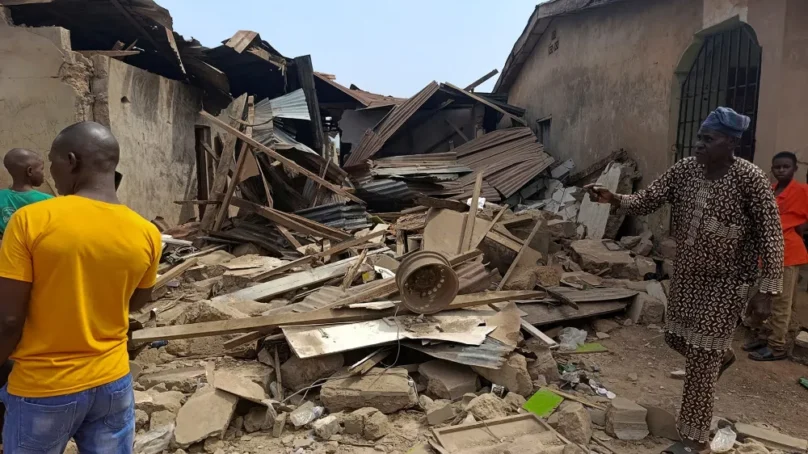
When gunmen raided Saint Mary’s school on November 21, 2025, they abducted more than 300 students – the single largest school kidnapping to date.
The following analysis of potential risks is based on exclusive reporting by Malik Samuel working with community informants who have in-depth knowledge of local insurgent groups.
US missile strikes in December on what the Pentagon described as Islamic State (IS) targets mark a significant escalation in Nigeria’s insurgent conflict, but they may not have brought a resolution to the crisis any closer.
President Donald Trump framed the December 25 strikes on north-western Sokoto State as part of a broader campaign to degrade IS and its affiliates allegedly operating in the region. He presented the intervention as necessary to protect “primarily, innocent Christians”, and to prevent the further spread of IS-linked violence.
This framing, however, sits uneasily with the realities on the ground.
There is no credible evidence that IS maintains an operational presence in Sokoto State. Patterns of violence in the area also show that the overwhelming majority of victims are Muslims drawn from the same rural communities affected by banditry, displacement and chronic insecurity.
The dissonance between the stated rationale for the strikes and the established conflict dynamics immediately raised questions about intelligence accuracy, threat perception, and the broader strategic logic underpinning the US decision.
Had the cruise missile strikes hit targets in north-eastern Nigeria, where the Islamic State West Africa Province (ISWAP) – arguably the most successful IS affiliate – is entrenched, the narrative would have been more coherent.
ISWAP has openly claimed and celebrated attacks against Christian communities in southern Borno and northern Adamawa states, routinely describing its victims as “crusaders” in its propaganda.
A similarly arguable though still contested justification might have existed had the strikes taken place in northcentral Nigeria, where armed Fulani militias have repeatedly targeted predominantly Christian farming communities. A US delegation had recently visited Benue – one of the states most severely affected by the rural violence.
Who and what did the US strikes hit?
Communities across northwest Nigeria have for years endured extreme levels of violence at the hands of multiple armed groups. The grim cocktail has included widespread killings, sexual assault and forced displacement, the destruction of livelihoods, mass kidnappings and systematic extortion.
These communities have largely been left to cope on their own, with state protection either inadequate or altogether absent. This persistent failure of governance and security has allowed the violence to deepen and spread.
Two distinct but occasionally overlapping phenomena drive the insecurity. The first is organised criminal violence, commonly referred to as banditry, which is perpetrated by armed groups composed largely of Fulani men and motivated predominantly by financial gain.
Although these groups have been formally designated as terrorist organisations by the Nigerian state, their activities remain rooted in criminality rather than ideology.
The second source of insecurity in the northwest is violent extremism. This is represented by, among others, the jihadist group known as Lakurawa. Unlike bandit gangs, Lakurawa is religiously motivated with an explicit objective of enforcing the comprehensive application of sharia law in territories under its influence. It was this group that was the primary target of the US strike.
A table containing information on various armed groups in northwest and northcentral Nigeria.
Very little is publicly known about Lakurawa. Even its name is mysterious, holding no meaning in either Hausa or Fulfulde – the main languages in the northwest. The group’s apparent Sahelian origins have led some researchers to suggest links to the Islamic State Sahel Province (ISSP). Others argue it is affiliated with the Sahel-based and al-Qaeda-linked Jama’at Nusrat al-Islam wal-Muslimin (JNIM).
In interviews, self-described members of the group asserted that it is an al-Qaeda offshoot formed in 2010. Its fighters largely originate from Mali, Niger, Chad and Nigeria, and most speak Zarma – a language that straddles the border regions – while some are drawn from the Yagamawa Fulani ethnic group.
Group members said Lakurawa initially settled in Borno State before relocating to Niger State and later Kebbi State, ultimately establishing a current base in the forested zone spanning the Gudu, Kware and Tangaza districts of Sokoto State in 2017. The informants estimated there were around 800 fighters in Sokoto.
Lakurawa initially presented itself to local communities as a protector against bandit groups and as an enforcer of full sharia law (sharia has only limited legal recognition under Nigeria’s secular constitution).
It imposed strict social and religious controls in areas under its influence. Celebrations involving music and dancing were prohibited, while mobile phones were searched for “unholy” content, with SIM and memory cards destroyed.
Non-bearded clerics were removed from their positions and barred from leading prayers. It also intervened in local markets to impose price controls, and the sale of cigarettes and alcohol was banned.
At the outset, communities were reportedly encouraged to pay taxes in the form of livestock, particularly cattle, framed as zakat or religiously sanctioned contributions. Over time, this arrangement deteriorated into outright confiscation, with cattle seized without the consent of their owners whenever they were discovered.
Despite these coercive practices, Lakurawa generally sought to avoid indiscriminate attacks on civilians. Violence was largely directed at individuals who refused to comply with its demands, particularly the payment of zakat. Increasingly, though, Lakurawa became more punitive, attacking communities and killing villagers unprovoked.
As part of its broader ideological goals, Lakurawa had sought to co-opt bandit leaders. These efforts have been largely unsuccessful. Bandit groups are primarily motivated by profit and have demonstrated little willingness to abandon lucrative activities such as kidnapping, cattle rustling and extortion in favour of strict behavioural codes that also outlaw drinking and sex outside of marriage.
The US strikes – in collaboration with the Nigerian authorities – are believed to have been by Tomahawk missiles fired from a destroyer stationed in the Gulf of Guinea. They hit three districts in Sokoto: Isa, Tangaza and Tambuwal. Yet only Tangaza is widely recognised as a core area of Lakurawa activity.
Tambuwal, by contrast, is not generally associated with organised armed violence; while Isa is a long-established bandit stronghold largely controlled by Bello Turji, a prominent bandit leader. Although specific details of the strike on Isa remain unclear, Turji is widely believed to have survived the attack.
A Lakurawa camp in Tangaza, however, reportedly suffered significant losses. US Africa Command – closely mirroring Trump’s characterisation of the targets – insisted it was “ISIS terrorists” that were killed.
Trusted informants told The New Humanitarian there were two missile hits. The first reportedly killed around 30 fighters. As surviving members converged to assess the damage and assist the wounded, a second missile struck, killing those who had gathered. In total, an estimated 155 Lakurawa were killed, including 19 who were initially injured but later succumbed to their wounds.
Dando Sibu, a key Lakurawa commander (see the who’s who section above), is reported to have survived the attack only because he left the location less than five minutes before the second missile’s impact. However, in the week following the strikes, approximately 200 Lakurawa fighters were reported missing. The group was also said to have lost nearly half of its cattle, which constitute a major source of its revenue and logistical support.
Nevertheless, the group managed to launch a major attack on the town of Birnin Yauri in Kebbi State on December 31. In the raid, which lasted several hours, at least 21 civilians were killed, with nine reportedly beheaded.
The US focus was Lakurawa. Yet untouched by the strikes were other jihadist groups in the northwest, including a franchise of Jama’atu Ahlis Sunna Lidda’awati wal-Jihad (JAS), better known as Boko Haram, as well as the al-Qaeda-linked Ansaru.
The JAS franchise, led by Abubakar Saidu, popularly known as Sadiku, operates in Niger, Kebbi, and Kwara states and is believed to have been responsible for the kidnapping of 300 children from a Catholic school in November. A week after the US launched its missile salvos, the faction was also accused of an attack on Kasuwan Daji Market in Niger State that killed at least 30 people.
- A Tell Media report / Republish with permission of The New Humanitarian


About author