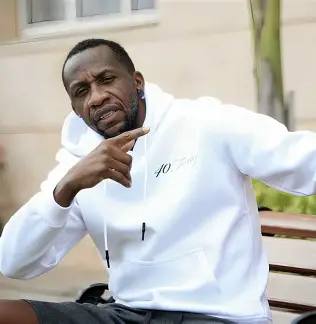

Mathews “Ottomax” Owino, born in Nairobi in 1974, remains one of the most colourful, talented and unforgettable goal-keepers Kenyan football has ever produced. Ottomax’s story began in Eastleigh where as a boy he was once asked by older boys to stand between two sandals being used as makeshift goalposts, an innocent moment that unknowingly introduced him to the position that would later make him famous.
He attended Eastleigh Airport Primary School before joining Kangaru High School in Embu, with football playing an important role in opening doors for his education. He became one of the pioneering youngsters associated with the Mathare Youth Sports Association, where the late Bob Munro is credited with giving him the nickname Ottomax – a name that would eventually become bigger than his official surname in Kenyan football circles.
In 1990, he was among the early group of MYSA boys who travelled to Norway for the Norway Cup, an experience that exposed the young boy from Nairobi to international football and strengthened his self-belief that the game could take him far. He later played for Undugu FC before earning a breakthrough with Re-Union FC in early 1990s.
His introduction to top-flight football was brutal – conceding six goals in two matches during one difficult weekend. Instead of disappearing, Ottomax fought back, improved and eventually established himself as one of the most promising young goalkeepers in the country. His performances attracted the attention of national-team selectors while he was still very young, and by the mid-1990s his reputation was growing fast.
In 1995 he joined Gor Mahia and became part of the side that won the Kenyan league title, proving that he belonged at the highest level of the domestic game. Then came one of the boldest moves of his career when he crossed from Gor Mahia to their fiercest rivals AFC Leopards – a transfer that required enormous confidence because very few players could comfortably move between the two clubs and win acceptance from both sets of supporters.
To this day, Ottomax’s attachment is very strong.
At AFC Leopards, Ottomax helped the club win the 1997 Council for East and Central Africa Football Associations (CECAFA) club title, and the 1998 Kenyan league title, giving him the rare distinction of becoming a league champion with both Gor Mahia and AFC Leopards. His time at Leopards produced some memorable stories, including a continental match in which he reportedly played for a long period without goalkeeper gloves after the team arrived without them, only for a pair to eventually be sourced from Nairobi’s Owino Market.
Ottomax was never an ordinary goalkeeper. He was tall, athletic, agile, brave and spectacular, but he was also a showman who enjoyed playing with confidence and sometimes taking risks that left supporters either cheering or holding their mouths in disbelief. He could dominate his penalty area, pull off breath-taking saves and then moments later attempt to dribble an attacker.
One of the most famous examples came in a Harambee Stars match against Djibouti, when Kenya won heavily but Ottomax conceded after trying to dribble his way out of trouble – a mistake that became part of Kenyan football folklore.
At international level, he represented Harambee Stars during the 1990s and was involved in some memorable matches, including the 1998 World Cup qualification campaign against Algeria. Kenya won the home leg 3-1 before travelling to Algiers for a difficult return fixture, where Ottomax came under sustained pressure and later recalled suffering a serious nose injury in hostile conditions but continuing to battle for the team.
He also spoke proudly of performing strongly against a powerful Nigerian side hat had the likes of Nwankwo Kanu, Dan Amolochi, Sunday Oliseh, Augustine Eguoevon, Tijani Babangida, Tario West and Jay-Jay Okocha, among others. These were players who would later become household names in Africa and big leagues in Europe.
Yet Ottomax’s greatest strength – his personality – was also sometimes his greatest weakness. He was outspoken, fearless and extremely confident – traits that made him popular with fans but also created clashes with coaches and administrators.
His relationship with Harambee Stars coach Reinhard Fabisch deteriorated, and he was eventually dropped from the national team, something Ottomax later reflected on with maturity, admitting that ego, stubbornness and early fame may have contributed to some of the problems he encountered.
After his time with AFC Leopards, he moved to Uganda and played for SC Villa, one of East Africa’s biggest clubs, before later returning to Kenyan football with teams including Gor Mahia, World Hope and AFC Leopards again. Even in his later playing years, his strong personality continued to follow him, including reported disagreements with coaches such as Robert Matano.
After hanging up his gloves, Ottomax remained involved in football as a goalkeeper coach and trainer with clubs including Gor Mahia, AFC Leopards and Nakumatt FC, using his experience to develop younger goalkeepers.
In 2010, during the tragic Gor Mahia-AFC Leopards stampede at Nyayo National Stadium, Ottomax ran onto the pitch trying to alert officials to the danger and have the match stopped as supporters were being crushed outside, a courageous act that showed another side of a man often remembered mainly for bravado and controversy.
Away from football he also became involved in business, including the popular Forty 40 sports Bar and Restaurant in Westlands, which enjoyed success for a period before financial difficulties eventually brought it down. The years after football were particularly difficult.
Ottomax later spoke publicly about prolonged unemployment, financial hardship, loss of belongings, family separation and the painful reality of moving from national fame to struggling for basic stability. At one point he openly pleaded for work, saying he was willing to take even humble jobs if that is what it took to survive.
Those revelations shocked many fans who remembered him as the confident Harambee Stars goalkeeper who once commanded packed stadiums, but Ottomax chose not to hide his struggles. Instead, he turned them into lessons for younger players, repeatedly warning them that football careers are short and that education, saving money, discipline, humility and planning for life after sport are just as important as talent.
He has also sought to give back through goalkeeper mentorship initiatives such as “The Next Gifted Hands,” offering guidance to young keepers from modest backgrounds, and in 2025 he found a new platform in broadcasting after joining Radio Jambo to contribute to football discussions.
His life has also inspired plans for a memoir, appropriately centred on the contrast between the bright lights of fame and the difficult realities that came afterward. The Mathews Ottomax Owino story is therefore much bigger than trophies or spectacular saves. It is a story of a boy from Eastleigh who rose through MYSA, played for Re-Union, won titles with both Gor Mahia and AFC Leopards, represented Harambee Stars, tested himself at SC Villa, clashed with coaches, made unforgettable mistakes, enjoyed fame, lost almost everything, admitted his failures and still found the courage to rebuild.
Kenyan football should remember him not only as a gifted goalkeeper, but as a complicated, charismatic and deeply humane figure whose life offers powerful lessons about talent, ego, success, preparation and second chances.
Ottomax lived football at full volume, and whether people loved him or criticised him, one thing is certain: whenever Mathews “Ottomax” Owino was involved, nobody ignored him.
- A Tell Media / By Gad Turutsi

About author