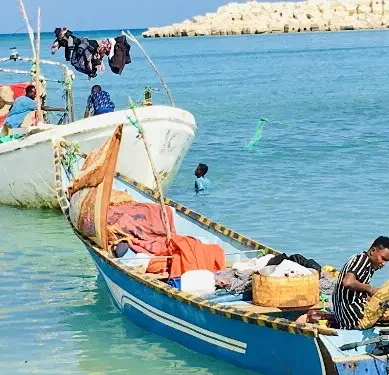


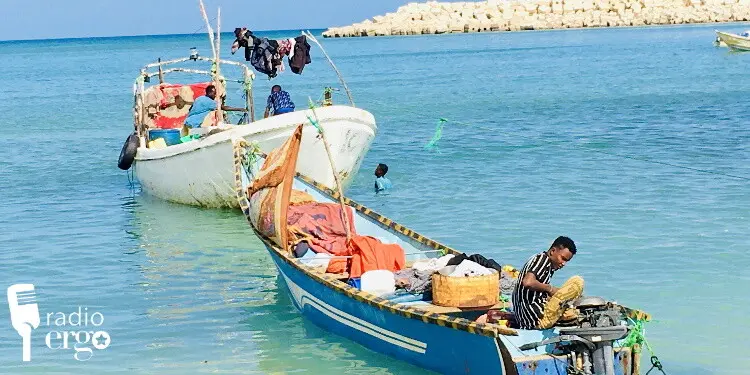
At 22, Sadam Adan starts each day by setting out to sea off Bosaso – the commercial port city of Somalia’s Puntland State – hoping for a catch large enough to support himself and help feed his family.
Adan is one of 100 beneficiaries – 80 internally displaced persons and 20 host community members – who completed vocational training at the Somali Marine and Fisheries Science Institute in Bosaso.
Established in 2014, the institute has trained participants in four practical areas: fish processing, modern fishing techniques, boat-engine maintenance and vessel operations. Adan trained in fish processing, but after completing the program, he turned to active fishing to earn a living, making about $9 on a typical day from his catch and related activities. His work takes him up to over 30 kilometres out to sea but without his own boat or gear, he relies on vessels owned by local Bosaso business owners, who take the majority of the profits.
Upon returning to shore, Adan sells part of his catch outside his home after struggling to secure a vendor spot at the local fish market.
“I would like to own my own boat and fishing equipment so that I can increase my production, support my community and improve my circumstances,” Adan said. “For now, what I earn is only enough for basic survival.”
Adan’s experience illustrates both the opportunities created by vocational training and the difficulties young people face when turning newly acquired skills into sustainable livelihoods.
Among the trainees is Rooda Ahmed Mohamed, another beneficiary of the skills development initiative supported by the United Nations Development Programme through its Saameynta project.
After learning fish-processing techniques during her 2025 training, Mohamed launched a fish-vending business to support herself and her parents, building a customer base that she said has expanded steadily ever since.
“My customers have continued to increase day by day since I started this business,” Mohamed said.
Despite her growing customer base, Mohamed’s business faces severe obstacles due to inadequate cold storage facilities and an unreliable, costly power supply.
Without proper equipment to preserve her inventory, which includes locally sourced tuna, she is often forced to sell her entire catch on the same day to avoid spoilage. Her experience shows how skills training can empower individuals to launch micro-enterprises, while highlighting the infrastructure and market constraints that continue to limit their long-term growth.
Mohamed Mohamud Quluxiye, director of the Somali Marine and Fisheries Science Institute, noted that the broader fisheries sector faces severe ongoing challenges, particularly as climate change disrupts fishing activities and surging fuel prices dramatically increase operational costs.
These ongoing developments have placed immense pressure on young people in Bosaso who rely on fishing for their livelihoods. For small-scale fishermen, rising fuel costs are especially challenging, as a full day at sea offers no guarantee of a catch large enough to cover operational expenses and turn a profit.
Despite these obstacles, the experiences of programme beneficiaries highlight the immense potential of skills development to build sustainable livelihoods for displaced people and host community members alike.
- A Tell Media / Xinhua report


About author