

Kenya and the United States have signed a landmark Strategic Objective Agreement (SOAG) for Health that will channel $1.686 billion (Ksh218 billion) in US funding and $850 million in Kenyan co-investment to strengthen the country’s health sector between 2026 and 2032.
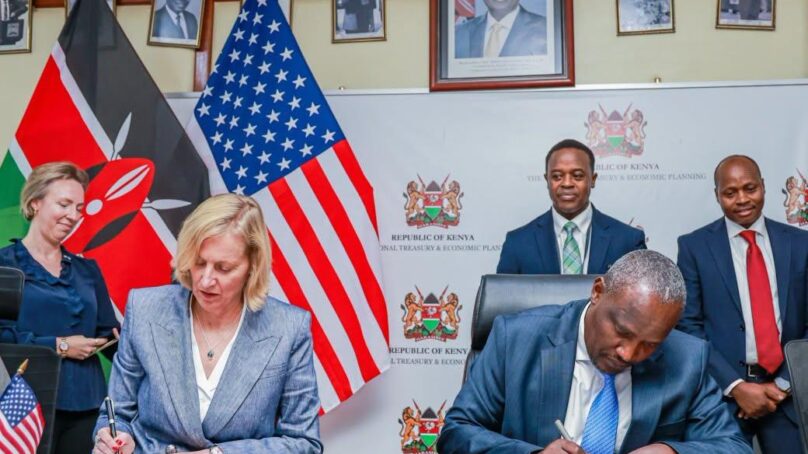
The agreement, signed at the National Treasury headquarters in Nairobi, ushers in a new phase of bilateral health cooperation through a government-to-government (G-2-G) financing model aimed at enhancing transparency, accountability and national ownership of donor-funded health programmes.
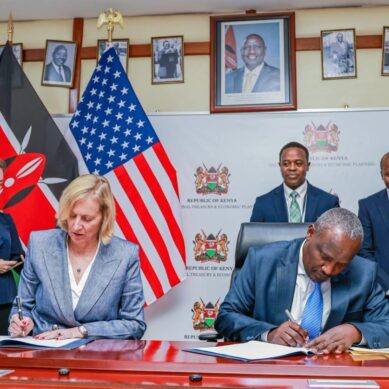
National Treasury and Economic Planning Cabinet Secretary John Mbadi and US Chargé d’Affaires Susan Burns signed the agreement in the presence of Health Cabinet Secretary Aden Duale, senior government officials and representatives from both countries.
Speaking during the signing ceremony, Duale said the agreement would support key health institutions and programmes including cancer care, the Kenya National Public Health Institute, the Digital Health Superhighway and the country’s HIV, tuberculosis and malaria interventions.
He welcomed the shift from donor-funded projects implemented through third-party agencies to direct government-to-government cooperation, describing it as a significant milestone in Kenya-US relations.
“For many years, US-Kenya health cooperation was implemented through partner agencies. Today, everything is government-to-government,” Duale said.
The new arrangement provides greater visibility of funding through the National Treasury and Parliament, strengthening oversight and accountability.
Mbadi described the agreement as another milestone in Kenya-US health cooperation, noting that Kenya is the first country to sign the new financing arrangement. He said the previous donor funding model often lacked clarity on financing commitments and implementation, making planning difficult for both the Treasury and the Ministry of Health.
“Now we have full visibility as the National Treasury, while the implementing ministry also has full accountability. At the click of a button, we can know how much is being spent with the support of our partners,” Mbadi explained.
Treasury cabinet secretary assured development partners that ongoing public finance reforms would guarantee transparency and prudent management of the funds. Burns praised the collaboration between the ministry of health, the national treasury and the office of the attorney general that led to the agreement, describing it as the first strategic objective agreement under the new Kenya-US Health Cooperation Framework.
She said the partnership reflects a transition towards shared responsibility rather than traditional donor assistance.
“We are trying to transition to a new model of assistance that is really about shared responsibility and close collaboration,” Burns said.
She noted that the United States and Kenya have worked together for decades to combat HIV, tuberculosis and malaria, helping save more than one million lives through HIV interventions alone.
According to Burns, the new agreement will support the Kenyan government’s vision of strengthening health systems, expanding digital health services, improving efficiency and ensuring continued access to quality healthcare.
The SOAG outlines shared strategic priorities, financing arrangements, implementation targets and performance measures to guide joint health interventions while reinforcing mutual accountability.
Key areas of cooperation include reforms at the Kenya Medical Supplies Authority (KEMSA), strengthening the Kenya National Public Health Institute, expanding digital health services, improving supply chain resilience, enhancing institutional capacity and supporting programmes targeting HIV, tuberculosis and malaria.
The framework also seeks to advance Kenya’s Universal Health Coverage agenda under Taifa Care by strengthening disease prevention, improving service delivery and building a more resilient and self-sustaining healthcare system.
The signing ceremony was attended by Principal Secretary for Medical Services Ouma Oluga, Principal Secretary for Public Health and Professional Standards Mary Muthoni, Social Health Authority Chief Executive Officer Mercy Mwangangi, Digital Health Agency Chief Executive Officer Anthony Lenayara, National AIDS and STIs Control Programme Director Andrew Mulwa, DPH-K Chair Brian Rettman and other senior government officials from Kenya and the United States.
- A Tell Media / KNA report / By Joseph Ng’ang’a

About author