



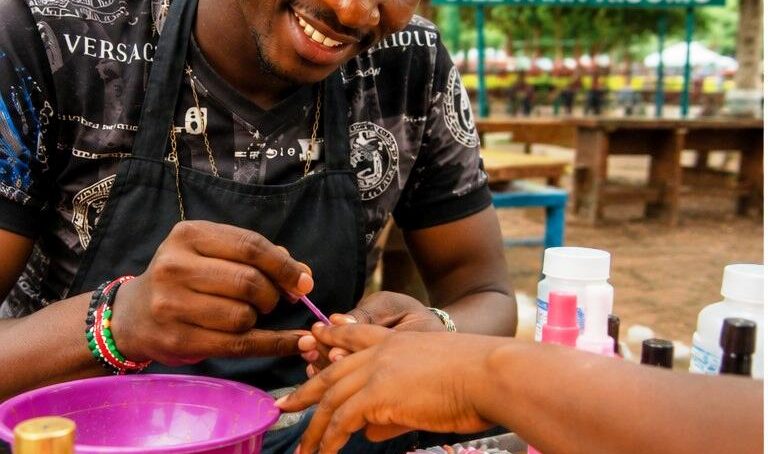
Surrounded by the daily hustle and bustle of traders, commuters and shoppers, Dominic Ogot sits patiently at his modest workstation at Oile Park in Kisumu City.
His table is neatly lined with nail files, polish bottles in different shades, artificial nails, buffers, brushes and other tools of his trade.
Every customer who sits before him leaves not only with polished nails but also with renewed confidence. His calm demeanour, steady hands and attention to detail have earned him a loyal clientele, making him one of the most recognisable and sought-after nail technicians in the area.
Dominic’s story is one of resilience rather than formal education. After dropping out of school in Class Eight, he was faced with a difficult reality. Like many young Kenyans who leave school early because of financial and personal challenges, employment opportunities were scarce.
Instead of allowing his circumstances to define his future, he made a courageous decision to pursue a practical skill that could earn him a living.
Beauty is a feature human civilisations. For thousands of years, people in different cultures have found new ways to take care for their bodies, decorate themselves and express their identity through grooming.
Archaeological records show that ancient civilisations such as Egypt, China and India practiced nail care long before the modern beauty industry emerged. In Ancient Egypt, polished and coloured nails were symbols of affluence, power and social status. In China, members of the royal family used natural dyes made from flowers, beeswax and egg whites to colour their nails, while in India, henna was commonly used to decorate both hands and feet during ceremonies and celebrations.
Over time, nail care evolved from being a symbol of royalty into an essential aspect of personal hygiene and fashion. Today, beauty has evolved into a multibillion-dollar global industry driven by innovation, creativity and fashion trends.
Nail salons are common in cities and towns across the world, offering services ranging from simple manicures and pedicures to intricate nail art, acrylic extensions, gel polish and customised designs. Social media platforms have further transformed the industry by exposing clients to new styles and inspiring nail technicians to sharpen their skills.
Traditionally, beauty services such as nail care have largely been viewed as women’s work. Salons have long been spaces associated with female clients and female technicians.
However, changing social attitudes and growing acceptance have seen more men entering the profession, proving that talent and professionalism matter far more than gender. Around the world, male nail artists are steadily gaining recognition for their precision, creativity, and customer service, breaking stereotypes that have existed for generations.
It is against this backdrop that, in the heart of Oile Park in Kisumu City sits, Dominic Ogot, a young man quietly transforming cultural and social perceptions of one client at a time.
With determination as his greatest asset, Dominic immersed himself in learning the art of nail care. He spent years practicing, observing experienced technicians, and gradually mastering every aspect of the profession. What started as a survival strategy slowly grew into a lifelong career.
Today, nearly fifteen years later, Dominic is an accomplished nail technician whose expertise includes manicures, pedicures, artificial nail application, stick-ons, nail shaping, polishing, foot scrubbing and creative nail designs. His experience has taught him that excellence cannot simply be learned in theory.
“Practice is everything,” he says. “The more you work with clients, the better you become, and from each customer, you learn a new thing in the trade and continue to understands the needs of your clients.”
Ironically, the very stereotype that might have discouraged him from joining the profession has become one of the reasons for his success. Many of Dominic’s clients specifically seek him out because he is a man. According to him, some female customers believe male technicians are more patient, gentle, and attentive to detail.
Whether driven by curiosity or personal preference, the trust his clients place in him has enabled him to build a thriving business despite working in an industry that is largely dominated by women.
On a normal day, Dominic serves between 15 and 20 clients. His most requested services include foot scrubbing, fake nail application (stick-ons) and nail polishing. On good business days, he earns an average of Ksh2,000; an income that has become the cornerstone of his family’s livelihood. Through the proceeds from nail care, he pays household expenses, meets daily needs, and supports his dependents.
For Dominic, every polished nail represents much more than beauty. It represents school fees, food on the table, rent paid on time and hope for a better tomorrow. Yet the success has not come without obstacles.
Operating in the open-air environment of Oile Park presents challenges beyond his control. The number of nail technicians in the area continues to grow, increasing competition for the same pool of customers. Every day requires persistence, excellent customer relations and consistency to remain competitive.
Weather poses an even greater challenge; during a heavy downpour for instance, business almost comes to a standstill. Since his workstation is outdoors, Dominic is forced to pack his paraphernalia to protect it from water damage.
His dream is to grow in the industry to become, not only a consultant, but also a supplier of beauty products. Hours that could have been spent serving customers are instead lost waiting for the skies to clear.
For someone whose earnings depend entirely on daily clients, every rainy day translates directly into lost income.
Despite these setbacks, Dominic remains optimistic. Rather than complaining about circumstances, he focuses on improving his services and maintaining the trust of his customers. His determination reflects the resilience of many young entrepreneurs across Kenya who continue to build livelihoods despite limited resources and uncertain economic conditions.
Beyond earning an income, Dominic hopes his story will challenge deeply rooted stereotypes surrounding gender and employment. He believes no profession belongs exclusively to men or women.
What truly matters is passion, discipline, professionalism and the willingness to learn. His journey also highlights the growing importance of vocational skills in addressing youth unemployment.
At a time when many graduates struggle to secure formal employment, practical skills continue to create opportunities for thousands of young people across the country.
Nail care, once dismissed as a small beauty service, has become a sustainable source of income capable of transforming lives and supporting entire families.
As the sun begins to set over Oile Park, Dominic carefully arranges his tools, ready for the next client who takes a seat before him. Every brush stroke, every polished nail and every satisfied smile tells a story of resilience, dignity and determination.
For young people searching for direction, Dominic offers a simple but powerful message: “Don’t look down on any honest job. Learn a skill, work hard, stay patient and never stop believing in your talent.”
In a society where success is often measured by academic certificates and white-collar careers, Dominic Ogot reminds us that sometimes the strongest future is built not with a pen, but with skilled hands.
Indeed, his hands have become hands of gold; creating beauty, breaking barriers, and building a better life one nail at a time.
- A Tell Media / KNA report / By Mabel Keya-Shikuku and John Yuri

About author