



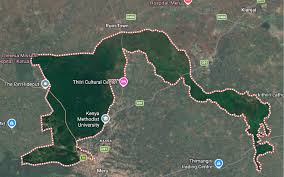
Rhino Ark Kenya Charitable Trust has strongly objected to the ongoing construction of an airstrip in the Upper Imenti Forest Reserve,
The leading Kenyan conservation organisation that develops and implements practical solutions to the challenges affecting Kenya’s mountain forests – also known as water towers and their threatened natural habitats in order to secure their ecological integrity – has asked the National Environment Management Authority (NEMA) to immediately suspend all works pending compliance with Kenya’s environmental laws and constitutional requirements.
The airstrip is being constructed in a protected forest landscape that forms part of the Mt Kenya Forest ecosystem, further gazetted as a national reserve to ensure maximum protection of its ecological, biodiversity and water catchment values.
The Rhino Ark says it is deeply concerned that no public participation was undertaken as required by the Constitution of Kenya, no Environmental and Social Impact Assessment (ESIA) has been conducted as required under the Environment Management and Coordination Act of 1999.
‘‘There is no licence authorising the project has been issued by NEMA. The absence of these legal requirements raises serious concerns regarding the legality and environmental oversight of the project,’’ says the organisation in statement issued by Ms Gloria Waswa, Rhino Ark’s Public Relations officer.
Moreover, Gaitu Airstrip, located approximately 14 kilometre from Meru Town and accessible via a paved road, already exists. Rather than constructing a new airstrip inside a protected forest ecosystem, Rhino Ark proposes that resources be directed toward upgrading the existing Gaitu Airstrip.
“This option would be more cost-effective and avoid the significant environmental risks associated with developing infrastructure inside a protected forest reserve,’’ proposes the Ark.
Rhino Ark has urged NEMA and all relevant government agencies to immediately halt construction activities and ensure that all legal, environmental and public participation requirements are fully met before any further action is taken.
‘‘Protecting the Mt Kenya ecosystem is not only a legal obligation but a national responsibility and the long-term value of safeguarding one of Kenya’s most important water towers, wildlife habitats and biodiversity hotspots far outweighs the short-term benefits of constructing an airstrip within a protected forest reserve,’’ says the organization.
As a long-standing conservation partner in the Mt Kenya ecosystem, Rhino Ark has invested over Ksh1 billion during the past 14 years in conservation infrastructure. This includes 320 kilometre of electric fencing around the Mt Kenya forests, of which 54 kilometre protects the Upper and Lower Imenti Forest Reserves. These investments have significantly reduced human-wildlife conflict, protected communities and strengthened conservation efforts in one of Kenya’s most important ecosystems.
Mt Kenya is one of Kenya’s five principal water towers and provides water that supports millions of Kenyans, major irrigation schemes, hydropower generation, agriculture and livelihoods across the country. The Upper Imenti Forest Reserve lies on the hydrological divide between the Tana and Ewaso Nyiro river catchments. Any degradation of this sensitive forest ecosystem risks undermining water security and the ecological integrity of two of Kenya’s most important river systems.
The Mt Kenya ecosystem is internationally recognised for its exceptional biodiversity, hosting more than 880 documented plant species. This includes 81 endemic species found nowhere else in the world; globally important populations of threatened species such as elephant, bongo, leopard and one of Kenya’s most significant forest bird habitats, supporting more than 50 African highland biome bird species.
The Upper Imenti Forest Reserve is one of the most ecologically important sections of the Mt Kenya ecosystem and plays a vital role in maintaining this biodiversity.
Scientific elephant surveys undertaken by the Wildlife Conservation Society, KWS, Rhino Ark, Mount Kenya Trust and the Bongo Surveillance Project established that the mountain supports between 1,900 and 2,600 elephants. The Upper Imenti Forest has the highest concentration of elephants during the dry season and the airstrip is being constructed in this critical elephant habitat and near a known elephant maternity area.
The Upper and Lower Imenti Forest Reserves also form the central section of a key wildlife corridor linking Mt Kenya to conservation landscapes in northern Kenya.
“The fragmentation of this corridor threatens elephant movement, habitat connectivity and long-term conservation objectives,’’ sys the Rhino Ark.
The proposed airstrip is inconsistent with Kenya’s commitments under the Sustainable Development Goals – particularly SDG 6 (Clean Water), SDG 13 (Climate Action) and SDG 15 (Life on Land) – Kenya’s climate commitments under the Paris Agreement and Nationally Determined Contributions (NDCs), the Convention on Biological Diversity, the UN Decade on Ecosystem Restoration and the Global 30×30 biodiversity Target.
The project also conflicts with key national policy frameworks, including Vision 2030, the National Spatial Plan 2015-2045, the National Climate Change Action Plan, the Upper Imenti Participatory Forest Management Plan 2022-2026 and the Mt Kenya Ecosystem Management Plan, none of which provide for the construction of an airstrip within this protected natural forest zone.
Rhino Ark is a Kenyan non-governmental conservation organisation dedicated to protecting Kenya’s mountain forest ecosystems through electric fencing, community partnerships, habitat conservation, and sustainable natural resource management.
It was established in 1988 as a charitable trust to help save Kenya’s Black Rhino population in the Aberdare ecosystem. The rhino were under severe threat from rampant poaching for their highly valued horn. At that time, wildlife would often invade the farms bordering the park, destroying crops; occasionally resulting in human fatalities.
The resulting fear and aversion towards wildlife worked in favour of poachers who got easy access to the protected area, since the local communities saw no value in protecting either the wildlife or the forest habitat at that time.
The charitable organisation aims specifically at assisting the Kenya Wildlife Service (KWS) in building an electric fence along sections of the Aberdare National Park on its Eastern Salient area which has the highest concentration of wildlife and borders directly onto farmland. The scope of the initial project then evolved into a much more ambitious task of protecting the entire Aberdare Conservation Area with the electric fence.
- A Tell Media report / By Chris Mburu


About author