

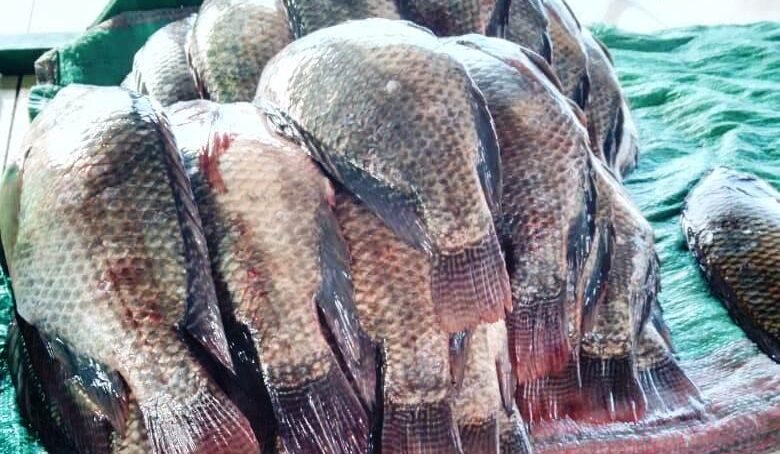
From fishermen spending nights in the deep-waters fishing to fish-mongers struggling with the volume of harvest and boat owners battling high operational costs, the fishing business remains a lifeline for many communities living around the lake.
For Mariam Musa, a widow and fishmonger at Dunga Beach, Lake Victoria is not just a source of fish and income. To her it is a source of hope for keeping her family alive as it feeds her grandchildren and gives her a reason to wake up every morning despite the challenges prevalent in the fisheries sector.
Mariam wakes early at five in the morning, prepares her grandchildren for school and heads to the beach by six o’clock in the morning.
In order be on the safe side of her competition, she relies on fish orders by hotel clients and other consumers at the beach who consume her fish directly served with ugali or any other accompaniment.
For Mariam on a good day when fish is available, she can make up to Ksh4,000 profit in a day. This is because there are times when fish is scarce because the lake has been overfished and needs regular restocking.
For Beryl Anyango Otieno, another fishmonger in Kisumu, things are looking up. For the six years she has been in business, she has managed to take her children through school and even has been able to employ a house help who looks after the children and house chores as she goes about her fish business.
“In this business you have to wake up at dawn and get to the beach early, just to be on time to book your fish from the fishermen because fish is sometimes scarce and the demand is high,” Beryl says.
Beryl says fish is sensitive to the weather and when the weather is too rainy or too dry or hot, the fish become scarce, so sometimes you have very little or nothing to sell. On a bad day, she makes Ksh1,000 as fish catches have been declining over the years.
Evans Okoth is a fisherman who has invested in this sector, but fish stocks have been dwindling. Coupled with rising fuel cost, illegal fishing, effects of climate change and the entry of coastguards who often harass wananchi make it so difficult for fishermen to earn a decent living.
According to Okoth, the amount of fish stocks in Lake Victoria is dwindling, and this is fuelled by wrong fishing methods and overfishing. Talking about his worst experience in his fishing life, Okoth remembers an incident when nyakowi cyclone almost took their lives when they were out in the deep waters.
Okoth who has been in this business for over 26 years, says this work is his lifeline and helps him pay the bills and appeals to the government to help them acquire better fishing gear. He also urges the government to bring back the periodic closure of the Lake, saying the closure which used to be done between April and August every year allowed the fish time to breed and replenish the stocks.
“Fishermen should also be trained and employ modern fishing gear and methods to minimize overfishing. He welcomes the introduction of cages to the fishermen, noting that it produces better returns.”
Okoth is appealing to Government to consider financing the fishermen with small affordable also install these cages since they are cost effective.
Some of the major projects to improve the fisheries sector in the country is Kabonyo Fisheries and Aquaculture Centre in Kisumu. It’s a flagship project expected to produce 28 million to 30 million fingerlings annually to support small-scale farmers and restock Lake Victoria.
Another project is the construction of nine modern fish landing sites in Lake Victoria basin, paired with the Homa Bay Modern Fish Market to serve 2,000 fishmongers daily, thus, reducing post-harvest losses.
The government has also set aside Ksh1.4 billion for the construction of new fish landing sites to ensure the coast region’s fishermen reap maximum benefits from fishing activities.
All this is part of Ksh10 billion, multi-year strategy to revitalise the fisheries and blue economy sector. The goal is to scale up fish production from 163,000 metric tons to over 450,000 metric tonnes and raise sectoral earnings to Ksh350 billion by 2030. It will be done through improvement of fishing gears and boats and with better equipment encourage deep sea fishing to improve the catches.
Kenya’s fisheries sector is a vital economic and nutritional pillar, supporting over 1.5 million livelihoods. It is dominated by inland capture fisheries (primarily Lake Victoria), followed by an expanding aquaculture industry and marine coastal fisheries.
Fishing activities along the shores of Lake Victoria support thousands of families despite the growing challenges the sector faces.
According to 2024 data from Kenya Fisheries Services (KeFS), Kenya produces about 168,000 metric tonnes of fish annually. This output is valued at roughly Ksh39.6 billion.
The fisheries industry provides direct employment to over 60,000 fishermen, while supporting an estimated 1.2 million people directly and indirectly through processing, trading and the fishing supply chain.
Fish production is primarily driven by inland capture fisheries (notably Lake Victoria) but marine and aquaculture sectors are actively growing to bridge the gap.
The 2024 breakdown is as follows: Inland capture: 86,500 metric tonnes (valued at Ksh14.5 billion), marine catches; 48,500 metric tonnes (valued at Ksh18.6 billion) and aquaculture (fish farming) 33,400 metric tonnes (valued at Ksh9.9 billion).
However, the country faces a massive supply-demand deficit of 350,000 to 450,000 metric tonnes, as national consumption demand heavily outpaces local production, forcing the country to import fish in order to try and fill this huge deficit.
India, Oman and the United Arab Emirates (UAE) are the top five main exporters of fish to Kenya, with the country annually importing roughly 620,000 kilogrammes (from India), 326,000 kilogrammes from Oman and 310 000 kilogrammes (from UAE) respectively.
In total, Kenya in 2024 imported 20 million kilogrammes of fish worth Ksh5 billion to meet the deficit in fish consumption in the country. The government says it is looking forward to increasing this production through encouraging aquaculture, provision of seed (fingerlings) to farmers and establishment of centres of excellence where farmers can get quality seeds.
Under the Bottom-Up Economic Transformation Agenda (BETA), the Kenya Kwanza administration has clear plans to revamp the sector in the country. BETA positions the fisheries sector and blue economy as critical drivers of wealth creation, targeting to expand the sector’s GDP contribution from Ksh37 billion to Kshh80 billion. Key initiatives focus on infrastructure, capacity building, and value addition.
- A Tell Media / KNA report / By Mabel Keya-Shikuku and Obed Ating`a


About author