



Public transport sector contributes – on average – eight to nine per cent of Kenya’s gross domestic product (GDP). It is a vibrant sub-sector within the broader service industry (which accounts for over 5.5 per cent of the national GDP) and operates primarily through road, rail, air and pipeline.
According to data from the Kenya Bureau of Statistics (KBS), this sector contributes between Ksh200 billion and Ksh400 billion to the Kenyan economy annually.
But road transport is the most used mode of haulage in Kenya to move goods and services.
Among the mediums of road transport in Kenya are matatus (min-buses licensed to operate as public service vehicles) as which is the most common, the boda-boda (taxi motorbikes) sector and more recently tuktuks.
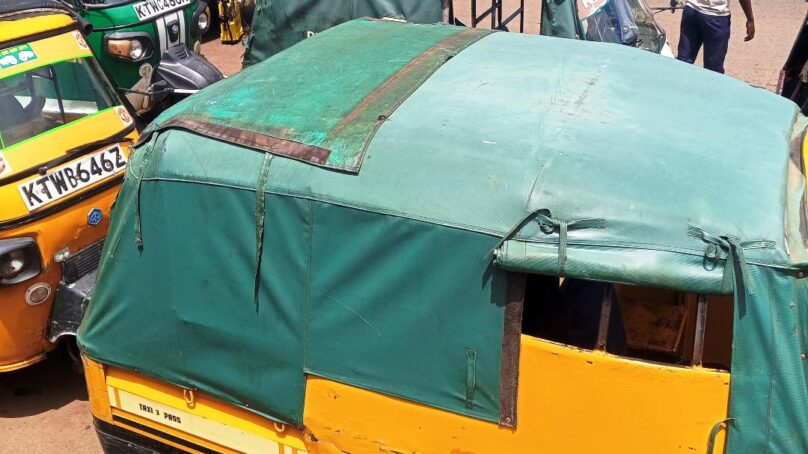
Tuktuks are three-wheeled vehicles with an open-sided body and a roof covered by a canvass. It’s usually used as a taxi and could also be used to ferry small quantity of items from one place to another.
Tuktuks (auto-rickshaws) evolved from early 20th century in Japan as motorised delivery tricycles and by 1930s, they had grown into a form of transport. They then received global adaptation in 1940s and 1950s after World War II, where the Japanese helpful vehicles were widely exported. Similar three-wheeled designs (such as Piaggio’s Ape in Italy) later emerged for post-war rebuilding.
In 1960s, Thailand imported these three-wheelers from Japan and modified them as taxis. The open-air cabin design then quickly replaced human-pulled rickshaws, becoming a major feature in Bangkok’s urban transport.
Tuktuks introduced in Kenya in the 1950s in coastal Kenya – especially Mombasa – it got its momentum in the 1960s when the medium of transport spread to other major towns.
Data show there are approximately 15,000 to 17,000 registered tuk-tuks operating in Mombasa and the rest of the country. This is according to data from the Ministry of Transport.
An owner hiring out a petrol tuktuk can expect a stable net profit of Ksh20,000 to Ksh30,000 per month.
If you choose to invest in an electric tuktuk or drive the vehicle yourself, your monthly net earnings can exceed Ksh50,000 due to massive fuel savings and eliminated driver friction.
For Vincent Otieno, a long-time resident of Kisumu, the three-wheeled motorised rickshaw known as the “tuktuk” is more than just a vehicle; it is a way of life. Having operated his business within the lakeside city for over ten years, Vincent views his work as both a vital lifeline and a personal passion.
“This business has been my primary source of income and employment and on a good day. I take home more that Ksh2,500 after deducting fuel costs,” Vincent shared. “It’s also my source of entertainment because I truly enjoy what I do.”
However, the journey has become increasingly uncertain for operators in the sector. Despite his decade long experience, Vincent notes that a combination of global and local economic pressures is squeezing the margins of a once-thriving business.
The primary challenge currently facing Kisumu’s Tuktuk community is the sharp rise in inflation, specifically the sky-high cost of fuel. For a business built on low-cost transportation, every shilling added to the pump price directly erodes the operator’s daily take-home.
“The way we used to work has been significantly reduced,” Vincent explained. “We simply cannot generate the same level of income we saw in previous years and competition too, is cutthroat due to the emergence of motorcycle transport, popularly known as boda-bodas.”
The sector has struggled to find its footing since the Covid-19 pandemic, which permanently altered movement patterns and economic stability in the region. Beyond fuel, the high cost of spare parts and general maintenance has become a heavy burden for operators.
In response to these tightening margins, Vincent offers a stark piece of advice for newcomers: prioritise ownership of your tuktuk over debt.
“I urge anyone willing to start this business to own their tuktuk outright. Avoid taking loans as much as possible. The revenue generated now from the business is so minimal that it is difficult for an owner and an operator to enjoy the profits, while still servicing a debt,” he says.
Despite these challenges, the tuktuk remains a staple of Kisumu’s urban transport system. Its survival is rooted in its unique utility within the Central Business District (CBD) and surrounding estates.
Vincent points out several reasons commuters choose tuktuks over other conventional taxis or other options like motorbikes (boda bodas) or traditional public service vehicles (PSVs).
First the tuktuk transport is affordable since they remain cheaper for passengers compared to many alternatives and are able to transport large quantities of goods that a motorbike cannot handle.
They can navigate narrow routes inaccessible to ordinary buses and minibuses. Further, their efficiency stems from the fact that despite the rising costs, they remain relatively fuel-efficient for short-distance hauling.
While the economic climate remains fluid, operators like Vincent will continue to provide an essential service, manoeuvring through the streets of Kisumu combines resilience and the love for the drive.
Vincent`s dream is to own a fleet of tuktuks and employ other people and even later in life own lorries for long distance hauls.
- A Tell Media / KNA report / By Mabel Keya-Shikuku and Nathan Kimwetich


About author