



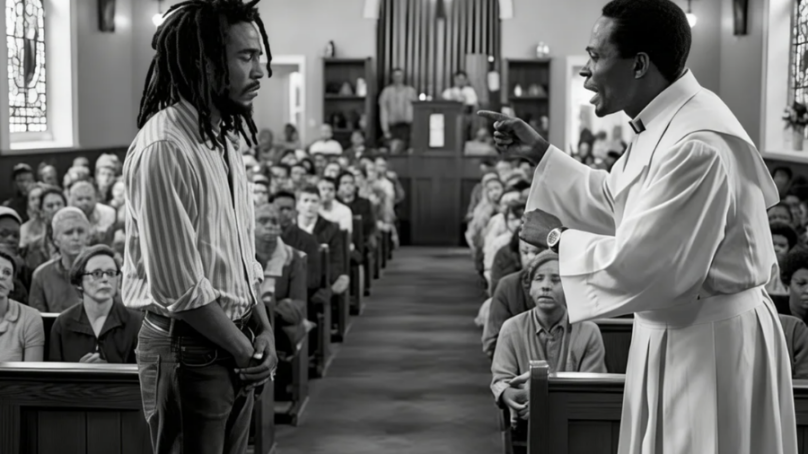
What would you do if a religious leader publicly accused you of worshiping the devil in front of hundreds of people? Would you argue, walk away or would you find a way to turn hatred into understanding through the very faith they claimed to defend?
Bob Marley faced exactly this situation in a small Georgia town in 1978. And his response would not only silence his accuser, but unite an entire congregation in a way that challenged everything they thought they knew about faith, judgment and the true meaning of Christianity.
August 27, 1978. Millerville, Georgia. Population 2.47 million. Bob Marley was travelling through the Deep South on his way to a concert in Atlanta when his tour bus broke down just outside this small, deeply religious town.
While his crew worked to fix the mechanical problems, Bob decided to take a walk through the town to stretch his legs and get a feel for the community. Millerville was the kind of place where everyone knew everyone, where the Baptist church was the centre of social life, and where anything different from the norm was viewed with suspicion.
The town was overwhelmingly white, overwhelmingly conservative, and overwhelmingly set in its ways. It was Sunday morning, and as Bob walked down Main Street. He could hear the sound of hymns coming from the Millerville First Baptist Church. The music drew him like a magnet. Bob had always been fascinated by the spiritual power of gospel music and its connection to the African-American musical traditions that had influenced reggae.
Bob approached the church and stood outside listening to the congregation singing How Great Thou Art. The voices blending together in worship reminded him of the spiritual gatherings he’d attended as a child in Jamaica and he felt a deep connection to the universal human need to praise the divine through music.
Without thinking about how his appearance might be received, Bob walked up the front steps of the church and quietly slipped inside during the hymn.
He stood at the back of the sanctuary, his head bowed respectfully, his heart moved by the beauty of the music and the sincere faith he could feel in the room. The sanctuary held about 300 people, mostly families dressed in their Sunday best. Bob, with his dreadlocks, casual clothes and dark skin stood out dramatically in the sea of white faces and conservative attire.
But he remained quiet and respectful, simply wanting to share in the collective worship. The hymn ended and Pastor William Johnson, a 52-year-old man who had led this congregation for over 20 years, stepped up to the pulpit.
Pastor Johnson was known for his fiery sermons and his unwavering belief in the literal interpretation of the Bible.
He was also a man who saw the world in stark terms of good versus evil, saved versus damned, righteous versus wicked. As Pastor Johnson looked out over his congregation to begin his sermon, his eyes fell on Bob Marley standing at the back of the church. The pastor’s face immediately hardened with disapproval and what he perceived as righteous anger.
“Brothers and sisters,” Pastor Johnson said, his voice carrying clearly through the sanctuary. “We have a visitor with us today who represents everything that is wrong with our modern world.”
The congregation turned to look at Bob, who remained standing quietly, confused by the sudden hostility, but not yet understanding that he was about to become the target of a public attack.
“This man,” Pastor Johnson continued, pointing directly at Bob, “with his ungodly hair and his heathen appearance, represents the devil’s influence in our society. He is a practitioner of a false religion that worships a false god.”
Bob felt every eye in the sanctuary turned toward him, but he remained calm. He had faced prejudice and misunderstanding many times before, and he understood that Pastor Johnson was reacting out of fear and ignorance rather than genuine spiritual concern.
“Rastafarianism,” Pastor Johnson proclaimed, pronouncing the word with obvious disdain, “is a cult that rejects Jesus Christ as our Lord and Saviour. These people worship a dead African king instead of the living God. They use drugs in their false worship and they spread their poison through so-called music that corrupts our young people.”
The congregation murmured uncomfortably. Some seemed to agree with their pastor while others appeared disturbed by the public attack on a visitor who had done nothing but stand quietly in their sanctuary.
“Sir,” Pastor Johnson said, addressing Bob directly, “I must ask you to leave this holy place. Your presence here is an insult to Jesus Christ and to every faithful Christian in this community.”
The sanctuary fell completely silent. Three hundred people waited to see how this confrontation would resolve. Bob could have simply left, avoiding further conflict. He could have argued or defended himself angrily.
Instead, he chose a different path. Bob walked slowly down the centre aisle toward the pulpit, his movements calm and dignified. Pastor Johnson tensed, unsure what this dangerous man intended to do. But when Bob reached the front of the church, he simply stood facing the congregation and spoke in a voice that carried clearly through the sanctuary.
“Pastor Johnson,” Bob said respectfully. “I thank you for allowing me to worship in your beautiful church, even if only briefly. Before I go, may I share something with your congregation?”
Pastor Johnson was caught off guard by Bob’s politeness and his lack of anger or defensiveness. “I suppose you can say whatever you need to say before you leave,” he told Bob.
Bob turned to face the congregation, looking out at 300 faces that ranged from hostile to curious to sympathetic.
“My name is Bob Marley,” he said simply. “I am a Rastafarian as Pastor Johnson correctly observed. But what he may not know is that Rastafarianism is fundamentally a Christian faith. We believe in Jesus Christ as our Lord and Saviour. We study the Bible daily. We pray to the same God that you worship here this morning.”
A murmur went through the congregation. This wasn’t what they had expected to hear. Bob continued, his voice growing stronger but never losing its respectful tone.
“Pastor Johnson said that we worship a false god, but we worship Jah, which is simply another name for Jehovah, the God of Abraham, Isaac and Jacob. We believe that Haile Salassie was a divine messenger, much as Christians believe in the divine nature of Jesus Christ,’” he said.
Pastor Johnson’s face was growing red with frustration. “You’re twisting the truth. You people reject the Bible.”
Bob smiled gently. Actually, “Pastor, we embrace the Bible completely. May I share a verse with your congregation?
Before Pastor Johnson could object, Bob began reciting from memory: “Judge not that ye be not judged. For with what judgment ye judge, ye shall be judged, and with what measure ye meet, it shall be measured to you again.”
The words of Matthew 7:12 rang through the sanctuary with perfect clarity and accuracy. Bob continued: “And why beholdest thou the moat that is in thy brother’s eye? But considerest not the beam that is in thine own eye?”
The congregation was stunned.
Here was a man their pastor had just condemned as a devil worshipper quoting scripture with the fluency and understanding of a seminary graduate. You see, Bob said:
“The same Jesus that you love and serve taught us not to judge others by their appearance or their differences, but to love one another as he loved us. When I walked into your church this morning, I came not as an enemy, but as a brother seeking to worship the same God that you worship.”
Pastor Johnson was speechless, clearly struggling with the cognitive dissonance of hearing perfect biblical truth from someone he had just labelled as evil. Bob wasn’t finished:
“Pastor Johnson, you mentioned that our music corrupts young people, but our music, like your hymns, is meant to praise God and to spread his message of love and unity. We sing about the same redemption that you preach about from this pulpit.”
Bob looked around the sanctuary, making eye contact with as many people as possible:
“You know, there’s a hymn that I learned as a child in Jamaica before I even knew what Rastafarianism was. It’s a song that speaks to the universal human experience of seeking God’s grace. Perhaps you know it, too. Without waiting for permission, Bob began to sing, his voice clear and powerful. Amazing grace, how sweet the sound that saved a wretch like me.”
The effect was immediate and profound. Bob’s voice, trained by years of professional performance, but filled with genuine spiritual emotion, transformed the familiar hymn into something transcendent.
His reggae influenced phrasing gave new life to the centuries-old words, while his obvious sincerity made it clear that this was no performance. This was worship. I once was lost, but now am found. Was blind, but now I see.
As Bob sang the second verse, something remarkable began to happen. Members of the congregation, moved by the beauty of his voice and the obvious faith behind it, began to join in. First just a few voices, then dozens, then nearly the entire sanctuary singing together.
It was grace that taught my heart to fear, and grace my fears relieved. By the third verse, even some of the people who had initially supported Pastor Johnson’s attack were singing along. The walls that had separated them from this dangerous stranger were crumbling in the face of shared faith and beautiful music.
When the hymn ended, the sanctuary was completely silent except for the sound of people wiping away tears.
Bob’s performance had been so moving, so obviously sincere that it had touched even the most sceptical hearts in the room. Bob turned back to Pastor Johnson, who was standing behind the pulpit with tears streaming down his face. The pastor’s anger had been replaced by shame as he realised the magnitude of his misjudgement.
“Pastor Johnson,” Bob said gently, “I harbour no anger toward you for your words this morning. I understand that you were trying to protect your flock from what you perceived as danger. But perhaps this morning we can all learn something about the difference between judging by appearance and judging by the fruits of the spirit.
Pastor Johnson struggled to find words. Everything he had believed about Rastafarianism, everything he had assumed about Bob Marley had been challenged and found wanting in the space of 15 minutes.
“Mr Marley, Pastor Johnson said, his voice thick with emotion. “I owe you a profound apology. I spoke out of ignorance and prejudice and I used this pulpit to spread judgment rather than love. You have shown me what true Christian grace looks like.”
The pastor turned to his congregation. “Brothers and sisters, I have sinned this morning. I violated one of Jesus’s most fundamental teachings by judging a man by his appearance rather than by his heart. Mr Marley has shown more Christian love in the past 15 minutes than I have shown in my sermon preparation all week.”
Bob stepped forward and extended his hand to Pastor Johnson. “Pastor, we all make mistakes. What matters is that we learn from them and choose love over fear.”
Pastor Johnson took Bob’s hand and then to the amazement of the entire congregation pulled him into an embrace. The sight of their pastor hugging the man he had just condemned brought many in the congregation to tears.
“Mr Marley,” Pastor Johnson said, “would you honour us by staying for the rest of our service? And perhaps, would you consider sharing another song with us?”
Bob smiled. “I would be honoured, pastor. What followed was one of the most memorable worship services in the history of Millerville First Baptist Church.
Bob shared three more songs, each one blending reggae rhythms with Christian themes. Each one performed with such obvious love for God that no one could doubt the sincerity of his faith. The congregation, initially suspicious and hostile, was completely transformed. By the end of the service, people were approaching Bob to thank him for sharing his music and his testimony.
Many apologised for their initial judgment, and several asked him questions about Rastafarianism, genuinely curious to learn more about a faith they had never understood. After the service, Pastor Johnson invited Bob to share lunch with his family – over-fried chicken and sweet tea.
Bob and the pastor had a long conversation about faith, music and the common ground between different Christian traditions.
“Bob,” Pastor Johnson said, “I want you to know that what happened this morning changed me. I’ve been a pastor for over 20 years, but I realised today that I’ve been preaching fear instead of love, judgment instead of acceptance. You reminded me what Jesus actually taught us to be.”
Bob nodded. “Pastor, we all need reminders sometimes. That’s why we gather together to help each other stay on the right path.”
The story of Bob Marley’s visit to Millerville First Baptist Church spread quickly through the small town and eventually made its way into local newspapers.
“Reggae Star preaches love in Georgia church” became a story that was picked up by news outlets across the south.
But the most lasting impact was on Pastor Johnson himself. The experience fundamentally changed his approach to ministry. He began studying other Christian traditions, reaching out to churches in the African-American community and preaching sermons focused on love and acceptance rather than condemnation and fear.
Six months later, Pastor Johnson invited Bob to return to Millerville for a special concert in the church. Bob accepted, and the concert drew people from across Georgia, filling not just the church but the streets around it with people who wanted to witness this unique blend of reggae music and Christian worship.
The concert became an annual tradition that continued for years, bringing together people from different races, denominations and backgrounds in a celebration of music and faith that transcended all divisions.
When Bob Marley died in 1981, Pastor Johnson was one of the speakers at a memorial service held at Millerville First Baptist Church.
“Bob Marley taught me what it means to be a real Christian,” he told the packed sanctuary. He showed me that faith isn’t about judging others or protecting ourselves from differences. It’s about recognising the divine in everyone we meet, even when they look different from us.
- A Tell Media report / Source: Life Story


About author