



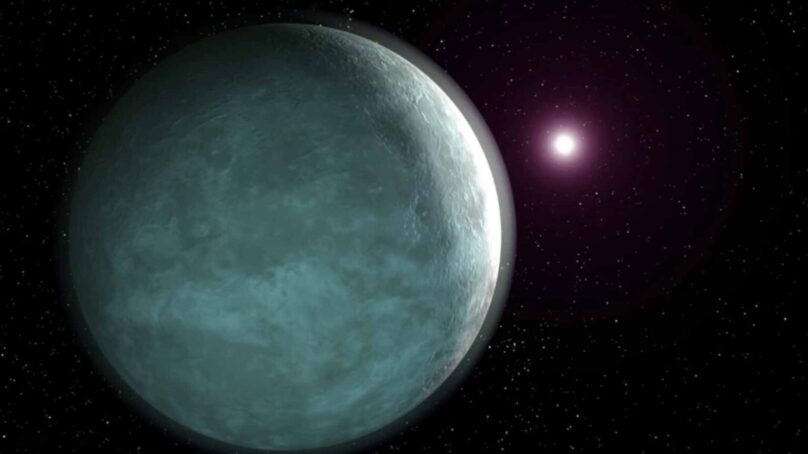
A super-Earth has been discovered just 10 light-years away, which could harbour an atmosphere and water, but reaching it with current technology would take us about 17,000 years
Astronomers have confirmed that the planet they have named GJ 887d is in the habitable zone of the nearby red dwarf star GJ 887.
It circles every 50.8 days and has at least six times Earth’s mass. That makes it one of the closest known worlds where liquid water might be possible, if it has a stable atmosphere.
So is it close? In space terms, yes, but it is still about 63 trillion miles (101 trillion kilometres) away, so this is a telescope story, not a travel story. The takeaway is that GJ 887d is now a more solid target for future atmosphere searches.
GJ 887, also called Gliese 887 and Lacaille 9352, is a cool “red dwarf” that puts out only a few per cent of the Sun’s light. That low energy shifts the habitable zone inward. Planets can orbit quickly and still be potentially temperate.
In the new analysis, GJ 887d orbits about 20 million miles from its star, closer than Mercury is to the Sun, yet receives about 80 per cent of the energy Earth gets. The same data confirm three other planets on tighter orbits, plus a weaker extra signal that could be another small planet. The team says that last signal needs more data.
The work comes from an international team led by astronomer C. Hartogh at the Institute of Astrophysics and Geophysics at the University of Göttingen, with partners including the University of St Andrews and Italy’s National Institute for Astrophysics.
Their paper, RedDots: Multiplanet system around M dwarf GJ 887 in the solar neighbourhood, reanalysed existing observations and added new ones to test whether the 51-day signal was real.
They used the radial velocity method, which detects a planet by measuring a star’s tiny back-and-forth motion.
The signal was measured with the HARPS spectrograph and the ESPRESSO spectrograph, instruments operated in Chile by the European Southern Observatory. Because star-spots can imitate planets, the team also used a statistical model called a “Gaussian process” to subtract the star’s own noise.
NASA defines a habitable zone as “the distance from a star at which liquid water could exist on orbiting planets’ surfaces,” sometimes called the “Goldilocks zone.” That definition is in this official habitable zone guide. It is a useful filter but it is not a guarantee of oceans or biology.
For GJ 887d, the study’s basic temperature estimate without atmospheric warming is below freezing by Earth standards.
A thicker atmosphere could warm it, but too much greenhouse warming can turn a planet into an oven, as Venus shows with temperatures around 867 degrees Fahrenheit.
And with about six times Earth’s mass, GJ 887d could be rocky or it could have a deep, gas-rich atmosphere.
Red dwarfs can produce intense flares that erode atmospheres, which is one reason Proxima Centauri b remains controversial. GJ 887 looks calmer, and a 2020 Science report highlighted its unusually low activity as good news for atmosphere retention “A multiplanet system of super-Earths orbiting the brightest red dwarf star GJ 887”.
The new paper builds on that by measuring the star’s rotation at about 39 days and using that cycle to separate stellar noise from planet signals.
A calm star today does not prove it was calm when it was young, so habitability remains uncertain. But cleaner data make follow-up observations more realistic.
Artist’s impression of a rocky super-Earth exoplanet orbiting a red dwarf star in the GJ 887 system.
Astronomers have confirmed that GJ 887d sits in the “Goldilocks zone” of its star, making it one of the most promising candidates for future atmosphere and water searches.
Even at about 11 light-years away, GJ 887d is far beyond any near-term mission. At about 430,000 miles per hour, the Parker Solar Probe would still need roughly 16,000 to 17,000 years to get there, based on its speed described in a recent Parker Solar Probe status update. That is why “nearby” planets are studied remotely.
Remote sensing means squeezing clues from light, such as heat changes over an orbit or, someday, direct images of the planet next to its star.
Scientists also look for signs of an atmosphere, including clouds and strong greenhouse gases, even if they cannot yet read a full chemical fingerprint. Slow, yes, but it is progress.
The next big question is straightforward. Does GJ 887d have a substantial atmosphere, and if it does, is it the kind that could support liquid water at the surface? Because the planet does not appear to pass in front of its star, many common atmosphere tests are harder.
For now, the discovery is less about claiming a living world and more about building a shortlist of the best targets. GJ 887d is close enough to keep showing up in telescope plans, and quiet enough to keep data cleaner than usual for a red dwarf system. That combination is rare.
- A Tell Media report / Source; Science. The main study has been published in Astronomy & Astrophysics.


About author