



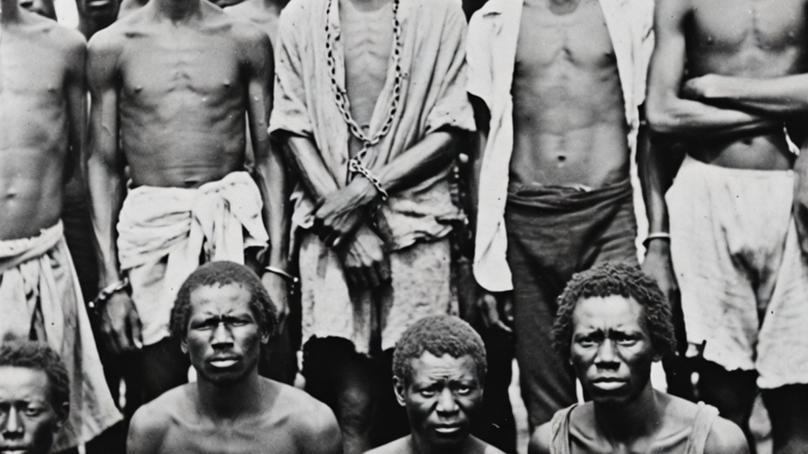
In March of 1849, a quiet entry appeared in the ledgers of Richmond’s most prominent families. Seventeen enslaved men had been recorded as “sold.”
No debate followed.
No public announcement stirred the streets.
Just another neat line of ink drying slowly on parchment in a city that valued reputation more than truth. Richmond was a place where appearances were guarded like treasure.
Where men spoke proudly of honor and women presided over charity circles with delicate smiles.
Every Sunday morning the pews of Church Hill were filled with families dressed in their finest clothes, their reputations shining brighter than the stained glass above them. But behind those polished manners lived a deeper silence.
Because no one questioned the strange detail hidden in the ledger. There were no shipping records. No wagons documented leaving the city. No river transport licenses.
The men had been sold on paper. Yet they had not left Virginia. They had not even left Richmond. They remained inside the same elegant mansions where the ledger claimed they no longer existed. Behind tall brick walls lined with climbing ivy.
Behind doors decorated with imported French wallpaper and carved mahogany frames. Inside the homes of Richmond’s most respected families. Eight women lived in those houses.
Eight names that carried weight in every drawing room in Virginia.
Margaret Whitfield.
Caroline Mercer.
Elizabeth Hawthorne.
Sarah Bellamy.
Louisa Grant.
Penelope Ashton.
Rebecca Talmadge.
And Eleanor Caldwell.
They were admired across the city.
Each of them led charitable work that was praised in newspapers and sermons alike. Together they formed a private organisation known as the Sisterhood of Mercy. Officially, the group existed to help widows and orphaned children.
They held regular gatherings in their parlors where donations were collected and plans for charity events were discussed. At least, that was what the public believed.
But once the parlor doors closed and the servants were dismissed, another kind of meeting began. Young enslaved men were summoned from the household quarters. Each time the reason sounded harmless.
A window latch that needed repair. A cabinet that required moving. A tray of tea to be carried upstairs.
Sometimes a servant was told the mistress required help organising books or lifting a heavy chest. The men entered the rooms alone. Hours later they emerged changed. Their shoulders tense. Their eyes fixed somewhere far away.
Their voices quiet and cautious. As though something inside them had been disturbed. At first the other enslaved people noticed but said nothing. Silence was a shield in a world where truth could be dangerous.
But the wives waiting in the slave quarters slowly began to see the pattern. Their husbands returned from those houses with strange behaviour. Some refused to meet their wives’ eyes. Some avoided touch altogether. Others lay awake through the night staring into darkness.
The silence between husband and wife grew heavier with each passing week.
Something was happening inside the mansions of Church Hill. Something no one dared speak about openly. Then one evening, everything began to unravel.
A young house servant named Daniel was cleaning the study of Eleanor Caldwell’s home when he noticed a loose floorboard beneath a writing desk. Curiosity led him to pry it up.
Beneath the board lay a small leather journal wrapped carefully in cloth. Daniel opened it slowly.
The pages were filled with writing in a strange mixture of code and ordinary sentences.
Most of it made no sense to him. But one line was clear enough to make his hands tremble.
“Tonight Margaret brings another one.”
Daniel closed the journal immediately. He knew enough about Richmond to understand that the names inside those pages belonged to powerful families.
But he also knew someone who might listen. Reverend Thomas Hale of St Mark’s Church.
Hale had earned a reputation throughout Richmond as a man who believed truth mattered more than comfort. When Daniel secretly delivered the journal to him, the reverend spent the entire night reading it.
The entries described private gatherings between the eight women and enslaved men summoned late at night. The language was careful. But the meaning was unmistakable.
The Sisterhood of Mercy had never been about charity. They had been using their power and privacy for something far darker.
For days Reverend Hale wrestled with the decision in front of him. Exposing the truth would shatter the reputations of Richmond’s most respected families. But remaining silent would allow the abuse to continue.
Finally he sealed the journal and sent a report directly to the governor of Virginia. The reaction in the capital was immediate.
The governor understood that if the story became public, the scandal could destroy Richmond’s carefully crafted image of moral authority. Within forty-eight hours an emergency legislative session was called in secret.
No newspapers were informed.
No records were publicly filed.
Just before dawn on September 15, several government officials rode quietly through the streets of Church Hill. They stopped in front of eight elegant homes.
Heavy knocks echoed against polished doors.
One by one the women were summoned to answer the accusations.
Inside Eleanor Caldwell’s drawing room, the officials laid the journal on a table. The charges were read aloud in a tense, quiet voice.
Adultery.
Abuse of authority over enslaved persons.
Conspiracy to conceal immoral acts.
The governor’s representative then offered the women a choice.
They could accept permanent exile from Virginia. Or face a public trial that would expose everything written in the journal.
The room fell silent as the words settled in the air.
Most of the men expected panic. Denial. Perhaps even tears.
But Eleanor Caldwell did something no one expected. She leaned back slowly in her chair.
And laughed.
The sound echoed through the room like cold metal striking stone. Every man present felt a chill.
Then she looked directly at the governor’s representative and spoke calmly.
“You believe you are protecting Richmond from scandal,” she said.
Her smile widened slightly.
“But if this becomes public… Richmond will not be the only city destroyed.”
The men exchanged uneasy glances.
“What do you mean?” one of them asked.
Eleanor’s voice remained steady.
“Because the journal you hold is only a copy.”
Silence fell instantly.
“A copy?” the official repeated.
“Yes,” Eleanor replied.
“The original contains names that do not appear in that version.”
She folded her hands calmly in her lap.
“Names belonging to men who sit in your legislature… and preach in your churches.”
The air in the room seemed to vanish. For several long seconds no one spoke.
Then Eleanor delivered the sentence that changed everything.
“If you put us on trial,” she said softly, “those names will be read aloud with ours.”
No one laughed now.
No one moved.
Because in that moment the officials realized the truth.
This was no longer just a scandal about eight women in Church Hill.
It was a web of secrets that reached far deeper into the foundations of Richmond’s society.
And exposing it might burn the entire city’s reputation to the ground.


About author