


Kenya has pledged to remain committed to addressing biodiversity loss by restoring degraded ecosystems and aligning environmental governance with economic transformation.
Environment, Climate Change and Forestry Cabinet Secretary Deborah Barasa says the move is in line with the launch of a key regional biodiversity support centres and the start of a comprehensive review of the 2013 National Environment Policy.
The minster said the two processes signal a shift from policy ambition to delivery, evidence-based monitoring and tangible socio-economic benefits in line with the Bottom-Up Economic Transformation Agenda (BETA).
Dr Barasa was speaking during the official launch of the Regional Centre for Mapping of Resources for Development (RCMRD) as a Sub-Regional Technical and Scientific Cooperation Support Centre under UN Convention on Biological Diversity (CBD), which also coincided with the opening of a sub-regional workshop on biodiversity monitoring and reporting related to Target 2 of the Kunming-Montreal Global Biodiversity Framework.
The cabinet secretary pointed out that Africa must strengthen technical and institutional readiness, as the world prepares for the 17th Conference of Parties (COP 17) in 2026, where implementation credibility and measurable results will be scrutinised.
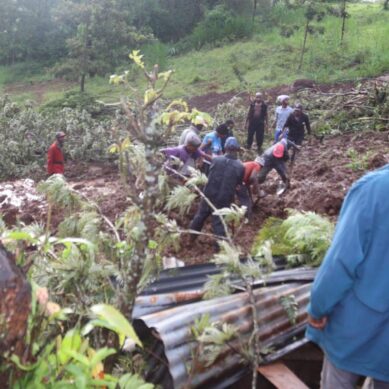
“All of us care deeply about our forests, rivers, wetlands, grasslands and coastlines yet many of these ecosystems are under pressure and some are already badly degraded,” Barasa observed.
“Restoration is about giving nature a chance to recover while protecting livelihoods, securing water, supporting food production and building resilience to climate change,” she explained.
The minister noted that the Kunming-Montreal Global Biodiversity Framework marked a decisive shift in global biodiversity governance by switching from ambition to implementation with emphasis on measurable action, credible monitoring systems and transparent reporting.
“Progress will increasingly be assessed not by intent alone but by evidence of outcomes and impact achieved on the ground,” she asserted.
Further, Barasa described Target 2 of the framework that calls for large-scale restoration of degraded terrestrial, inland water, coastal and marine ecosystems by 2030, as both an environmental necessity and a development priority for Africa, where ecosystems underpin livelihoods, food security, water systems and climate resilience.
She acknowledged that delivering on this target is technically and financially demanding as it require clear baselines, consistent indicators, reliable data systems and the ability to aggregate locally generated information into national and global reporting processes that include the Seventh National Reports to the CBD.
Against this backdrop, Barasa noted that the designation of RCMRD as a Sub-Regional Technical and Scientific Cooperation Support Centre was timely and strategic, enabling countries to strengthen technical readiness for biodiversity monitoring and reporting.
“RCMRD will support parties to apply harmonised methodologies, utilise appropriate indicators and leverage geospatial and earth-observation data to monitor ecosystem restoration effectively,” outlined the cabinet secretary. She noted that it will also assist countries to strengthen national and subnational data systems and improve the quality of reporting to the convention.
Additionally, she pointed out that the Centre would serve as a regional hub for technical exchange and learning, promoting consistency, comparability and shared learning across Africa.
The cabinet secretary at the same time established that Kenya’s ecosystem restoration initiatives are firmly anchored in BETA, which prioritises inclusive growth, livelihood creation and resilience through locally driven action.
She cited the 15-billion-tree growing national programme and broader landscape restoration efforts as practical contributions to Target 2 of the Global Biodiversity Framework.
“Our restoration initiatives place communities at the centre of county governments, community forest associations, farmer groups, schools, faith-based institutions, the private sector and individual citizens,” she said. “However, restoration success is not measured by numbers alone, but by survival rates, ecosystem functionality, biodiversity outcomes and long-term resilience.”
She underlined the importance of credible monitoring frameworks to bridge the gap between grassroots action and national and global reporting, noting that institutions such as RCMRD are well placed to address this challenge.
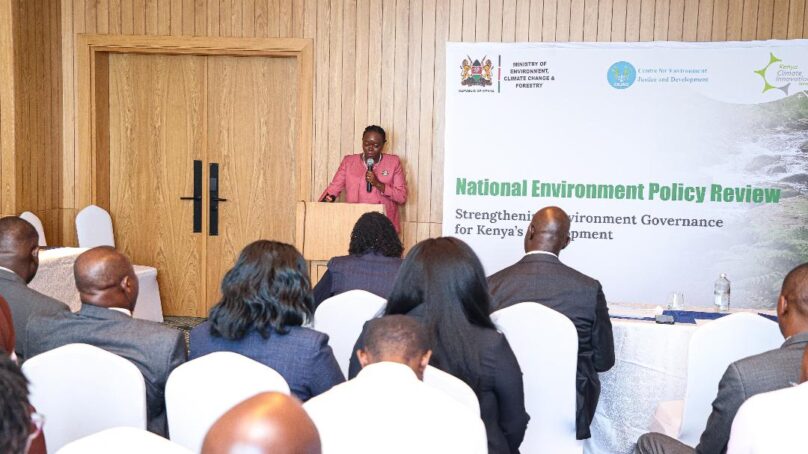
In a separate but related engagement, the minister officially launched the review of the National Environment Policy of 2013, which she described as a critical national process focused on delivery, livelihoods, and economic transformation rather than a routine administrative exercise.
“Kenya’s environment is the foundation of our economy. When ecosystems fail, livelihoods collapse. When forests disappear, water security is threatened. When land is degraded, food systems weaken,” she elaborated, noting that environmental sustainability is a core economic issue for ordinary Kenyans.
Consequently, the minister observed, the updated policy would serve as the overarching anchor aligning climate-smart agriculture, sustainable water management, green industrialisation, affordable energy and resilient infrastructure across national and county governments.
The review process, she added, would be inclusive but firmly results-oriented.
“We want a policy that is implementable, measurable and enforceable,” cabinet secretary directed, and called for stronger national-county coordination and clearer institutional mandates under devolution.
Environment and Climate Change Principal Secretary Festus Ng’eno reiterated that the review was timely, noting that Kenya’s environmental governance landscape has evolved significantly since 2013, amid intensifying climate change impacts, biodiversity loss, pollution, land degradation and emerging issues such as waste management and green financing.
“This review is a strategic repositioning of our nation to address contemporary challenges and seize new opportunities,” Ng’eno said. Mr Ng’eno noted that the review is anchored in Vision 2030, the
Kenya Climate Innovation Centre (KCIC) Chief Executive Officer Joseph Murabula observed that the review reflects the recognition that environmental challenges and solution pathways have changed dramatically over the past decade.
“The triple planetary crisis of climate change, biodiversity loss and pollution is now a systemic threat to our economic and social stability,” Murabula reported, adding that the updated policy must enable climate entrepreneurship, embed circular economy principles and unlock innovative financing to attract climate finance and private investment.
- A Tell Media / KNA report / By Naif Rashid


About author