


Alongside official efforts, African think-tanks, research institutions and civil society organisations (CSOs) are becoming more active in scrutinising China-Africa cooperation. Some of these groups work directly with the African Union (AU) to provide research insights, strengthen oversight frameworks and support public accountability.
Still, CSOs face significant obstacles. Many bilateral agreements, including those involving Chinese financing, remain opaque. Limited data access – both from African governments and Chinese entities – restricts the ability to conduct thorough assessments. Despite these difficulties, the growing participation of CSOs strengthens public scrutiny, encourages more responsible engagement by foreign partners and reinforces African demands for transparency and sustainable development outcomes.
NEPAD/AUDA plays a central role in coordinating Africa’s engagement with China by aligning Chinese-financed projects with continental priorities like PIDA, ensuring they support regional integration rather than isolated national initiatives. NEPAD/AUDA is also expanding into digital governance as China’s role in Africa’s tech sector grows, drafting early guidelines on cybersecurity, data protection, privacy and digital sovereignty, through enforcement remains limited.
In education and skills development, NEPAD/AUDA and other AU bodies are gradually improving the impact of Chinese scholarships – a major pillar of the Africa-China partnership – by promoting joint research centres and university partnerships that strengthen long-term institutional capacity rather than only relying on short-term training programs.
Where do African countries want to increase security and military cooperation with China?
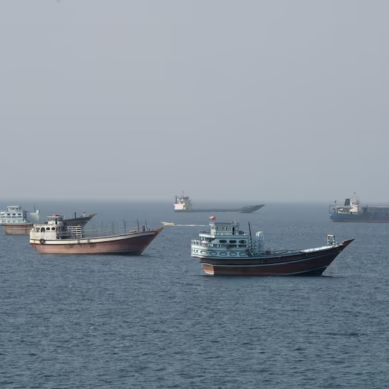
Africa-China security cooperation is expanding, but African countries are approaching it cautiously, focusing mainly on non-combat support. Maritime security is one area of interest, with African countries looking to China for patrol vessels, surveillance systems and technical training to help secure vulnerable waterways such as the Gulf of Guinea, the Red Sea and the Mozambique Channel. This, however, has not interfered with African countries’ maritime security agreements with other foreign partners.
An overly militarised Africa-China relationship does not really serve our shared development objectives.
China has also provided financial and logistical backing for various AU- and UN-led peacekeeping operations, including in the Horn of Africa, Sahel and Central African Republic, which supports regional stability efforts. Professional military education (PME) has emerged as another area of cooperation given African countries’ interest in expanding the technical capacity of their militaries. Beyond this, some African governments are exploring Chinese assistance in cyber-defence, border surveillance, and, increasingly, in joint defence manufacturing.
Yet by and large, African leaders remain careful to preserve balanced defence relations with both Chinese and Western partners. As a result, I would say cooperation remains practical, limited and focused on technical needs. As I observed earlier, an overly militarised Africa-China relationship does not really serve our shared development objectives.
What do African countries bring to the table in the larger relationship?
The Africa-China relationship is often seen as one-sided but it is in fact a complex partnership in which China also relies heavily on Africa in critical respects. We supply minerals essential to China’s green energy, EV and high-tech manufacturing sectors.
Yet we are insisting more strongly on retaining more value through local processing and industrialization at different points of the value chain. But it doesn’t happen overnight. China’s dominance in refining and manufacturing poses significant challenges to African economies seeking to break into high-tech industries.
Yet, progress can be achieved. Africa’s first EV battery gigafactory is set to begin production in 2026 in Morocco. Zambia and the Democratic Republic of the Congo have created a cross-border special economic zone to attract EV component manufacturers, supported by the African Development Bank and the United Nations (UN) Economic Commission for Africa. Rwanda is pursuing full-cycle EV manufacturing through strict tech-transfer agreements between Chinese firms and Ampersand Energy, Africa’s first electric transport energy company.
Meanwhile, at least 13 African countries have banned raw critical mineral exports to push China and others toward value addition on the continent. The AU is also helping establish an association of critical mineral producers to strengthen collective bargaining power.
Africa’s rapidly growing and youthful population creates one of the world’s largest emerging consumer markets.
Africa’s global representational strength further enhances its leverage. With 54 votes and a strong tradition of bloc voting, African states form the largest voting group in the UN General Assembly, the G-77 and the World Trade Organization. This collective weight allows African countries to encourage concessions from China on issues such as UN Security Council reform and other global priorities where a broad consensus exists, but progress is slow.
Demographics add another source of influence. Africa’s rapidly growing and youthful population -projected to reach 2.5 billion by 2050 – creates one of the world’s largest emerging consumer markets. With stability and sound policy, this young workforce can attract more Chinese manufacturing to Africa, mirroring development strategies China itself used in earlier decades.
Finally, Africa plays an increasingly important international role as the largest developing region, as shown by its inclusion as a permanent member of the G-20. China often frames its engagement with African countries as part of a shared Global South agenda focused on mutual benefit and respect for national priorities. At the same time, African governments have leverage points that they use to shape the direction of this cooperation.
Advancing these priorities and policy choices will help define the economic, diplomatic and developmental character of the relationship, underscoring that Africa is a strategic partner with its own agency.
Where do African countries want to take Africa-China relations over the next 10-20 years?
Looking ahead, African nations aim to reshape their engagement with China into a more balanced, strategic partnership. This will be our focus going into the 10th FOCAC summit in September 2027, which comes back to Africa. While Chinese financing and project management have delivered essential infrastructure, they have also created dependencies that limit African autonomy.
African governments intend to move toward a co-development model in which they play a central role in setting priorities and determining outcomes. The framework for this has already been laid through co-financing arrangements between African multilateral financial institutions – like the African Development Bank and the African Export Import Bank – and Chinese banks.
African actors must be in joint ventures that distribute risks, responsibilities, and profits.
A key shift that we want to see by the time we head to Brazzaville for the 10th FOCAC summit next year and to Beijing in 2030 is shared ownership and financing of infrastructure. Rather than relying primarily on Chinese loans and contractors, African actors must be in joint ventures that distribute risks, responsibilities and profits. This will strengthen local skills, improve sustainability and prioritise infrastructure that supports local economies – such as industrial parks, logistics hubs and technology centres – over large standalone projects.
African leaders are serious about accelerating investment partnerships that stimulate job creation and innovation. This includes expanding support for subject matter experts, youth start-ups and innovation ecosystems in areas such as fintech, agritech and renewable energy. Strengthening the private sector will diversify economies and reduce reliance on raw material exports.
On the trade front, we want a more balanced exchange based on value-addition. Industrial policy reforms and regional integration initiatives like the AfCFTA are designed to move Africa up the value chain.
Knowledge partnerships – spanning education, joint research, and emerging technologies such as AI, biotechnology, and green tech – will further support this shift.
Transparency and governance will be vital. As public demand for oversight grows, African governments will need stronger institutions, clearer rules and active civil society participation to ensure Chinese investments align with national priorities.
Ultimately, the goal is a mature, equitable partnership grounded in mutual respect, sustainable growth and long-term shared prosperity.
- A Tell Media report / Republished from Africa Centre for Strategic Studies


About author