
When a young American cardiologist named David Silverstein arrived in Kenya in the mid-1970s, he could hardly have imagined that the country would become his lifelong home – or that he would eventually spend decades standing beside one of Africa’s longest-serving presidents.
Born in Chicago around August 1944, Silverstein was academically gifted from an early age. He graduated from the University of Chicago School of Medicine in 1967 at only 22, later training in internal medicine and cardiology at the University of Washington in Seattle. He also served in the United States Air Force in Taiwan, an experience that awakened in him a desire to practise medicine beyond America.
When his cardiology fellowship ended in 1974, Silverstein considered several destinations, including Israel and the South Pacific. Kenya eventually won.
What attracted him was the opportunity to help develop a cardiac catheterisation programme at Kenyatta National Hospital and teach at the University of Nairobi School Of Medicine. He arrived at a time when specialised cardiology services in Kenya were still in their infancy and soon became one of the central figures in building modern cardiac medicine in the country.
Silverstein helped establish and run an early cardiac catheterisation laboratory, headed cardiology services at Kenyatta National Hospital and taught generations of medical students and young doctors at the University of Nairobi. By 1977, his reputation had grown sufficiently for him to be appointed chief cardiothoracic physician of the government of Kenya.
That same year, a patient walked into his professional life who would change it forever. His name was Daniel Toroitich arap Moi.
Moi was then Kenya’s vice-president. Silverstein examined him at Kenyatta National Hospital in 1977, beginning a doctor-patient relationship that would stretch across more than four decades.
When President Jomo Kenyatta died in August 1978, Moi became Kenya’s second president. A few years later, in 1983, Silverstein was formally appointed his personal physician. From that moment on, the Chicago-born cardiologist entered an extraordinary world.
He examined Moi regularly, often weekly, travelled with him on presidential missions and remained close during both ordinary medical check-ups and potentially serious health situations. His work took him into presidential residences, State House and international delegations, including journeys to China during the era of Deng Xiaoping.
Yet Silverstein consistently maintained that his role was medical, not political. Over time, however, the relationship between doctor and president became something deeper.
Moi was a committed Christian. Silverstein was a practising Jew. Yet the two men found common ground in faith, scripture, history and international affairs. They often discussed the Old Testament, Israel, medicine and world politics after medical examinations.
Silverstein later described Moi as disciplined about his health, respectful towards medical advice and generally an exemplary patient. He also remembered the president as polite, direct and deeply interested in religious matters.
There were humorous moments too. Moi was famously fond of meat, and Silverstein occasionally joked about the former president enjoying small quantities of what he referred to as “dawa ya wazee.”
For decades Silverstein saw a side of Moi that very few Kenyans ever encountered – not the commanding politician standing before enormous rallies but the patient sitting privately with his doctor discussing health, scripture and life.
Silverstein’s medical world, however, extended far beyond State House. Among his other famous patients was former Attorney-General Charles Njonjo, one of the most powerful figures in Kenya’s political history. Even when Moi and Njonjo later became bitter political adversaries, Silverstein continued treating both men. For him, medicine came before politics.
Another extraordinary patient was Nelson Mandela. Silverstein attended to Mandela when the South African freedom icon became unwell during a visit to Kenya. He later recalled meeting Mandela again and being amused when Mandela remembered the doctor who had treated him.
Silverstein also found himself at the centre of some of Kenya’s darkest national emergencies.
Following the 1998 bombing of the United States Embassy in Nairobi, he participated in treating casualties at Nairobi Hospital. Amid that tragedy, his personal life took an unexpected turn. He met American emergency nurse Channa Commanday, who had also been involved in caring for victims. They later married.
Silverstein had four sons from an earlier marriage, and he and Channa eventually made their home life partly around a farm near Lake Naivasha where the doctor found relief from the intensity of hospital work among the open landscapes and wildlife of the Rift Valley.
His Kenyan career was not without controversy or pressure. He faced professional scrutiny following the 1999 death of Chief Justice Zacchaeus Chesoni, but survived the difficult period and continued practising.
Through the decades he also became an important figure within Kenya’s small Jewish community and frequently spoke about the historical relationship between Kenya and Israel. Moi himself maintained relatively warm relations with Israel, giving Silverstein yet another area of common conversation with the president.
Remarkably, Silverstein remained Moi’s doctor even after the president peacefully handed power to Mwai Kibaki in December 2002. The presidency ended. Their relationship did not.
Silverstein continued seeing Moi throughout retirement and remained involved in his medical care during his later years.
When Moi died on February 4, 2020, Silverstein had known him for roughly 43 years and had formally served as his personal physician since 1983. At Moi’s burial in Kabarak, perhaps one of the most memorable moments came when the American Jewish doctor stood before thousands of mourners to honour his old patient and friend.
Wearing a Jewish prayer covering, Silverstein recited El Malei Rachamim, the traditional Jewish prayer for the departed, first in Hebrew and then explained its meaning in English.
It was a striking scene: a Jewish doctor from Chicago saying a Hebrew prayer in rural Kenya for a deeply Christian former African president whom he had treated for most of his adult life.
Silverstein has even questioned Moi’s officially recorded age. Based partly on what he learned during their earliest medical encounters, he has suggested that Moi may have been considerably older than official records indicated – possibly more than 100 years old when he died – although Kenya’s official history records Moi as having been born in 1924.
By then Silverstein himself had already spent almost half a century practising medicine in Kenya.
He became a fellow of both the American College of Cardiology and the American College of Physicians, remained involved in teaching and specialist medicine and earned recognition as one of the pioneers who helped lay the foundations of modern cardiology in Kenya.
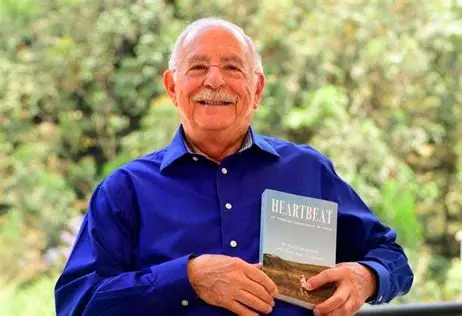
In 2023, he finally put much of this extraordinary journey into a memoir titled Heartbeat: An American Cardiologist in Kenya. The book tells the story of medicine, presidents, political crises, terrorism, international diplomacy, friendship and a young doctor’s unexpected love affair with an African country.
Dr David Silverstein’s legacy therefore cannot be reduced simply to the title “Moi’s doctor.”
He was part of the generation that helped establish specialist cardiology in independent Kenya. He trained Kenyan doctors, treated ordinary patients as well as presidents, witnessed some of the country’s most dramatic historical moments from unusually close quarters and built his entire adult life thousands of kilometres from the city where he was born.
He arrived from Chicago expecting an adventure. Kenya gave him a career. President Moi gave him an extraordinary place in history. And somewhere along the way, Kenya became home.
- A Tell Media report / By Gad Turuti – Special Correspondent


About author