
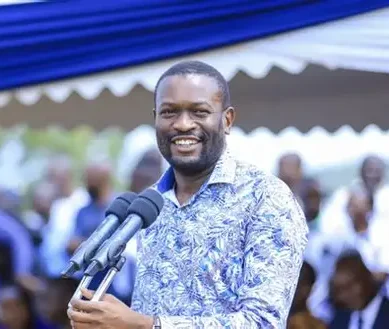

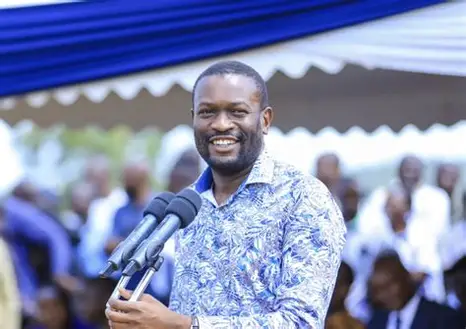
Even before he declares intention to run for presidency in the 2017 poll – although there are obvious pointers that he will – Nairobi Senator Edwin Sifuna is eliciting uninterrupted attention of both friend and foe over his prospects and capacity of unseating the unpopular President William Ruto, who the entire country knows is over-resourced to vie for the position.
While President Ruto has cut the unviable picture of what speech experts describe as a claptrap in which tautology is stock in trade oratory, Senator Sifuna is the opposite: succinct and suave. In Ruto’s frequent public rumble-ons – most run for hours – it is common to be treated to utterances such as:
“Kenya has deficit of fools. These fools, idiots, empty heads and naysayer are not like me because I am not a fool, idiot or silly like them.” Then veers into self-adulation.
Critics contrast Ruto’s claptrap with Sifuna’s polished and suave delivery in Kiswahili and English, like: “By the grace of God and with your (Kenyans) support, we must fight corruption because this is an ill that is gnawing at the very heart and soul of the nation; Kenya’s economic and political stability.”
Analysts argue that while Ruto boasts about his controversial doctorate (there have been allegations by senior staff at Kenya Wildlife Service that his PhD dissertation was done for him by his supervisor), there is a wide berth in terms intellectual acumen and gravitas between the president and youthful senator.
Against this backdrop, Sifuna’s discourse is often guided by verifiable facts while the president’s success is in casting himself as a pathological liar, according former Attorney General Justin Muturi. Mr Muturi says Ruto is the most cunning leader to ever to emerge in Kenya.
“Ruto is the only one who believes his own lies,” says Muturi.
Political analyst Byron Okech says of Sifuna, “The future belongs to leaders who can still speak truth to power. That is why George Natembeya and Edwin Sifuna inspire hope. They have chosen conviction over convenience and the people over political deals. Western Kenya must decide whether it wants more well-fed brokers in government or leaders who will finally restore the region’s long lost dignity.”
To Okech Ruto is symbol of hopelessness and all that is wrong with Kenya.
Thus, after Sifuna was dismissed as a nondescript and poor man by Atwoli and a political neophyte by Mudavadi that should stop daydreaming of stripping away the presidency from incumbent, the Nairobi senator and former deputy leader of minority (Edwin Sifuna’s) response was acerbic despite its biblical anchorage:
“They can also take the coat and shirt. But God promises us: ‘I will restore to you the years that the locust hath eaten, the cankerworm and the caterpillar and the palmerworm, my great army which I sent among you’. So God will restore the years and blessings lost to devastation, symbolised by locusts, bringing both material and spiritual renewal.”
Sifuna’s “great army…I sent among you” is a generation of young Kenyans that has catapulted him to cultic status that has authorities worried.
The young generation, who coalesce under the tagline Gen-Z have responded to the ridicule by Atwoli and Mudavadi sending money to his campaign kitty. Figures shared publicly – albeit unverified – show that the campaign is netting Ksh2 million per day.
Senator Sifuna’s response to Atwoli and Mudavadi – again – was uncannily modest: “Mr Atwoli, I don’t want your money, please, old man! I would rather be indebted to 10 million Kenyans, each of whom give me Ksh10 for my election campaigns than to one person who gives me Ksh1 billion while Kenyan workers are suffering under his watch.”
It did not end there. Tycoons from Sifuna’s origin in western Kenya have joined the fray to buttress his campaign financially. Multibillionaire Ibrahim Ambwere is rallying businessmen in the region to back Sifuna’s presidential ambitions – a development that has already unsettled President Ruto.
Similar support has come from former Vice President Moody Awori, former influential cabinet minister Fred Gumo and former Attorney General Amos Wako, among many others.
Nearly a year ago, President Ruto appeared to be on a roller-coaster, exuding confidence at every turn that he would coast easy victory if he were pitted against former Vice President Kalonzo Musyoka, Jubilee Party’s Fred Matiang’i or former Deputy President Rigathi Gachagua.
In his own words, Ruto has admitted on a number of occasions that his only impediment to a second term had been the late Raila Odinga, whose mantle was taken over by his nonchalant elder brother Oburu Odinga. Dr Oburu is party of the waning Orange Democratic Movement (ODM).
While Sifuna’s response to Atwoli and Mudavadi belittlement is religious and philosophical in many ways, the ideological and moral sting it transmitted has elicited comparisons to the humble demeanour of “world’s poorest president” – former Uruguayan President José Mujica, known as “Pepe”.
Atwoli’s – Central Organisation of Trade Union (Cotu) Secretary General – reference to Sifuna as a poor man brought to the fore subtle class tensions and antagonism in Kenya from colonial, with the proletariat seeing to get the short end of the stick.
“I have been telling this boy, Sifuna, that he cannot be president without money, but he looks ignorant. He thinks being president is like a walk in the park. I am ready to help him raise money for his campaign. He should remember that he cannot be president without my endorsement. I own the key to Western votes. Whoever I endorse from western should win the presidency in 2027,” Atwoli told Sifuna.
Such was the impudence that President Ruto resorted to using diatribes in his public speeches and rhetoric to deride the opposition which he roundly dismissed as an assembly of “fools”, “idiots” and wannabes “who know nothing and incapable of denying him a second five-year.
The fact that he also secured the support of former Prime Minister Odinga – Broad-Based government deal – Ruto’s 2027 re-election looked a foregone conclusion, according to his allies that include Head of Public Service Felix Koskei, semi-illiterate Kesses MP Oscar Sudi, Speaker of National Assembly Moses Wetang’ula and Prime Cabinet Secretary Musalia Mudavadi.
The radical following Sifuna commands among the youth – who inspired by his robust fight against corruption and human rights violation – who have enthusiastically taken up the challenge to freshen up Kenyan politics by sending home some political ‘dinosaurs’ or ‘forever’ politicians that have been calling the shots.
Speaking during a Kalenjin meeting last weekend in Eldoret town – Ruto’s political base – Felix Koskei shed light on the panic in the president’s columns.
“As you saw in Ol Kalou, Ruto is in a big problem. It’s no longer a joke and Mt Kenya won’t vote for Ruto. We cannot rely on western votes since they might not support Ruto,” Koskei told his audience.
Speaking to Tell Media, former Kanduyi MP Wafula Wamunyinyi, without naming names, hinted that Sifuna has been under pressure to do business – including promise of being running-mate in 2027 – with Ruto. However, the Nairobi senator has stubbornly remained resolute in his rejection of the president’s “pork-barrel” politics – a stand that rankled the president and his henchmen at State House.
“You must have noticed that Sifuna is moderating his speeches – from radical intellectualism and proletariat activism – with statesman. He is undergoing tutorials by tried and tested mentors who acknowledged him as a rough diamond that requires polishing. He is a fast learner. His energy and enthusiasm is political capital the youth in the country need to tango with old guard. Sifuna is undergoing re-honing to equip him with the craft that will enable him to carry the economic and political dreams of ordinary Kenyans who see him as their hope. If he is picked to be the opposition flagbearer, you will see more refined Sifuna. More presidential. Already, he is beginning to sound presidential with his new temperament that Ruto is finding difficult to match.…” Wamunyinyi says.
Indeed, during an interview with Luhyia vernacular radio stations on Monday, Senator Sifuna unwittingly drew comparisons with Mujica for his austere lifestyle and humble background when he said, “I have been mocked and ridiculed as a poor senator. Some friends and colleagues in the senate laughed at me when they heard that I declined accept property in prime areas in Nairobi. What would it have benefitted me to accept a huge so I can look the other way when crimes are being committed with impunity?”
In an interview with Mulembe FM, he said he still lives in the modest house he built with earnings as lawyer before he was elected in 2022. Not so different from the disposition of the former Uruguayan president. Not so different from US former President Barack Obama.
President Mujica’s 15 year tenure in office is known in recent memory as the most austere by an executive office holder. His election campaigns were modest – usually personally driving around in weather-beaten blue 1986 Beetle (Volkswagen).
When he died in 2025, BBC said of him, “Because of the simple way he lived as president, his criticism of consumerism and the social reforms he promoted – which, among other things, meant Uruguay became the first country to legalise the recreational use of marijuana – Mujica became a well-known political figure in Latin America and beyond. His global popularity is unusual for a president of Uruguay – a country with just 3.4 million inhabitants where his legacy has also generated some controversy.
In fact, even though many tended to see Mujica as someone outside the political class – that was not the case. He said his passion for politics as well as for books and working the land, was passed on to him by his mother, who raised him in a middle-class home in Montevideo, the capital city.
By comparison, Sifuna is a son of a lower cadre civil servant father and his mother a primary school teacher. However, his streak of humanist politics can be traced to his paternal uncle Lawrence Sifuna – a member of parliament in the late 1970s and early 1980 that kept the governments of the on their toes.
As a young man, Mujica was a member of the National Party, one of Uruguay’s traditional political forces, which later became the centre-right opposition to his government.
In the 1960s, he helped set up the Tupamaros National Liberation Movement (MLN-T), a leftist urban guerrilla group that carried out assaults, kidnappings and executions, although he always maintained that he did not commit any murder.
- A Tell Media report / By Samini Juma

About author