
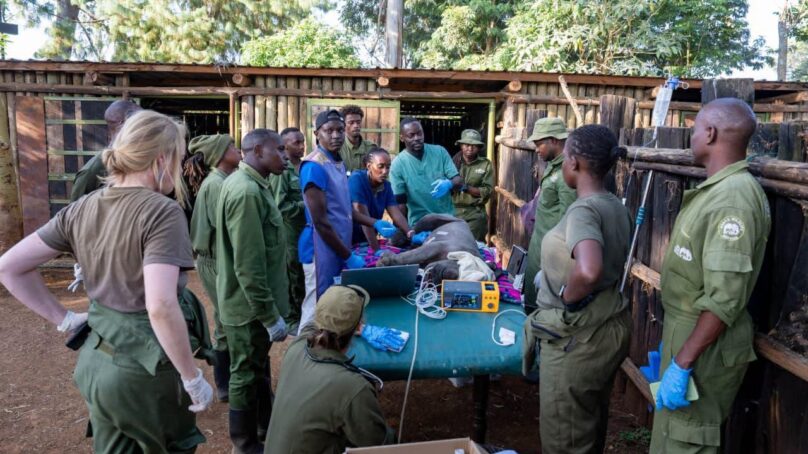
A five-day-old white rhinoceroses’ calf has been given a new lease of live after a team of Kenyan wildlife veterinarians successfully performed what is believed to be the first recorded corrective surgery in the world for atresia ani in a white rhinoceros.
The calf, a hermaphrodite given the name Bahati (Kiswahili for Lucky), was diagnosed with atresia ani – a rare congenital condition in which an animal is born without an anal opening to expel faeces normally.
Without immediate surgical intervention, the condition is invariably fatal.
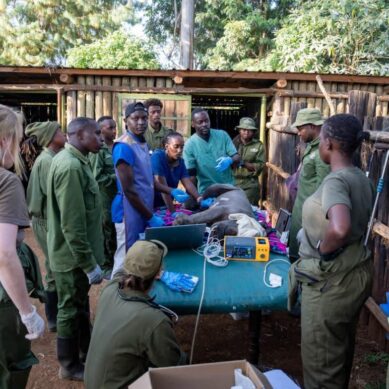
The diagnosis was done at Ol Pejeta Conservancy and prompted the rapid mobilisation of a five-member veterinary team drawn from the Kenya Wildlife Service (KWS), Mount Kenya Wildlife Conservancy (MKWC), Ol Pejeta Conservancy (OPC) and Northern Kenya Veterinary Services (NKVS).
A statement to newsrooms said the team comprised Dr Mukami Ruoro Oundo and Dr Mathew Mutinda Ndunda of KWS, Dr Robert Aruho of MKWC, Dr Joseph Mbuthia of OPC and Dr Benjamin Oundo of NKVS.
The complex two-hour operation was carried out at Mount Kenya Wildlife Conservancy under full immobilisation and epidural anaesthesia.
Using advanced veterinary techniques, the surgeons created a functional anal opening, restoring Bahati’s ability to pass faeces naturally.
The procedure was successful. After recovering from anaesthesia, Bahati expel stool for the first time, a critical milestone that signalled the success of the operation and significantly improved the calf’s chances of survival.
Veterinarians involved in the procedure believe it is the first documented successful corrective surgery for atresia ani in a white rhinoceros, marking a significant milestone in wildlife veterinary medicine.
The achievement also highlights the importance of collaboration among Kenya’s conservation institutions. Wildlife veterinarians, rangers, researchers and conservationists routinely work together to protect endangered species, often carrying out complex interventions that are rarely seen by the public.
Kenya is home to some of the world’s most iconic and threatened wildlife, and veterinary care plays a critical role in ensuring the survival of vulnerable populations.
Bahati’s successful surgery underline how coordinated conservation efforts, scientific expertise, and rapid emergency response can make the difference between life and death for endangered animals.
As Bahati recovers, conservationists hope the young rhino will one day contribute to the long-term survival of the species, serving as a symbol of both medical innovation and Kenya’s enduring commitment to wildlife conservation.
- A Tell Media / KNA report / By Joseph Ng’ang’a


About author