



The future of Kenya’s food system will not be determined solely by what farmers grow but by whether they can earn a decent living from it.
That was the resounding message from agroecology advocates at the Financing Agri-Food Systems Sustainably (FINAS 2026) Conference in Nairobi, where calls for increased investment in sustainable agriculture were matched by a plea to create reliable markets that reward farmers for producing healthy food while protecting the environment.
For Rosina Mbenya, Country Coordinator of Participatory Ecological Land Use Management (PELUM) Kenya, agroecology is no longer just an environmental agenda; it is an economic necessity.
“Agriculture remains the backbone of Kenya’s economy, yet investment in the sector remains far below what is needed,” she says.
Representing a network of 68 organisations working with smallholder farmers, pastoralists and fisher-folk, Mbenya believes that transforming Kenya’s food systems will require governments, financiers, researchers and the private sector to rethink how agricultural investments are made.
Although financing for agriculture is already limited globally, she notes that agroecology receives an even smaller share despite its proven ability to improve food security, restore soils and build resilience against climate change.
She argues that sustainable farming practices from healthy soils to farmer-managed seed systems offer practical solutions for communities facing increasingly unpredictable weather, particularly in Kenya’s arid and semi-arid regions.
Mbenya says young people need access to digital technologies, while women must receive equal opportunities in financing, decision-making, and ownership of productive resources if agriculture is to attract a new generation.
She added that schools as powerful drivers of change have seen PELUM Kenya piloting an agroecological school meals programme in Murang’a County that links local farmers directly to schools, providing nutritious meals for children, while creating dependable markets for producers.
The organisation is also digitising agro-ecological knowledge through online platforms and artificial intelligence to make sustainable farming information more accessible to farmers across the country.
Today, PELUM Kenya reaches about 1.5 million farmers, pastoralists, and fisher-folk but Mbenya acknowledges that millions more still need training, technical support and access to indigenous agricultural knowledge.
She believes Kenya has already laid the policy foundation through the National Agroecology Strategy launched in 2024 and several county-level policies, but says the challenge now is implementation backed by meaningful investment.
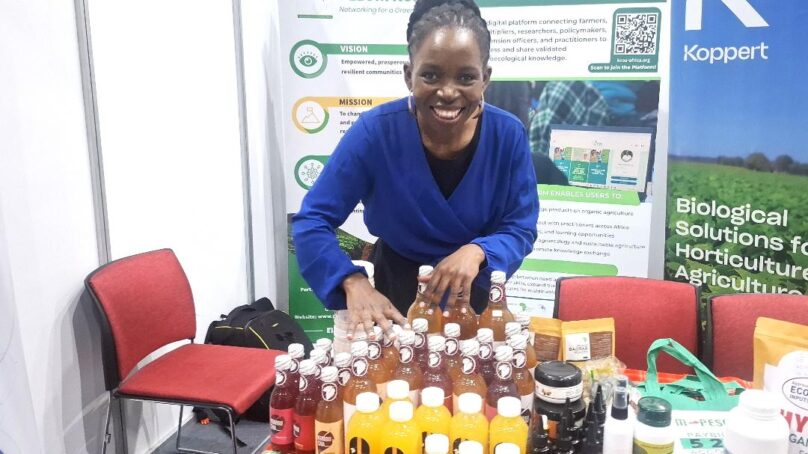
While Mbenya speaks about financing systems, a young farmer and entrepreneur Nyambura Simiyu speaks from lived experience. More than a decade ago, she joined a community of organic farmers, only to discover that producing healthy food did not guarantee buyers.
Rather than watch surplus herbs go to waste, she began processing them into products with longer shelf life, and that simple decision gave birth to Ardor Life Kenya.
Today, her organisation located in Ngong transforms organic produce into juices, kombucha and herbal beauty products sourced from agro-ecological farmers, creating value while reducing post-harvest losses.
For Simiyu, markets are the missing piece in Kenya’s agricultural transformation. “Unless there is a market for what agroecological farmers produce, they have little incentive to continue farming sustainably,” she says.
She believes agriculture should no longer be viewed simply as farming, but as a complete value chain encompassing production, transport, processing, branding, marketing and retail, creating thousands of employment opportunities for young people beyond the farm.
“The only way to attract young people into agriculture is to show them that there is money in it,” she says, adding that technology is helping bridge the gap between producers and consumers.
Ardor Life Kenya has introduced a traceability system that allows customers to scan product codes and identify where ingredients were grown and the farming practices used. The products are also laboratory tested to verify they are free from harmful pesticide residues, giving consumer confidence in the authenticity of organic foods.
Simiyu argues that financing agriculture should increasingly support agribusinesses that connect farmers to markets.
“If farmers have no buyers, agriculture cannot generate returns, making it difficult to attract investment,” she says.
She has now employed 13 people, works with numerous agro-ecological farmers and has expanded her customer base through digital marketing and consumer education.
She also challenges the perception that organic food is only for wealthy consumers, insisting many products are competitively priced while offering long-term health and environmental benefits.
Like Mbenya, Simiyu believes government support remains essential. Subsidising organic farm inputs, strengthening market systems and raising public awareness, she says, would encourage more farmers to adopt sustainable agriculture.
Together, the two women present different pieces of the same puzzle, one pushing for policies, financing and institutional reforms that enable agroecology to flourish and the other demonstrating how innovation, entrepreneurship and market access can turn sustainable farming into a viable business.
Their shared message is simple but powerful: Kenya’s agroecology movement will succeed not merely by teaching farmers how to grow food sustainably, but by ensuring that sustainable farming becomes profitable.
For millions of smallholder farmers the future of agriculture depends not only on what happens in the field but also on what happens after the harvest, where finance, markets and innovation come together to transform livelihoods.
The FINAS 2026 summit, held in Nairobi from 30th June to 2nd July 2026, under the theme: Towards Sustainable Financial Architecture for Africa’s Food Systems, brought together governments, financial institutions, development partners, private sector actors, farmer organizations, researchers, and innovators to explore sustainable financing solutions for Africa’s agri-food systems.
- A Tell Media / KNA report / By Wangari Ndirangu


About author