

Police in Kenya sealed off key roads leading into central Nairobi ahead of planned nationwide protests marking two years since deadly Gen-Z-led anti-government demonstrations.
Protesters say they are demanding justice for more than 80 people killed and dozens more injured during the 2024 anti-tax demonstrations and anniversary protests last year.
There have been pockets of clashes between police and protesters, with security forces firing teargas and demonstrators throwing stones in some areas.
But central Nairobi was deserted after security forces blocked access, stranding commuters on the city’s outskirts, while many businesses and schools remained closed.
On Thursday, Kenyans took to the streets under heavy security in memory of protesters killed two years ago when massive anti-government demonstrations erupted in Nairobi over proposed tax hikes and the surging cost of living.
Organisers had planned remembrance marches in the coastal city of Mombasa and the capital Nairobi to mark the second anniversary of the June 25, 2024 unrest, when protests escalated dramatically and protesters breached parliament grounds before a security crackdown left dozens dead.
The planned protests, largely mobilised through social media platforms, were expected to take place in major towns including Nairobi, Mombasa and parts of central Kenya.
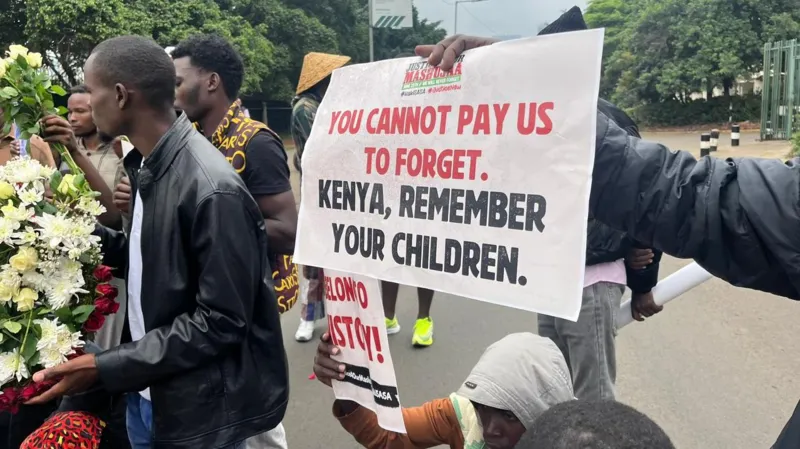
In Nairobi, opposition leaders led by Kalonzo Musyoka, Martha Karua and Eugene Wamalwa joined families of the victims to march to parliament, where they laid wreaths in honour of those who died during the 2024 demonstrations.
In June 2024, tens of thousands of Kenyans protested against proposed tax hikes, culminating in the storming of parliament and the eventual withdrawal of the controversial finance bill. But the security forces were accused of using excessive force, with a BBC investigation finding that police had deliberately tried to kill protesters.
On the eve of Thursday marches, Interior Minister Kipchumba Murkomen warned that anyone seeking to engage in “chaos, looting, destroy property, disrupt businesses or commit any other criminal acts” would face “the full force of the law,” adding that investigators were already looking into reports of people mobilising gangs and securing weapons ahead of the anniversary.
In the days that followed, dozens of people were reportedly abducted, allegedly by members of the security forces. Some were later found badly beaten, while others were found dead, fuelling concerns over enforced disappearances and extrajudicial killings.
On Thursday, police officers on horseback dispersed crowds trying to gather along Nairobi’s streets, which remained largely empty as police set up roadblocks with water cannons to block demonstrators.
Footage from a local TV station showed flames and smoke rising in the Githurai area near Nairobi as protesters lit fires during clashes with police.
Police officers were also seen firing teargas to disperse crowds gathered in the area. Several people have been arrested by anti-riot police in Nairobi while trying to access the city centre.
In the coastal city of Mombasa, dozens of marchers turned up escorted by security forces while Nairobi’s streets appeared largely deserted as police set up roadblocks with water cannons and mounted a razor wire barricade outside parliament. Shops and restaurants within the central business district, the site of previous protests, remained shut on Thursday.
Thousands of commuters were stranded for hours after security officers blocked public transport vehicles in Nairobi
Deputy Police Chief Gilbert Masengeli said roadblocks were mounted to ensure no criminals or weapons entered the city, adding that the country remained calm, with citizens going about their daily activities without disruption.
“There are no blocked roads. We are just ensuring the safety of Kenyans. We are just checking if they are carrying weapons,” Masengeli said.
“I am grateful because there are no vehicles being burnt and people are going about their work,” he added.
Some parents who lost children during the 2024 protests have asked the government to allow them to peacefully remember their loved ones.
“We don’t want tear gas and running battles in the streets. We are too old for that,” one of the parents told journalists in Nairobi.
Authorities have urged protesters to remain peaceful and avoid acts of violence, looting, or destruction of property.
“Today we remember our comrades who died in the demonstrations,” John Maina, 26, said in Nairobi. “They were not fighting for any profit, which is why we remember them; it’s not a protest, it’s a remembrance.”
In Nairobi, opposition leaders joined victims of alleged police brutality and families of slain protesters in a march towards parliament to place flowers and candles outside the building.
Brian Musyoka, a 37-year-old motorbike taxi driver, said the shutdown was adding to the economic pressures faced by ordinary Kenyans.
“There is not much work, I may not make anything to cover the loan that paid for this electric bike,” Musyoka said.
The US Embassy in Nairobi last week issued an alert advising US citizens in Kenya to avoid protest areas and crowds and to expect traffic disruptions and roadblocks on Thursday.
Protest organisers say they are demonstrating to demand justice for victims, credible investigations into past police conduct and guarantees against the use of excessive force during rallies.
President William Ruto said last week that Ksh2 billion ($15.5 million) had been set aside for victims of protest-related rights abuses under a national reparations framework.
However, rights groups, and civil society organisations say compensation alone does not amount to accountability for alleged abuses by security forces and have called for Ruto to apologise publicly over the issue.
President William Ruto on Friday said people had a right to protest but warned that anyone “mobilised to destroy property or cause chaos” would not be tolerated.
Several political leaders, civil society groups, and human rights organisations have expressed support for peaceful demonstrations, describing them as part of the right to democratic expression protected under the country’s constitution.
Ruto’s former deputy Rigathi Gachagua, now a bitter rival, has urged Gen Z activists to stay away from the streets, citing concerns that the protests could turn violent. Instead, he has called on Kenyans to remain at home in a symbolic show of dissent.
Last week, President Ruto announced a fund of nearly $15 million (£11 million) to compensate nearly 2,000 victims of protest-related human rights abuses between 2017 and 2025 identified by rights groups.
Ruto said the compensation was not a “price for life, pain or loss” and should not be seen as rewarding violence or criminality. However, human rights organisations have rejected the compensation plan, citing the exclusion of some victims, inadequate pay-outs and a lack of transparency.
President Ruto is facing growing public discontent ahead of the 2027 elections, with critics accusing his government of failing to deliver on key campaign promises.
He rejects those claims, insisting his administration has fulfilled most of its pledges and saying he is ready to defend its record as he seeks re-election.
($1 = Ksh129.2000
- A Tell Media / BBC/ Reuters report


About author