



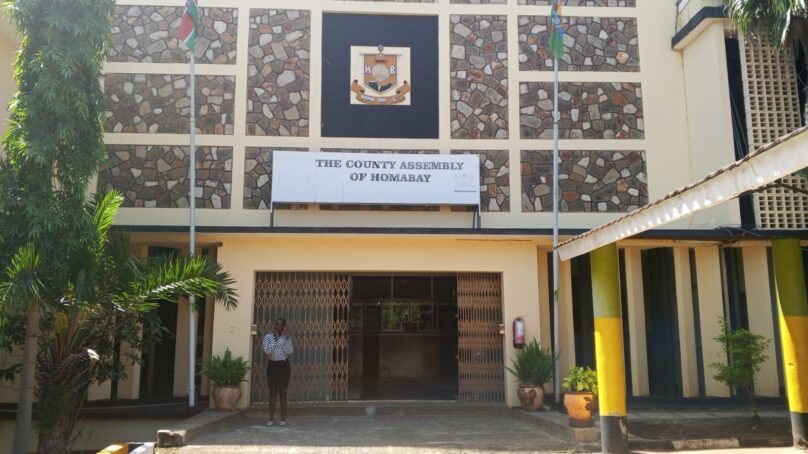
Members of Homa Bay County Assembly are vouching for a policy framework that will protect rice value chain in Kimira-Oluch Irrigation Scheme, raising concerns over loss of economic benefits to external traders and middlemen.
Speaking at the county assembly in Wednesday, Kagan Ward MCA David Hamilton said the critical role of the scheme in enhancing food security, creating employment opportunities and boosting agricultural production in the county cannot be gainsaid.
Hamilton noted that success of rice farming depends on robust value chain encompassing production, aggregation, milling, processing, value addition and marketing.
However, he expressed concern that traders and cartels often purchase rice after harvesting and transport it outside the county for processing before selling it back to local consumers at a higher price.
According to the MCA, the practice robs local millers, aggregators and other stakeholders of opportunities to benefit from the rice subsector. He warned that the continued export of unprocessed rice undermines the economic potential of the irrigation scheme and limits employment creation, revenue generation and industrial growth within Homa Bay County.
Hamilton further informed the assembly that there is currently no specific policy dedicated to promoting and safeguarding the rice value chain in the county. He highlighted the challenges facing rice farmers in areas served by Kimira-Oluch Irrigation Scheme that include Kagan, Kochia, Central Karachuonyo and Kibiri wards.
The MCA further appealed to the county government to formulate a policy that will expand land under rice cultivation, eliminate cartels in the sector and strengthen the rice value chain.
Speaking in support, Lambwe Ward MCA Sophie Salim called for a comprehensive policy to help regulate the rice market and protect farmers from exploitation by middlemen.
“Middlemen often buy rice immediately after harvest, process it elsewhere, and later sell the finished product back to local consumers at higher prices. Their role should be properly regulated to ensure farmers receive fair returns for their produce,” she said.
In addition, she said, if approved, the proposed policy is expected to benefit farmers, traders, transporters, millers and consumers by ensuring that more value generated from rice production is retained in the county’s agricultural sector.
The matter has since been referred to the Agriculture Committee to conduct further investigations and prepare a report for consideration by the assembly.
The committee’s findings are expected to guide the formulation of a policy aimed at protecting rice farming and enhancing the sustainability of the Kimira-Oluch Irrigation Scheme.
- A Tell Media / KNA report / By Barasa Irene and Sitna Omar


About author